


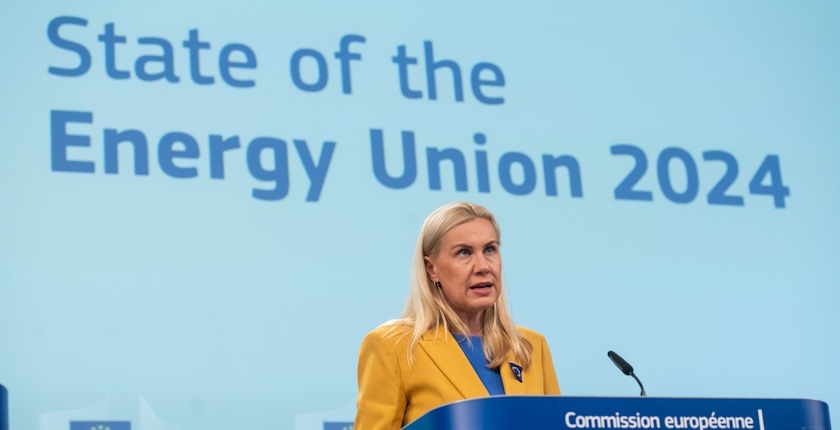
The European Commission has published its 2024 State of the Energy Union report. It said that European Union overcame unprecedented challenges in the energy policy landscape during the current mandate of the 27-member bloc’s executive body. In contrast, the European Environmental Bureau said the report acknowledges a glaring gap in efforts to meet crucial climate targets.
Significant progress has been made on renewable energy, the European Commission said. In the first half of 2024, half of the EU’s electricity generation came from renewable sources.
Wind power overtook gas to become the EU’s second-largest power source behind nuclear.
In 2022, the EU’s primary energy consumption renewed its downward trend, falling by 4.1%. Nevertheless, energy efficiency efforts will need to be stepped up further for the EU to meet the 11.7% final energy consumption reduction target by 2030.
Further improvement is needed, not least in the electrification of heating equipment across the board and the rate of renovation of buildings, the commission said.
Strengthened efforts are needed to address high energy prices
The share of Russian gas in EU imports dropped from 45% in 2021 to 18% by June 2024, while imports from trusted partners like Norway and the US have increased. The EU has reduced gas demand between August 2022 and May 2024 by 138 billion cubic meters.
According to the EU’s executive arm, greenhouse gas emissions fell by 32.5% from 1990 to 2022, while the economy has grown by around 67%.
The commission said energy prices are more stable and that they remain significantly below the peak levels of the energy crisis of 2022. However, it pointed out that strengthened efforts are needed to address high energy prices. It is key to improving the competitiveness of the EU industry, the report reads.
All EU countries must submit their final updated NECPs as soon as possible
The commission recalled that all EU countries must submit their final updated national energy and climate plans (NECPs) as soon as possible, to ensure collective achievement of the 2030 energy and climate goals.
The current ambition gap in renewables and energy efficiency targets, the increase in energy poverty, the energy price differential compared to other global competitors, and the risk of new strategic critical dependencies are new and emerging challenges that must be addressed in the future, according to the commission.
Commissioner for Energy Kadri Simson asserted that the EU is well equipped to navigate the profound changes and challenges that lie ahead and deliver on its commitments towards the planet and its citizens.
EEB: It’s time to get serious about implementation
It’s alarming that the EU is still importing fossil fuels worth hundreds of millions of euros each week from Russia, even after two and a half years of war that has deliberately targeted Ukrainian civilians, the European Environmental Bureau (EEB) said.
The EU executive must call for more ambition on renewables and energy efficiency in the NCEPs. It also needs to pay special attention to plans that rely heavily on new nuclear plants, as alternative pathways will be necessary if construction timelines are missed, EEB stressed.
The energy transition must accelerate, or the consequences will be felt across Europe’s economy and society
The Brussels-based nongovernmental organization also called on the commission to immediately improveme monitoring and enforcement of key climate targets. It proposed the establishment of national and EU-level task forces to evaluate and report on measures that member states take to achieve the targets for renewables, energy efficiency and emission reductions.
According to Luke Haywood, EBB’s policy manager for climate and energy, the report is a clear message to the commission and EU states: it’s time to get serious about implementation.
EEB said the current ambition gap in renewables and energy efficiency targets is not just a climate issue but a socioeconomic risk. Limited progress on building renovations and renewable energy for transport and heating will hit the most vulnerable, especially with carbon pricing set to raise fossil fuel costs by 2027. The NGO has warned that the energy transition must accelerate, or the consequences will be felt across Europe’s economy and society.