

A European energy system based on a high share of renewable energy is the cheapest scenario until 2050 for achieving the net-zero goal, when compared to an increased use of nuclear capacity, or hydrogen, or carbon capture and storage, and against a delayed energy transition, according to a study produced by Hitachi Energy for WindEurope.
Costs for each scenario include not only generation facilities, but investments in grids, storage and back-up systems, according to WindEurope.
The study has mapped out the total system costs of five energy scenarios. Four scenarios deliver net zero and the remaining one is for a slow transition, where Europe doesn’t meet its climate targets, wind power advocacy group said.
The difference between the cheapest net zero path (Renewables+) and the most expensive path (Slow Transition) is EUR 1.64 trillion, the study reveals.
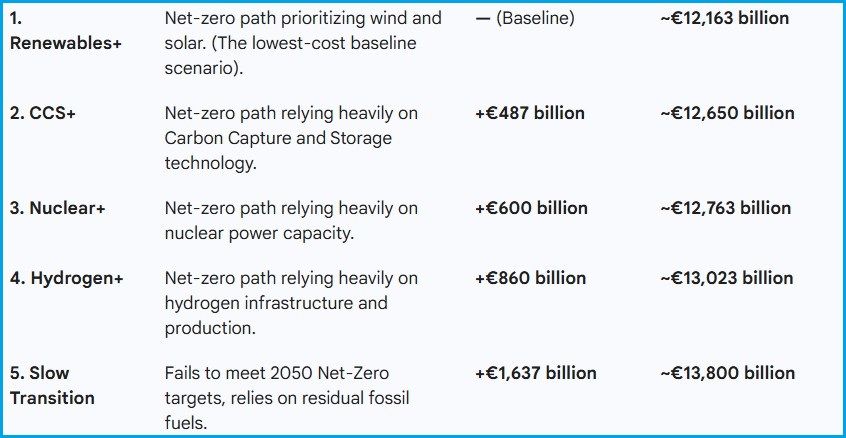
The study’s authors calculated the total societal cost of building, operating, and adapting to the required energy system across electricity, transport, heat, and industry to meet or fall short of the 2050 climate targets.
The total system costs have three major groups of expenses.
The first group are new infrastructure investments in generation assets, as well as in grid, hydrogen, storage and carbon capture and storage (CCS) infrastructure.
Operational expenses are represented by fuel and CO2 costs, while the third group are electrification and demand shift costs.
The Renewables+ scenario drastically lowers import dependency
The Renewables+ scenario achieves net zero by 2050 through a massive deployment of variable renewable energy, primarily wind and solar power, leading to high electrification across the energy mix.
The renewables share reaches 85% of total electricity and nearly 70% of total gross available energy. Dependency on imported energy fuels falls drastically from 71% in 2030 to just 22% in 2050, the report reads.
“As Europe looks ahead to 2050, it is revealing to think what our energy system looked like 25 years ago. Back in 2000 the share of wind and solar in Europe’s electricity was a combined 0.8%. It’s 30% today. And Europe’s emissions are down by nearly 1/3 compared to 2000 while the economy has grown 45%. Let’s build on this success,” WindEurope stressed.
It is an inception report for the Energy System Costs Study, a project commissioned by WindEurope.