



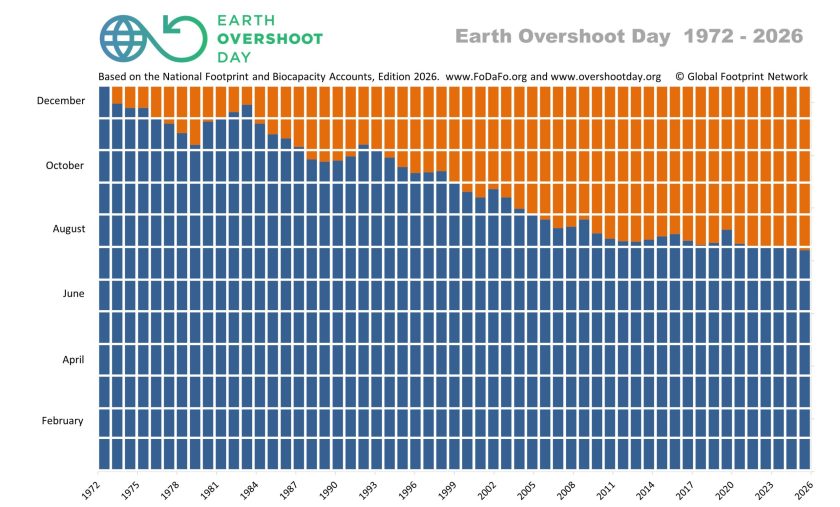
Earth Overshoot Day falls on July 30 this year. This means that five months before the end of the year, humanity has used up all the natural resources that Earth can regenerate in one year.
Earth Overshoot Day marks the date when humanity’s demand for ecological resources and services exceeds what Earth can regenerate during that year. From that point onward, humanity is, symbolically speaking, living beyond its means by drawing down the planet’s natural capital.
According to calculations by the Global Footprint Network, humanity’s current level of resource consumption corresponds to the capacity of 1.73 Earths. In other words, humanity is consuming resources about 70% faster than Earth can regenerate them.
The depletion of natural capital threatens long-term resource security. Its consequences include deforestation, soil erosion, biodiversity loss, and the accumulation of carbon dioxide in the atmosphere, contributing to more frequent extreme weather events and reduced food production.
Since the early 1970s, when humanity first began consuming more resources than Earth could regenerate within a year, the date of Earth Overshoot Day has steadily moved earlier. This year, that threshold will be reached on July 30.
According to the Global Footprint Network, if ecological overshoot were fully reversible and nature were no longer subjected to additional pressure starting today, it would take more than two decades for Earth to restore its lost ecological balance.
Mathis Wackernagel, member of the Global Footprint Network’s Board, said that, because of the laws of physics, ecological overshoot cannot continue indefinitely.
“It will end either by deliberate design or dumped-on disaster. It should not be too hard to choose which one is preferable, particularly in light of so many possible choices”, he said.
The Global Footprint Network emphasizes that numerous solutions can help reduce ecological overshoot, particularly in running cities, sectors of energy and food, natural resource management, and ecosystem protection. As one example, the organization notes that cutting carbon dioxide emissions from fossil fuels by 50% would push back Earth Overshoot Day by almost three months.
Country Overshoot Days in 2026
In addition to the global date, the Global Footprint Network also calculates a country overshoot day for each nation. It indicates the date on which Earth Overshoot Day would fall if everyone on the planet lived and consumed resources like the average resident of that country.
Qatar once again ranks first. If everyone on Earth lived like the average resident of Qatar, the planet’s annual renewable resources would have been exhausted by February 4. Luxembourg follows, on February 17, while Singapore reaches its overshoot day on February 23.
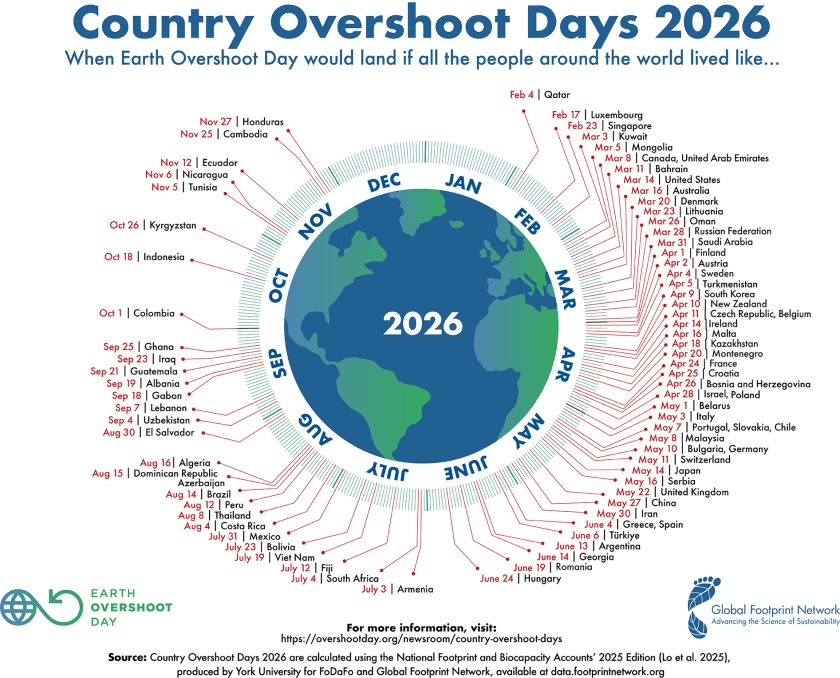
Among the countries covered by Balkan Green Energy News, Montenegro overshoots first, on April 20. It is followed by Croatia (April 25), Bosnia and Herzegovina (April 26), Bulgaria (May 10), Serbia (May 16), Greece (June 4), Turkey (June 6) and Romania (June 19).
As in previous years, Albania comes last, on September 19.
At the other end of the global chart is Bangladesh. If everyone on Earth consumed natural resources like the average resident of Bangladesh, humanity would require only 46% of Earth’s biocapacity, meaning it would remain within the planet’s annual regenerative capacity. Other countries whose ecological footprint per person is below the global biocapacity per person include Nigeria, Nepal, Ethiopia, Kenya, Tanzania, Côte d’Ivoire (Ivory Coast), India, Sri Lanka, Egypt, Jordan, the Philippines, and Senegal.
The Global Footprint Network didn’t publish the dates for several countries, because of incomplete or unreliable statistical data. These include Bhutan, Botswana, Cuba, Cyprus, Estonia, Guyana, Iceland, Latvia, Mauritius, Morocco, Namibia, the Netherlands, Norway, Panama, Slovenia, Trinidad and Tobago, Uruguay, and Venezuela.