

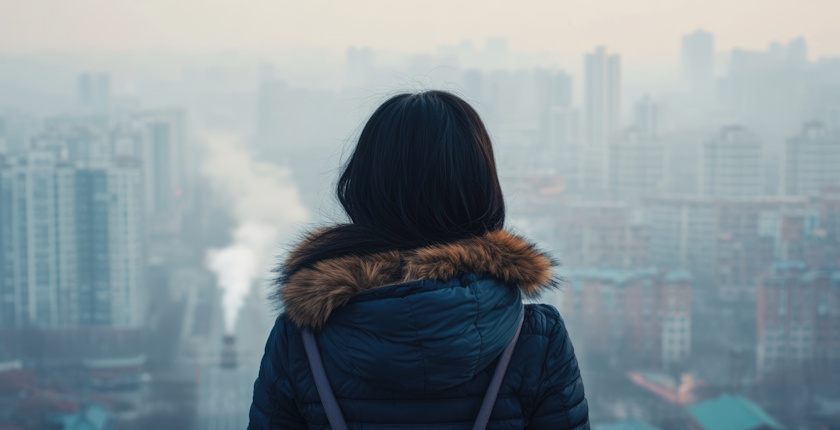
The Renewables and Environmental Regulatory Institute (RERI) has published an analysis of air quality in Serbia in 2025, warning that air pollution remains one of the country’s most serious public health problems, while national legislation and institutional response continue to lag behind new European standards.
According to Serbia’s Air Protection Programme for the period 2022–2030, adopted by the Government, air pollution causes almost 10,000 premature deaths in the country every year. RERI notes that even if all measures planned under the programme are fully implemented, the number of premature deaths caused by air pollution would still stand at 7,373 in 2030, translating to a 39% higher rate per million inhabitants than in the European Union, including the United Kingdom, in 2018.
Serbia adopted a new Law on Air Protection last year, but RERI says it was not aligned with the new EU Ambient Air Quality Directive, from 2024. The directive introduced stricter limit values for pollutants, the right to compensation in cases of proven breaches of air quality rules, and the obligation to carry out preventive planning before exceedances occur.
RERI also points out that the Serbian Environmental Protection Agency has not yet published its annual air quality report for 2025, although the legal deadline expired on May 31.
Serbia still has no daily limit value for PM2.5
A particular concern is fine particulate matter, PM2.5, which is considered among the most harmful air pollutants for human health. According to data from the European Environment Agency for 2023, the premature mortality rate attributable to exposure to PM2.5 in Serbia was 188.3 cases per 100,000 inhabitants over the age of 30. The Nišava District is highlighted in RERI’s analysis as one of the European regions with the highest such mortality rates.
Monitoring stations in Serbia recorded an average of 104 days in 2025 with PM2.5 levels above the value introduced by the new EU directive.
Unlike EU legislation, Serbia still does not prescribe a daily limit value for PM2.5. The new EU directive introduces a daily limit of 25 micrograms per cubic metre, which, from 2030, must not be exceeded on more than 18 days per year. RERI’s analysis shows that monitoring stations in Serbia recorded an average of 104 days in 2025 with PM2.5 levels above that value.
The analysis also shows widespread exceedances of PM10 limits. The highest number was recorded in Novi Pazar, with 127 days of exceedances, while the legal limit in Serbia is 35 days per year.
RERI says air pollution in Serbia is present throughout the year. PM10 exceedances are most common during the heating season, ozone pollution is more pronounced from May to September, and nitrogen dioxide exceedances occur throughout the year, especially in urban areas with heavy traffic.
RERI calls on the authorities to speed up the alignment of Serbian regulations with EU air quality standards
RERI also analysed the implementation of Serbia’s Air Protection Programme for the period 2022–2030 and its Action Plan. In March and April 2026, the organisation asked six ministries responsible for specific measures and activities under the document to provide information on what had actually been implemented. According to RERI, a significant share of the measures whose deadline expired by the end of 2025 had either not been carried out or were not supported by concrete evidence of implementation.
RERI calls on the authorities to speed up the alignment of Serbian regulations with EU air quality standards, introduce a daily limit value for PM2.5, establish an interministerial body to monitor the implementation of the Air Protection Programme, and launch a national study on the health impacts of long-term exposure to polluted air.