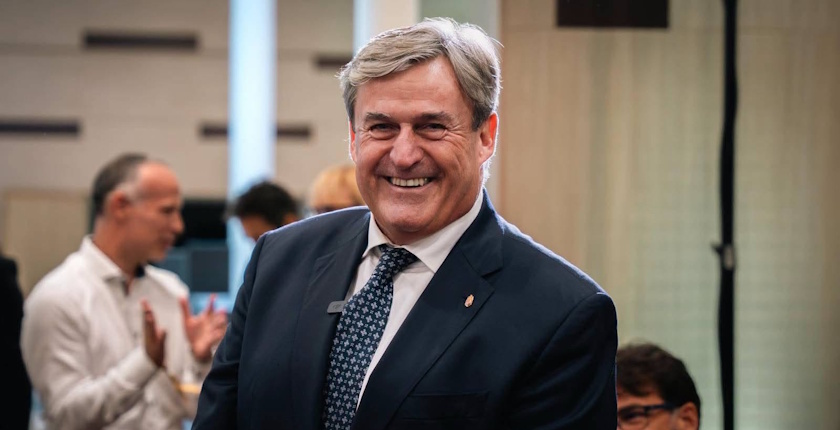



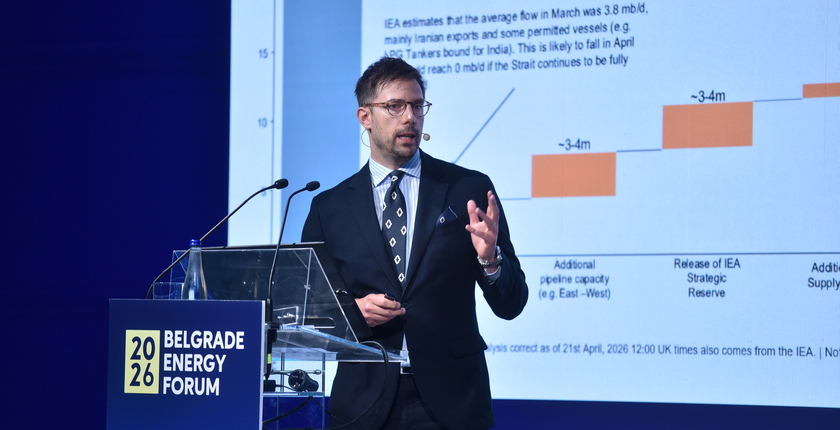
Key focus on energy sector has moved away from sustainability towards security. Energy security is today increasingly seen as an essential element of national security. Wars, global crises, and growing dependence on energy sources have shifted Europe’s priorities, and Southeast Europe now faces a critical choice – an accelerated transition and strong joint collaboration on infrastructure development and integration or continued costly reliance on fossil fuels, Mislav Slade-Šilović, Energy Consulting Director at PwC SEE, said at Belgrade Energy Forum 2026.
Until just a few years ago, Europe’s main focus was the climate. Today, it is security. Mislav Slade-Šilović, Energy Consulting Director at PwC SEE, warns that security is not only defined through military lens but as well as thorugh the reliability of energy supply.
At the opening of Belgrade Energy Forum – BEF 2026, organized by Balkan Green Energy News, he stressed that the war in Ukraine, the conflict in the Middle East, and the rising cost of living have shown how vulnerable energy systems are and how quickly an energy crisis can escalate into political and economic instability.
“This is a signal that regional cooperation, strategic planning, and a joint approach are essential,” Slade-Šilović said.
The Strait of Hormuz has shown how interconnected the world is
One of the most striking examples of global energy dependence today is the Strait of Hormuz – a maritime corridor for the transit around 30% of the world’s exports of oil and petroleum products.
PwC’s analysis shows that a more severe and prolonged disruption in that region would trigger a shock in the global energy market. Despite interventions, alternative supply routes, and the release of strategic reserves, the world is still roughly 50% short of crude oil and derivative exports passing through the Strait of Hormuz.
Although Europe imports only about 5%-6% of its energy needs from that route, there is no room for complacency, as global energy markets are interconnected and Europe would certainly feel the consequences through rising prices and disruptions in the global market.
The effects of the crisis would be felt far beyond the energy sector, as the Middle East also plays a major role in the production of helium, ammonia, and urea (a nitrogen fertilizer) – raw materials essential for agriculture, the chemical industry, and healthcare.
Oil and gas are here to stay – despite the green transition
Although the world is rapidly turning to renewable energy sources, fossil fuels will not disappear so quickly, Slade-Šilović explained.
Estimates suggest that oil and natural gas will remain an important part of the energy system for decades to come. What is particularly interesting is that current proven and probable reserves cover only demand in the lowest projection trajectory, indicating that the oil and gas sector will require as much as USD 350 billion of CAPEX annually for exploration activities, he added.
At the same time, liquefied natural gas (LNG) has become a new instrument of influence. “LNG is becoming a geopolitical force today,” Slade-Šilović warned, noting that the global market for gas in that form could grow by more than 90% by the middle of the century with over 35 new countries getting directly involved into the LNG market. This trend is also seen in SEE, where countries are either directly participating in the LNG market, or through capacity reservations. “We also see efforts in Albania, Montenegro and Bosnia and Herzegovina to connect on LNG markets,” he added.
Europe between Russia and America
The energy crisis has also raised a new question concerning Europe’s dependence. As the European Union is trying to free itself from Russian gas, it is increasingly relying on American LNG, which raises the question of whether Europe is simply replacing one energy partner with another, Slade-Šilović said.
While the United States insists on maximizing oil and gas production and views energy independence as a matter of national security, the EU is pursuing more climate oriented policy driven by fossil fuel phase out and strong renewable uptake supported with nuclear power where viable. Renewables are currently only source of energy which Europe has in abundance and can scale independently making it most critical lever in increasing energy independence, according to Slade-Šilović.
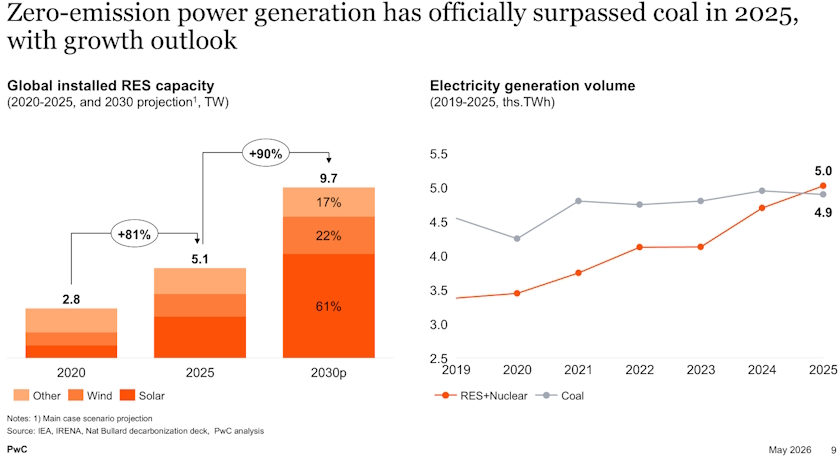
In 2025, global electricity generation from zero-emission sources officially surpassed coal-fired generation, with further growth expected in the coming period, he noted, adding that this is a clear signal that it is not a question of if, but when the world should switch to clean energy sources.
PwC estimates that around two-thirds of energy sector emissions can be decarbonized with a positive business case and commercially available technologies.
“The risk for Southeast Europe is not the cost of transition, but the cost of inaction,” Slade-Šilović said. He noted that the European carbon pricing system and the Carbon Border Adjustment Mechanism (CBAM), which impose additional costs for CO2 emissions, will effectively make coal-based electricity generation uncompetitive. Still, CBAM requires selected upgrades and modifications to be fully fit for purpose.
“This means that power utilities across the region will have to change their business models much faster than they planned,” he added.
The region needs up to EUR 80 billion
However, the energy transition in Southeast Europe will not be cheap. Estimates suggest that countries in the region will need between EUR 50 billion and EUR 80 billion in investments in this decade in order to modernize their energy systems. According to benchmarks, core part of energy system decarbonization requires at least 2% of national GDP per annum. It is clear that the funding cannot be secured by states and power utilities alone, meaning that European funds, IFIs and private capital will also play a critical role.
Another challenge lies in both current and future electricity consumption, which is growing rapidly with the expansion of artificial intelligence (AI), digitalization, data centers and electrification in general. Analysts estimate that global electricity consumption will increase by around 20% over the next five years, with a significant share of that growth – as much as 15% – coming from the AI sector and data centers.
Return of nuclear energy and gas-fired power plants
The need for a stable energy supply has prompted many countries to start investing in gas-fired power plants and nuclear energy again. By 2040, a significant expansion of global gas-fired capacity is expected, while nuclear energy capacity could double by 2050.
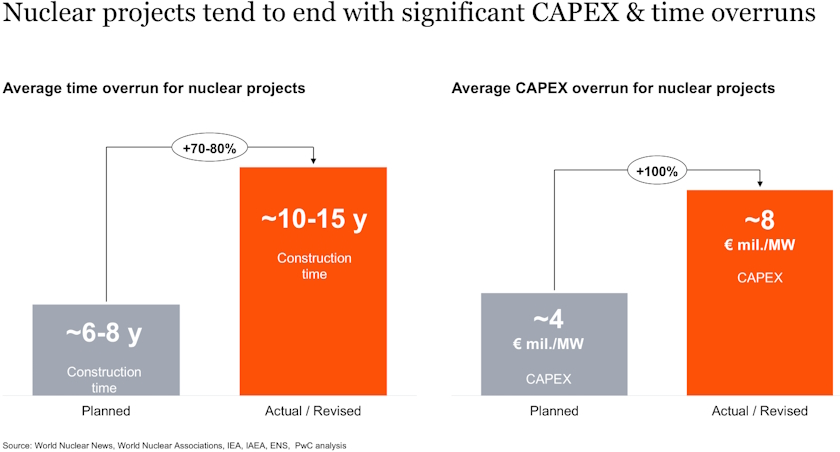
“At the moment, we see strong activity in SEE in terms of gas power plant early developments. Both nuclear and gas technologies can have positive roles in the national energy systems, however they also carry certain risks which need to be properly managed. For example, analysis indicates that nuclear projects have strong tendency for time and CAPEX overrun that significantly impacts cost of electricity and project economics,” Slade-Šilović said.
In addition, for technologies where fixed costs dominate, it is essential to bring cost of financing down as much as possible, as it also has significant impact, he explained.
Renewable energy sources are not enough without new grids
Although the costs of key energy transition technologies have fallen dramatically, Slade-Šilović warns that there are other challenges, such as the need for substantial infrastructure development, financing, permitting, and grid access. Negative electricity prices and grid curtailment caused renewable energy producers to lose billions of dollars in 2025. As a result, there is an increasing emphasis on battery energy storage systems, flexibility, and power grid modernization.
He noted that transmission and distribution system operators plan to double the length of the global electricity grid by 2050, to as much as 166 million kilometers. European transmission system operators plan to invest nearly four times as much in the 2025–2029 period as in the previous five-year cycle. However, the problem in Southeast Europe is further complicated by outdated infrastructure and low returns, making new financing models an absolute necessity, Slade-Šilović said.
Serbia and Southeast Europe are racing against time to build interconnections
Slade-Šilović recalls that Southeast Europe is already trying to accelerate its energy transition. The LNG terminal in Croatia is being expanded, new gas interconnections are being built between Serbia, Bulgaria, North Macedonia, and Romania, as well as between Croatia and BiH, while Greece and Albania are investing in new energy infrastructure and renewable energy sources. The goal is to reduce dependence on individual suppliers and ensure stronger integration of the region’s energy systems.
“The region stands at a crossroads. We can be the last remaining region in Europe to cling to the old energy system, pay the CO2 tax, and depend on others. Or we can move forward decisively, leveraging the competitiveness of green technologies, EU funds, and our own renewable energy potential. We can build a modern, secure, and competitive energy system. The choice is ours, but the window is closing. However, I believe we will succeed,” Mislav Slade-Šilović concluded.
Comments (1)
vladimir popovic
There are numerous Pleistocene and Pliocene “bright spots” on 2D seismic (seismically outlined gas reservoirs in porous sand) offshore Montenegro. They are like “bright spots“ of gas fields in the Adriatic Sea south of the river Po’s entrance to the sea. Those sand gas reservoirs, formed by sea currents, are the major gas producers for Croatia. Also, the Barbara field in the Italian North Adriatic produces gas from Pleistocene turbidite sands. Based on 2D seismic, there are more “bright spots“ and most likely more gas in offshore Montenegro than in offshore Croatia, as currents have brought sand from several Albanian rivers to offshore Montenegro for the last 30 million years. There are several deep wells near Ulcinj Block showing gas and 17 gas chimneys on 2D seismic data. There are reports and 3D seismic data, 1586 km sq, acquired by oil and gas companies Energean and Eny-Novatek. We should reinterpret this data and “farm out.”, sell out prospects to oil companies, which should be obliged to drill prospects only in the out-of-season period, from November to May next year. As a result, Montenegro, without involving any money, would resolve its debt problems, obtain 60% of the profit, reduce carbon dioxide emissions in the Western Balkans. The best way to achieve this result would be if part of the offshore area, the Ulcinj Block with 3D data, gets privatized. If we start as soon as possible, we will have results in 2-3 years and a express ticket for EU.