



Author: Zsanett Gréta Papp, EU Young Energy Ambassador
As the EU accelerates its twin transitions, attention is turning towards the Arctic and especially Greenland, long viewed through the lenses of science and climate, is emerging as a potential strategic partner for Europe’s energy, industrial and digital ambitions. While exporting electricity to Europe is currently unrealistic, Greenland’s renewable resources could support local industries, sustainable data infrastructure and critical raw material processing. Unlocking this potential, on the other hand, requires respecting local needs, community priorities and sustainable land-use planning.
Greenland’s strategic relevance
Greenland has attracted renewed geopolitical attention amid repeated statements by United States President Donald Trump advocating greater United States control over the island. The reasons behind are due to its vast renewable energy potential, untapped critical raw of hydrocarbons, and strategic location (e.g. GIUK Gap, maritime chokepoint) between Europe and North America. In addition, although commercial use of those routes remains constrained and uneven, the Arctic Ocean may offer shorter routes between parts of Europe and Asia as well.
EU-Greenland cooperation has developed over more than four decades
Greenland is an autonomous, self-governing territory within the Kingdom of Denmark and an Overseas Country and Territory associated with the EU. The EU-Greenland partnership has spanned more than four decades, since the 1985 Greenland Treaty. Today, Greenland is increasingly strategic for Europe, given its renewable energy potential, critical raw materials, location and digital connectivity. While the cooperation has developed over more than four decades, as the island’s energy potential is linked to the efforts to diversify supply chains and enable the EU’s energy security, the EU has always been committed to prioritise local value creation rather than power exports.
Local use of renewable electricity
While renewable electricity exports to Europe are often discussed, a direct Greenland–Europe interconnector is not a near-term option due to the major technical, financial, environmental and security challenges involved, requiring dedicated assessments. Local use of renewable electricity from Greenland’s abundant hydropower and wind resources is more realistic, supporting energy-intensive industries and digital infrastructure. In addition, Greenland could also to lead green hydrogen and ammonia production, strengthening the island’s leading role in clean energy transition.
Digital and industrial potential
Greenland has valuable assets for the twin industrial transition – green and digital: renewable electricity, a naturally cold climate that reduces cooling requirements, political stability, and proximity to emerging Arctic fibre-optic communication routes. As the EUSEW session on ‘’AI, cloud infrastructure and the energy transition’’ mentioned: digitalisation drives rapidly growing electricity demand since the EU aims to triple data-centre capacity in the coming years. As Europe strengthens digital sovereignty and resilience, data centres are becoming strategic infrastructure, making Greenland’s renewable energy and resilient connectivity increasingly valuable for European and transatlantic markets. In addition, initiatives like the proposed Polar Connect could enhance global digital infrastructure, by installing a resilient fiber-optic cable offering a shorter, more secure data transmission route between continents via the Arctic Ocean, improving Arctic digital connectivity.
Combining raw materials, local processing and industrial value creation
Greenland is reported to hold 25 of the 34 critical raw materials identified by the European Union, and the Union seeks to limit dependency on any one third country to 65% for each strategic raw material by 2030. In 2023 the EU and Greenland signed Memorandum of Understanding (MoU), a strategic partnership on sustainable raw materials value chains. The Malmbjerg molybdenum project for instance has the potential to cover roughly 25% of Europe’s molybdenum needs. Greenland’s renewable energy resources could also support the processing of these critical raw materials, as this process requires substantial amounts of electricity.
Community participation, land use, environmental safeguards, skills and benefit-sharing
Natural resource extractions, or data centers raise important questions about land use rights and equitable benefit-sharing. The question is whether Greenland can transform geological resources into sustainable economic capabilities without sacrificing environmental integrity, extended autonomy or social legitimacy. argue that the promised local benefits are overstated, while noting that data centers rank among the least labour-intensive structures in the broader economy.
To contribute to a more resilient and sustainable value chains while generating economic benefits for Greenlandic communities, the Mineral Resources Authority requires not only Environmental Impact Assessments but also Social Impact Assessments for major extraction activities, such as oil drilling, or mining activities, in which public consultation, and draft assessments are submitted through a formal regulatory process.
Education and skills are key areas for deeper cooperation
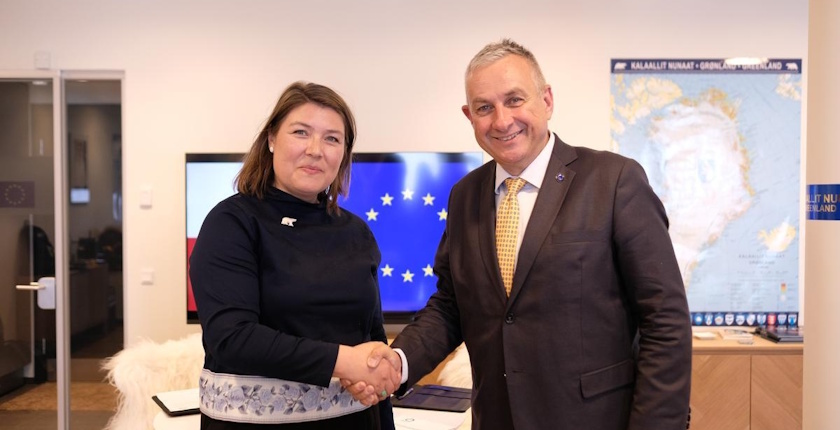
During the EUSEW session on “Europe’s critical raw materials supply chains: enabling a secure, sustainable and competitive EU”, the discussion also underlined that securing raw materials requires more than extraction: investment in infrastructure, responsible mining practices, local processing capacity and skills is essential. As Commissioner Dan Jørgensen highlighted in 2025 during his Greenland mission: “Clean energy, green growth, digitalisation and education are key areas for deeper cooperation”. During the Future Greenland Conference 2026, Commissioner Jozef Síkela confirmed not only a new undersea cable linking communities across Greenland, and first commercial hydropower project in Tasersiaq, but also education support for the Greenlandic community needed in the clean and digital transitions.
Strategic partnership on Greenlandic terms
Greenland is unlikely to export renewable electricity to Europe soon, but it could become an important partner in renewable-powered industry, resilient digital connectivity and sustainable raw-material value chains – provided that investment strengthens Greenlandic communities, skills, infrastructure and decision-making power. These assets can complement the EU’s efforts to strengthen competitiveness, strategic resilience and energy security while contributing to Greenland’s own economic and energy community development.
This opinion editorial is produced in co-operation with the European Sustainable Energy Week (EUSEW) – the biggest annual event dedicated to renewables and efficient energy use in Europe. #EUSEW2026 marked the 20th edition and once again brought together the community of people who care about building a secure and clean energy future for the next generations.
Disclaimer: This article is a contribution from a partner. All rights reserved. Neither the European Commission nor any person acting on behalf of the Commission is responsible for the use that might be made of the information in the article. The opinions expressed are those of the author(s) only and should not be considered as representative of the European Commission’s official position.