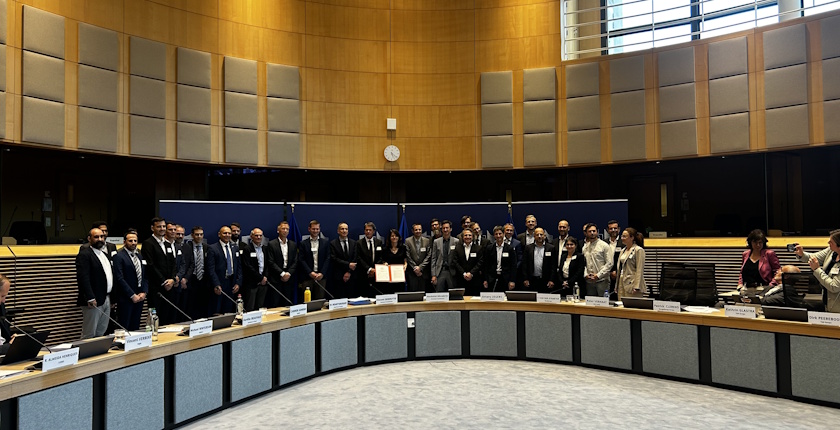
Slovenia’s transmission system operator ELES is one of 12 European TSOs participating in the first joint European project focused on the use of artificial intelligence in energy. The project is called AI.grids.
After the European Commission adopted its strategic roadmap on the digitalisation and artificial intelligence in the energy sector, 48 partners signed a partnership agreement for the AI.grids project.
The list consists of non-governmental organisation CRESYM, the associations of transmission and distribution system operators E.DSO and ENTSO-E, the association T&D Europe, 12 TSOs, six distribution system operators (DSOs), 21 research organisations and five companies (AI.grids partners).
The project’s goal is the development of a pan-European foundational AI model for grids
According to ELES, the EU’s roadmap envisages AI becoming a cornerstone of the energy system, with data being its key value and digitisation a fundamental prerequisite for the energy transition.
AI in energy could improve the management of energy systems by 2030 and deliver significant operational savings by 2035. However, as was emphasised, since digitalisation – data centres – also increases energy consumption, it must be introduced and managed in a sustainable way.
Therefore, the goal of the AI.grids project is the development of a pan-European foundational model of AI for electricity grids, ELES stressed.
During the development of the model, priority use cases will be identified, unique standards for data exchange and management will be established, synthetic databases will be created, and the planning, learning, and evaluation of physically-backed AI models will be defined, the company explained.
The US and China are currently ahead of the EU
According to the update, artificial intelligence models are expected to help TSOs and DSOs, for example, in forecasting grid operation, generation and consumption, in congestion management and malfunction detection, in assessing connection capacity, optimising renewable energy generation and in planning the infrastructure itself.
In the growing complexity of grids, with increasing proportion of variable renewable generation, AI could help to manage the grids and energy devices more efficiently and cheaply.
First prototype in a year
The European Commission believes that its own AI models and algorithms will be key to achieving strategic autonomy and strengthening competitiveness. It noted that the US and China, for example, are currently ahead of the EU on this path.
According to ELES, the first prototype of the basic model is expected to be developed within a year. Over the following two years, the project will be systematically evaluated and its feasibility assessed.
The partners will allocate EUR 2.5 million for its implementation in the initial phase.