


Veolia received a green light from Bulgaria’s capital city to install two hydropower generators within the city’s major water supply lines. The system is envisaged to generate 12 GWh of electricity per year.
Mostly owned by local authorities and underfunded, water and sewerage utilities in Southeastern Europe are struggling to provide enough drinking water and even to remain financially stable. They are under pressure from the effects of global warming and volatile electricity costs. After a water supply firm in Bansko in southwestern Bulgaria installed a miniature in-pipe hydropower generator, the solution sparked interest throughout the country.
Sofiyska voda, Veolia’s subsidiary that produces drinking water and manages wastewater for the capital city, is about to deploy the technology. In-pipe hydropower systems could play a part in decarbonization and energy efficiency as they are simple and don’t harm the environment. Such devices utilize the flowing water’s kinetic and potential energy and excess pressure – otherwise it would be released in the form of heat through a valve and wasted.
Making Sofia sustainable, energy-efficient, modern European city
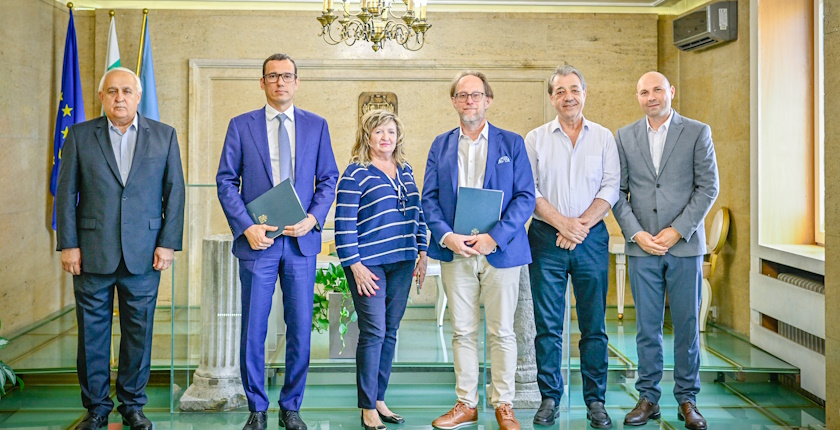
Sofia Mayor Vasil Terziev and Country Director of Veolia for Bulgaria, Greece and Albania Francois Debergh signed a memorandum of cooperation for the construction of two small hydropower plants along the city’s trunk water mains.
Earlier, the Sofia Municipal Council approved the findings of a joint working group that explored the possibilities for the investment.
“Our goal is to work consistently for making Sofia a sustainable, energy-efficient and modern European city. One of the key priorities in our vision for development is the use of renewable energy sources. Therefore, among the important fields in which we are working is the construction of small hydropower plants that will allow our city to generate clean electricity locally – with care for nature,” said Mayor Vasil Terziev.
Sofia has been planning in-pipe hydroelectric systems for more than two decades
Such facilities will help reduce the carbon footprint of the capital city and improve the management of water resources, according to the company and the Sofia Municipality, also known as Stolichna (capital) Municipality. They added that renewable energy investments are contributing to the city’s efforts toward energy independence and climate neutrality.
“The project is an example of how the existing infrastructure can be best utilized for clean energy production. After commissioning, the plants will produce approximately 12 GWh of renewable energy per year, which will account for additional annual savings of over 8,000 tonnes of CO2 emissions. The memorandum is fully aligned with Sofia’s commitments to climate neutrality and Veolia’s participation in the NetZeroCities initiative,” Debergh stated.
Sofiyska voda utility striving for energy independence
Sofiyska voda’s wastewater treatment plant in Kubratovo has been energy independent since 2015. It produces biogas from the sludge separated in the process. The parent company stressed that a pending solar power project would make Sofiyska voda the first energy-neutral water supply and sewerage operator in the region, among only a few on the global scale.
The local authority in Sofia recalled there was an idea already in 2003 for eight hydropower facilities on the water supply lines.
Another alternative hydroelectric project was recently unveiled in northwestern Bulgaria. With the ambition to build several hydroelectric plants on pontoons on the Danube river, a local company intends to install a 20 kW pilot facility in Vidin.