


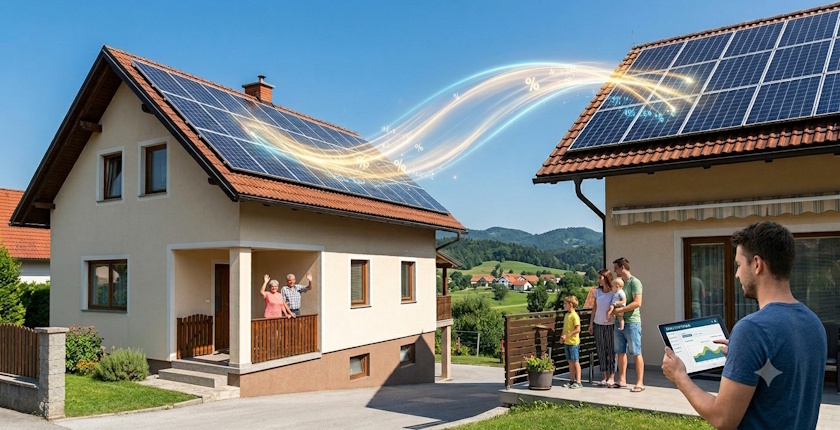
From July 1, 2026, citizens of Slovenia will be able to independently share surplus electricity from their solar power plants with family, neighbors, or friends across the country. This opportunity, which represents a new step in the democratization of the country’s energy sector, is available for active consumers – households and small and medium-sized enterprises (SMEs) that produce electricity from solar power plants.
Energy sharing has been enabled by the transposition of the European Union’s directives into domestic legislation—primarily through the electricity supply act (Zakon o oskrbi z električno energijo – ZOEE) and the act on the promotion of the use of renewable energy sources (Zakon o spodbujanju rabe obnovljivih virov energije – ZSROVE).
Until July 1, 2026, electricity sharing is strictly limited to collective models. Tenants in the same building or citizens in the local community had to jointly invest in a power plant and fix their sharing percentages in advance.
Every owner of a PV plant can send their surplus electricity to any meter in real time
All other owners of individual power plants (prosumers) who weren’t part of these models, had no right to redirect their energy; instead, they could only deliver all their surpluses to the grid via their supplier. Under the old net metering system for prosumers, these surpluses were handed over to the supplier free of charge at the end of the year, while under the new net billing system (that substituted net metering), suppliers purchased these surpluses at very low prices.
Starting July 1, every individual owner of a PV plant gains the freedom to send their surpluses in real time—on a 15-minute basis—to any individual meter in the country.
Sharing rules depend on the self-sufficiency model
According to the Ministry of the Environment, Climate and Energy, the new regulatory framework defines the sharing rules depending on the chosen self-sufficiency (self-consumption) model.
Those who are still in the net metering system have the privilege of the grid storing their surpluses during the summer for free and returning them in winter. As of July 1, they are allowed to donate or transfer their final annual surplus to another meter, but only once a year during the final settlement, rather than month by month. They cannot receive energy from others.
Producers in the net billing system have the greatest flexibility
Producers in the net billing system don’t have the option of annual virtual storage in the grid. From July 1, they will be able to transfer and receive energy in real time.
Energy communities are another model of self-sufficiency besides net metering and net billing. They previously operated with fixed and pre-agreed sharing percentages. It can result in wasting energy if, for example, a member isn’t at home.
Now they will get the right to redistribute surpluses in real time. It means that unused electricity is automatically redirected to a community member who is consuming it at that exact moment, thereby preventing energy loss.
They can also transfer electricity to other communities or individual consumers, as well as receive it from them.
Prerequisites
The prerequisite for the energy sharing system are smart meters, which register consumption and production in real time – every 15 minutes. According to the rules of the distribution system operator, SODO, energy sharing is only possible within the framework of a single supplier. Both the party providing and the party receiving the energy must have supply contracts with the same company.
SODO has also defined that the contract must precisely specify the sharing key or allocation percentage. Sharing can be either fixed or dynamic, with the latter being essentially achievable only through digital platforms provided by energy suppliers. GEN-I is currently the only supplier offering such a platform.
Framework distinguishes two types of sharing based on physical distance in the grid
The regulatory framework distinguishes two types of sharing based on distance within the grid, which is directly linked to the new network fees system introduced by the Energy Agency.
Local sharing, or sharing within the same substation, is incentivized by the agency. Therefore, a significantly lower network fee is paid since it doesn’t burden the wider distribution and transmission system.
National sharing, according to the regulator’s rules, incurs the full price of the grid fee depending on the valid tariffs at that moment. There are five tariffs. The price within a tariff depends on the peak (winter) or off-peak (summer) season, as well as specific time intervals throughout the 24-hour period.
Donations and sales
Sharing can be carried out as a solidarity-based or a commercial activity. This means it can take the form of a gift, but also a commodity that is bought and sold.
The first and mandatory step for all citizens and companies wishing to enter the energy sharing system is official registration on the state portal Moj Elektro. This website serves as the central hub where the power plant owner submits a request and enters data regarding the meters with which they wish to share their surpluses.
The entire registration and contract confirmation process on this portal must be successfully completed no later than the 10th day of the month to be able to start energy sharing on the first day of the following month.