


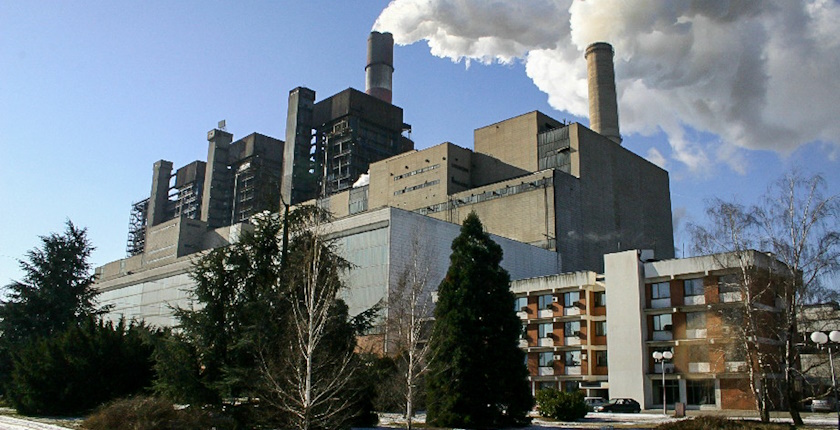
State-owned power company Elektroprivreda Srbije plans to co-incinerate waste at the Nikola Tesla A thermal power plant in Obrenovac, some 30 kilometers southwest of the capital Belgrade. The Serbian utility has asked the Ministry of Environmental Protection to determine the scope and content of the environmental impact assessment study required for the project.
Elektroprivreda Srbije (EPS) has already initiated several studies and pilot projects to analyze the use of alternative fuels in coal-fired thermal power plants. However, the impact assessment would be the most concrete step in that direction.
In July 2022, EPS published a tender for project design for co-incineration of alternative fuels in coal power plants Nikola Tesla A (TENT A) and Kostolac B including solid recovered fuel (SRF), which is produced from waste. Just a month ago, it launched a public call for an analysis of the availability of biomass in Serbia for use in its power plants.
The company now submitted a request to the ministry to determine the scope and content of an environmental impact assessment (EIA) study required for the project for the construction of co-combustion facilities in TENT A for alternative fuel, within units A3, A4, and A5.
The concept of a waste co-incineration unit in TENT A was developed by Dornier Power and Heat
TENT A is EPS’s largest coal power plant. It has a capacity of 1,600 MW, while the three designated units have 1,000 MW combined.
The project for the co-combustion of alternative fuels was launched to increase the efficiency of boilers in coal power plants, modernize their operation, and increase the production of electricity, according to the update.
The SRF would be produced by suppliers, from non-recyclable municipal waste.
EPS added that the project is based on a concept of a facility that Dornier Power and Heat GmbH developed for the purpose of waste incineration in TENT A.
EPS intends to consume 300,000 tonnes of SRF annually
According to the project, waste would represent 3% of the fuel mass. The calorific value of the waste should be about 5%. It is the common value for similar facilities in the European Union.
The annual consumption of SRF is estimated at 300,000 tons. EPS prefers SRF over refuse-derived fuel – RDF.
In addition to reducing the use of lignite, the project has wider social importance. It would contribute to achieving waste management goals in Serbia because non-recyclable municipal waste is used for the production of SRF. It means the amount of waste would be lowered in line with environmental protection regulation, according to the update.
EPS noted that by landfilling the energy value of waste is irretrievably lost. The use of lignite contributes significantly to CO2 emissions, and therefore its share in the annual production shouldn’t be increased – on the contrary, it should be reduced until coal is phased out, the company said.
Waste incineration of waste – opportunity or not
The option to incinerate waste in coal power plants has been widely discussed in the region for several years. In 2021, Slovenia’s Holding Slovenske Elektrarne (HSE) abandoned a project to burn waste in the Šoštanj thermal power plant (TEŠ) due to opposition from local authorities and citizens.
In September 2022, non-governmental organizations criticized Bosnia and Herzegovina’s Elektroprivreda BiH (EPBiH) for its intention to burn waste. The company said that it analyzed the option to incinerate biomass. In May 2023, another BiH power utility, Elektroprivreda Republike Srpske (ERS), also said it would launch trial incineration of waste.
Producing energy from waste is one of waste management tools in the European Union. The primary goal is to permanently tackle waste, not replace coal in power plants.
There are many plans for waste incinerators as part of waste management systems. For example, Croatia said its first would be built in Dalmatia.
Slovenia has a waste incinerator. One was recently built in Serbia. The 103 MW waste-to-energy facility at the Waste Management Center in Vinča, near Serbia’s capital Belgrade, officially started operating on July 1, 2024.