


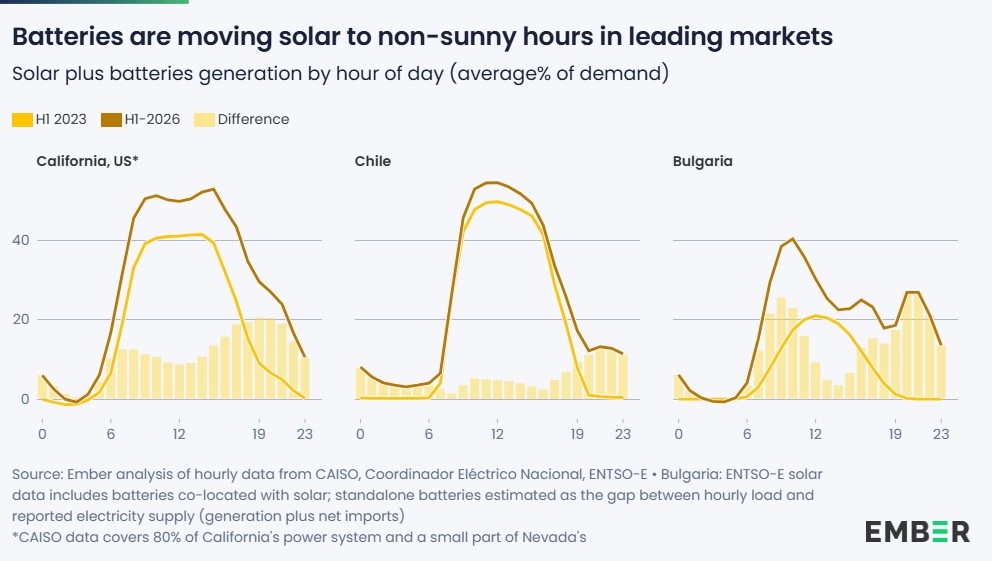
Batteries are moving solar into non-sunny hours in leading global markets, according to Ember’s latest analysis. The combination of solar and batteries is meeting around a quarter of evening electricity demand in California and Bulgaria.
In California, solar plus batteries met over a quarter of electricity demand during the evening peak (7–9pm) on the average day in H1 2026, up from just 6.8% in H1 2023, Ember report reads.
On the average day in H1 2026, solar plus batteries met more than a quarter of electricity demand in California in the evening (7-9pm), up from just 6.8% in H1 2023.
The report examined how battery storage is turning solar power from a daytime-only resource into anytime electricity. Ember earlier said that solar power has become dispatchable anytime at low cost.
Battery energy storage systems will not solve every seasonal challenge
In Chile and Bulgaria, solar was effectively absent from the evening in H1 2023 but on the average day in H1 2026, batteries delivered over 10% of evening electricity demand (7–9pm) in Chile and nearly a quarter (24%) in Bulgaria.
Solar plus batteries averaged 10% of demand between 7 pm and 7 am in Bulgaria, the analysis reads.
Ember stressed that battery energy storage systems (BESS) will not solve every seasonal challenge, but they remove solar’s daily limit, allowing cheap daytime solar to power the non-sunny hours and unlocking its next phase of growth.
BESS build-out is already transforming power systems
The analysis revealed that the strong BESS build-out in leading markets is already transforming power systems.
California, a leading battery market globally, illustrates the scale of this shift, however Chile and Bulgaria have seen an even more dramatic transformation.
Embers pointed out that both countries illustrate how quickly battery deployment can scale.
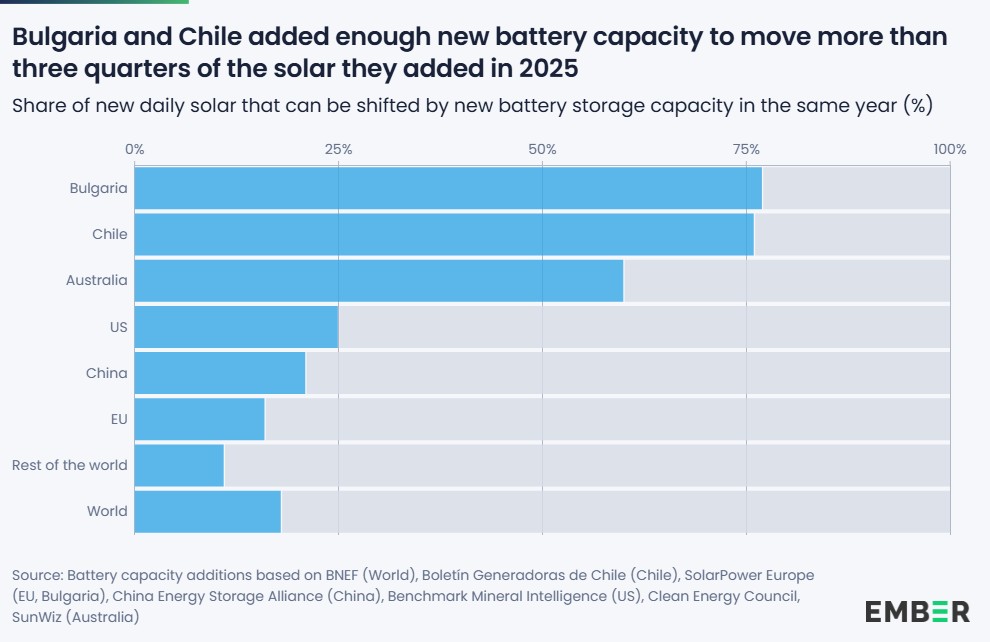
Bulgaria added around 3 GWh of new battery capacity in 2025, supported by government financial support and fast permitting. By May 2026, installed battery capacity in Bulgaria more than doubled to reach 8.6 GWh.
Rangelova: Solar’s role in global power systems can be far bigger than previously thought possible
Chile added 4 GWh of BESS in 2025, more than doubling its installed capacity to 7.6 GWh.
Kostantsa Rangelova, Global Electricity Analyst at Ember, said that cheap daytime solar has become the most powerful transformative force reshaping power grids globally, growing faster than any other source of electricity.
“Now batteries have become cheap and good enough to unlock the next stage of solar growth with anytime solar. Delivering solar in non-sunny hours, the current stronghold of fossil power, changes everything: solar’s role in global power systems can be far bigger than previously thought possible,” Rangelova explained.
The era of anytime solar has begun
The report noted that solar’s record 10% share of global electricity was built almost entirely in the daytime hours. As midday solar has expanded, the first signs of strain have emerged in more mature markets, with negative prices, curtailment and slowing deployment, it added.
Batteries mean solar is no longer limited by the hours of sunshine alone, so the next phase of solar growth will depend on more than installing additional batteries.
Countries also need to ensure batteries can participate fully across electricity markets, so they are used where they deliver the greatest value, the analysis reads.
Where deployment is matched by effective market design, batteries can increase the use of cheap solar generation, reduce reliance on fossil fuels during the evening and strengthen the business case for continued solar expansion, Ember concluded.