


The latest edition of the IEA’s World Energy Outlook underlines the need for governments to pursue greater diversification of supplies and increased cooperation with one another to help navigate the uncertainties and turbulence ahead.
One of the major changes compared to last year’s report is the reintroduction of the current policies scenario (CPS) in World Energy Outlook 2025 (WOE-2025), which models a future based only on policies and regulations already adopted.
In CPS, oil and natural gas demand continues to grow until 2050, and coal only begins to decline before 2030. In World Energy Outlook 2024 (WOE-2024), under the stated policies scenario (STEPS), oil and natural gas demand both peak before 2030.
Energy is becoming a core economic and national security issue
Pressing threats and longer-term hazards are elevating energy to a core issue of economic and national security, according to the International Energy Agency’s flagship report.
IEA listed four main reasons that make the situation complex for the creators of energy policy.
Geopolitical fragility coexists with subdued oil prices. At the same time, countries are prioritizing energy security and affordability, but are reaching for different levers to achieve them.
The report also points to the fractures in the international system and uncertainties over the outlook for trade, in times when energy trade is more important than ever. And fourth, there is less momentum than before behind national and international efforts to reduce emissions, yet climate risks are rising.
Three scenarios
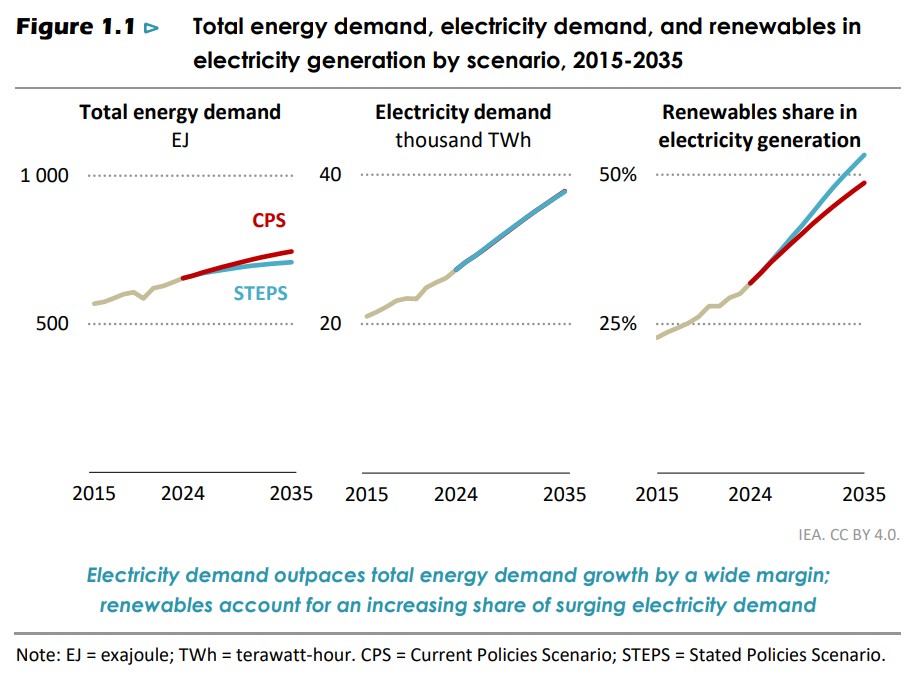
The report notes that renewables set new records for deployment in 2024 for the 23rd consecutive year, but that the consumption of oil, natural gas and coal, and nuclear output all reached all-time highs as well.
Driven mainly by China, the demand for coal has grown 50% faster since 2019 than the next fastest growing fossil fuel – natural gas, which is the key reason why energy-related emissions have continued to increase, the report reads.
There is no single storyline about the future of energy
IEA admitted that there is no single storyline about the future of energy and argued that the World Energy Outlook (WEO) presents multiple scenarios, none of which is a forecast.
WEO has three main scenarios. The current policies scenario (CPS) and stated policies scenario (STEPS) set starting conditions and then examine where they lead. The net zero emissions by 2050 (NZE) scenario maps out a pathway to achieve specific energy and climate-related goals.
Each scenario sees the world’s need for energy services increase while four other commonalities stand out, according to the report.
They are the changing nature of energy security, with the supply of critical minerals as an acute vulnerability; the arrival of the age of electricity; a shift in the centre of gravity of the energy system towards India and other emerging economies beyond China; and a rising role for renewables, accompanied by the comeback of nuclear energy.
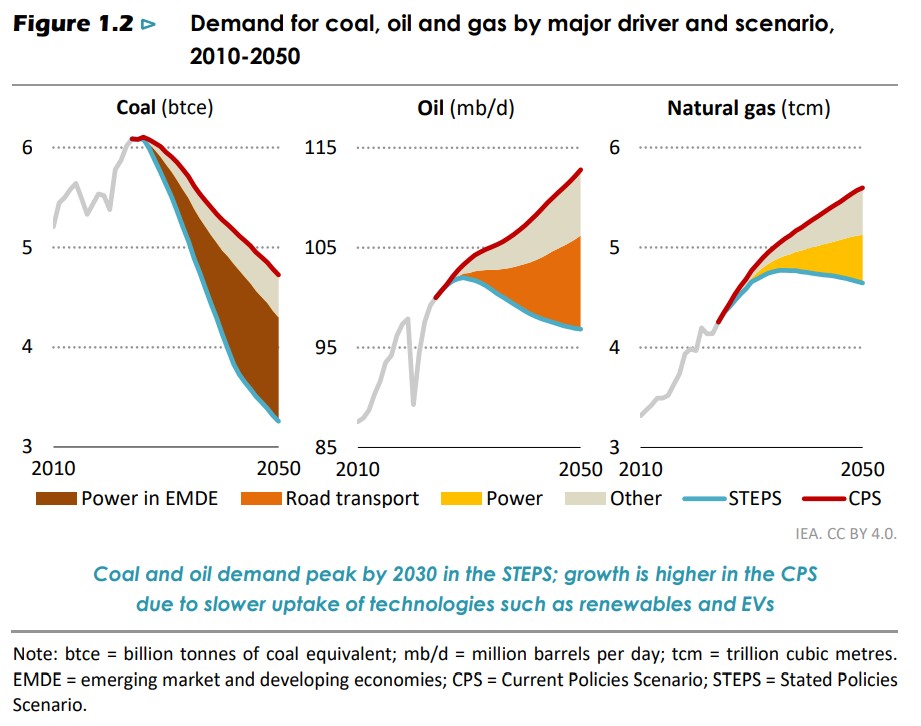
The scenarios diverge in the ways in which energy needs are met, reflected in differing outlooks for oil, natural gas and coal, IEA underlined.
In CPS, demand for oil and natural gas continues to grow to 2050, although coal starts to fall back before the end of the current decade.
In STEPS, the peak in coal demand is accompanied by a flattening in oil use around 2030. However, in contrast to last year’s outlook, gas demand continues growing into the 2030s, due mainly to changes in US policies and lower gas prices.
In the NZE scenario, much swifter deployment of a range of low-emissions technologies brings consequent declines in demand for all the fossil fuels.
Birol: Energy security tensions have applied to so many fuels and technologies at once
“When we look at the history of the energy world in recent decades, there is no other time when energy security tensions have applied to so many fuels and technologies at once – a situation that calls for the same spirit and focus that governments showed when they created the IEA after the 1973 oil shock,” said IEA Executive Director Fatih Birol.
He underlined that with energy security front and centre for many governments, their responses need to consider the synergies and trade-offs that can arise with other policy goals – on affordability, access, competitiveness and climate change.
The World Energy Outlook’s scenarios illustrate the key decision points that lie ahead and, together, provide a framework for evidence-based, data-driven discussion over the way forward, he concluded.