


The world added an all-time high 664 GW of solar power capacity in 2025, reaching 2.9 TW, SolarPower Europe has found. While market growth is dropping, the pace and projections nevertheless imply that the global total advanced to 3.2 TW in the meantime. Several Balkan countries remained in the top tier in Europe and overall.
Last year brought 664 GW of new photovoltaic capacity, which was 69 GW more than in 2024 and 212 GW above the 2023 advance, SolarPower Europe said in its Global Solar Market Outlook 2026-2030.
Notably, relative annual additions are on the decline: from 85% year over year, to 32%, to 2025’s 12%. The projection even shows a temporary negative rate, 8%, for this year. The document’s authors attributed it to the solar market’s restructuring in China.
Looking at the total global capacity, it rallied by 30% to 2.9 TW, following 36% in 2024. The medium scenario is 20% both this year and next, with a moderate slowdown afterward.
And now for the big picture and solar power’s unmatched scalability. It has taken almost seven decades until the first terawatt in late 2022, but the global fleet was doubled within two years, and it took less than that to hit 3 TW! In the outlook, the capacity reaches 6.6 TW by the end of the decade.
Solar power production expanding two times faster than wind power
In 2025, photovoltaics accounted for 77% of all capacity additions from renewables – 861 GW, versus 17% in wind power. Hydropower’s share was a mere 3%.
For the first time, solar power production, at 2.78 PWh, beat wind power, which amounted to 2.71 PWh. In the five years through 2025, they jumped 3.3 times and 1.7 times, respectively. Last year’s PV output was equivalent to nearly five years of liquefied natural gas (LNG) flows through the Strait of Hormuz, the report notes.
The share of PV systems in electricity production has tripled to 9%
Solar power tripled its share in global electricity output since 2020, to 9%. Other renewables have been flat altogether, remaining at 25%.
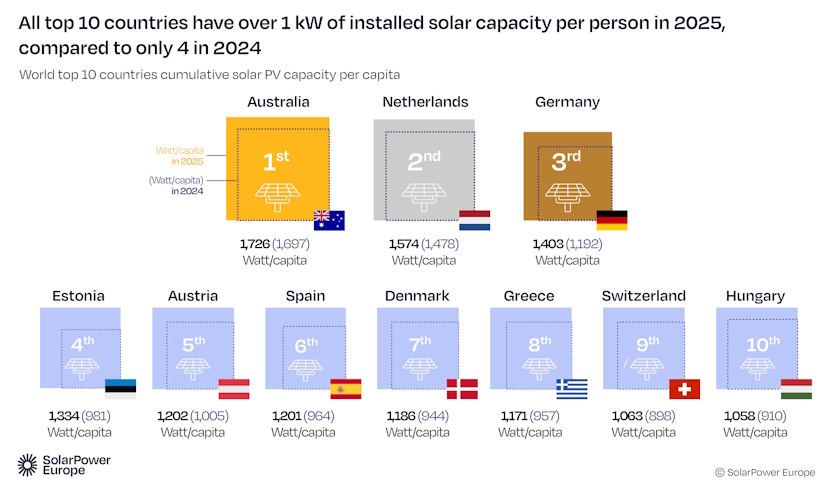
Australia hosts the most PV capacity per person, 1.73 kW, followed by the Netherlands (1.57 kW) and Germany (1.4 kW). Greece, in eighth place, and Hungary, tenth, both surpassed the 1 kW mark. They reached 1.17 kW and 1.06 kW, respectively.
China hosted 57% of the global capacity additions in 2025. India and the United States were the distant second at third, both with 7%. In cumulative terms, China had 1.37 TW at the end of last year. The capacity in the US reached 266 GW, there was 166 GW in India. Germany was fourth, with 118 GW, of which 17.4 GW was new.
Romania, Greece, Bulgaria growing above EU average
Fourteen countries in the European Union added more than 1 GW each, compared to 47 in the whole world. Just like the year before, Romania was sixth in the EU chart, Greece seventh, and Bulgaria held the tenth place.
Turkey has the potential to boost its photovoltaic capacity by as much as 150 GW
Turkey, another major market in the region that Balkan Green Energy News covers, is remaining in the global first league. It took the country just one decade to grow from what would now be considered negligible capacity, to 24.8 GW.
Last year’s expansion was 26.5%. According to the update, Turkey has a potential for 105 GW to 150 GW more solar power, of which 52 GW to 65 GW on roofs. Floating PV plants could contribute between 3 GW and 5 GW, while 5 GW to 8 GW is possible within irrigation systems.