

Croatian passenger rail operator HŽ Putnički Prijevoz is acquiring six battery-electric trains and installing a hybrid charging station. The project is valued at EUR 53.6 million.
Contracts have been signed in Croatia’s capital Zagreb for the allocation of grants from the Modernisation Fund, the purchase of six battery-electric trains, and the construction of a hybrid charging station at the Kotoriba station, located in the north, near the border with Hungary.
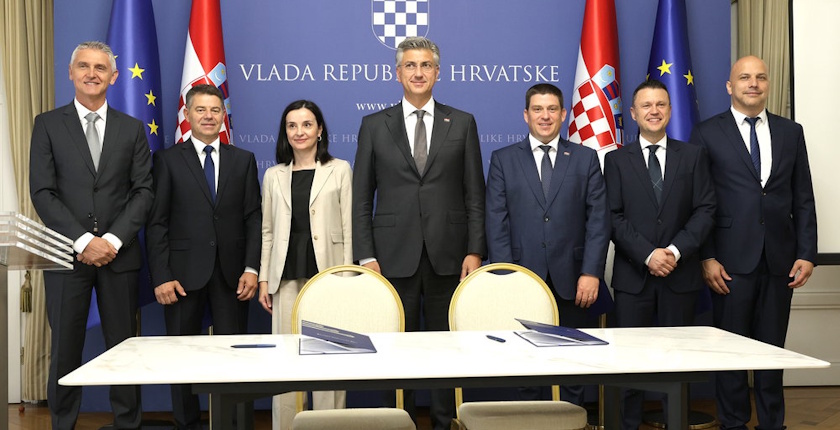
The project financing agreement was signed by Deputy Prime Minister and Minister of the Sea, Transport and Infrastructure Oleg Butković, Minister of Environmental Protection and Green Transition Marija Vučković, Director of the Environmental Protection and Energy Efficiency Fund (FZOEU) Luka Balen, and CEO of HŽ Putnički Prijevoz Željko Ukić.
First hybrid charging station designated for Kotoriba
The contract for the purchase of the trains and the construction of the charging station was signed by Ukić and the CEO of Končar – Electric Vehicles Josip Ninić.
The project is set to significantly improve rail passenger transport in northern Croatia, where the new trains are scheduled to operate, according to the Government of Croatia. The trains are expected to enter service in 2028 and early 2029.
After six charging stations for battery-powered trains have been installed, this project includes building the first hybrid charging station at the Kotoriba station. It comprises a photovoltaic plant and a battery energy storage system (BESS).
Funding planned for 30 additional battery-electric trains and charging hubs
On non-electrified tracks, the battery-electric trains are designed to run on battery power (with a maximum speed of 120 km/h), while on electrified lines, they utilize electricity from the overhead catenary system (reaching a maximum speed of 160 km/h). The batteries are charged either from the overhead network or at charging stations.
By implementing green technologies and replacing older diesel trains with new battery-electric models, the project aims to substantially reduce polluting emissions, noise, fuel consumption, and operational costs, the update reads.
Minister Marija Vučković noted that under its Social Climate Plan, Croatia has earmarked funding for an additional 30 battery-electric trains and charging infrastructure in Knin, Perković, and Benkovac.
Trains “Made in Croatia”
Prime Minister Andrej Plenković pointed out that the project strongly supports the overall decarbonization process within the transport sector, representing a major strategic goal for both the country and the European Union.
He added that the investment serves as an excellent example of utilizing resources from the Modernisation Fund, which is financed through CO2 emissions allowances trading, since the capital is reinvested into greenhouse gas reduction and energy efficiency improvement.
According to Željko Ukić, CEO of HŽ Putnički Prijevoz, the greatest advantage of these battery-electric trains is their dual capability to run on both electrified and non-electrified tracks.
Končar CEO Gordan Kolak explained that the battery-electric trains are developed, designed, and manufactured entirely in Croatia, reflecting the expertise, experience, and innovative potential of domestic experts.