



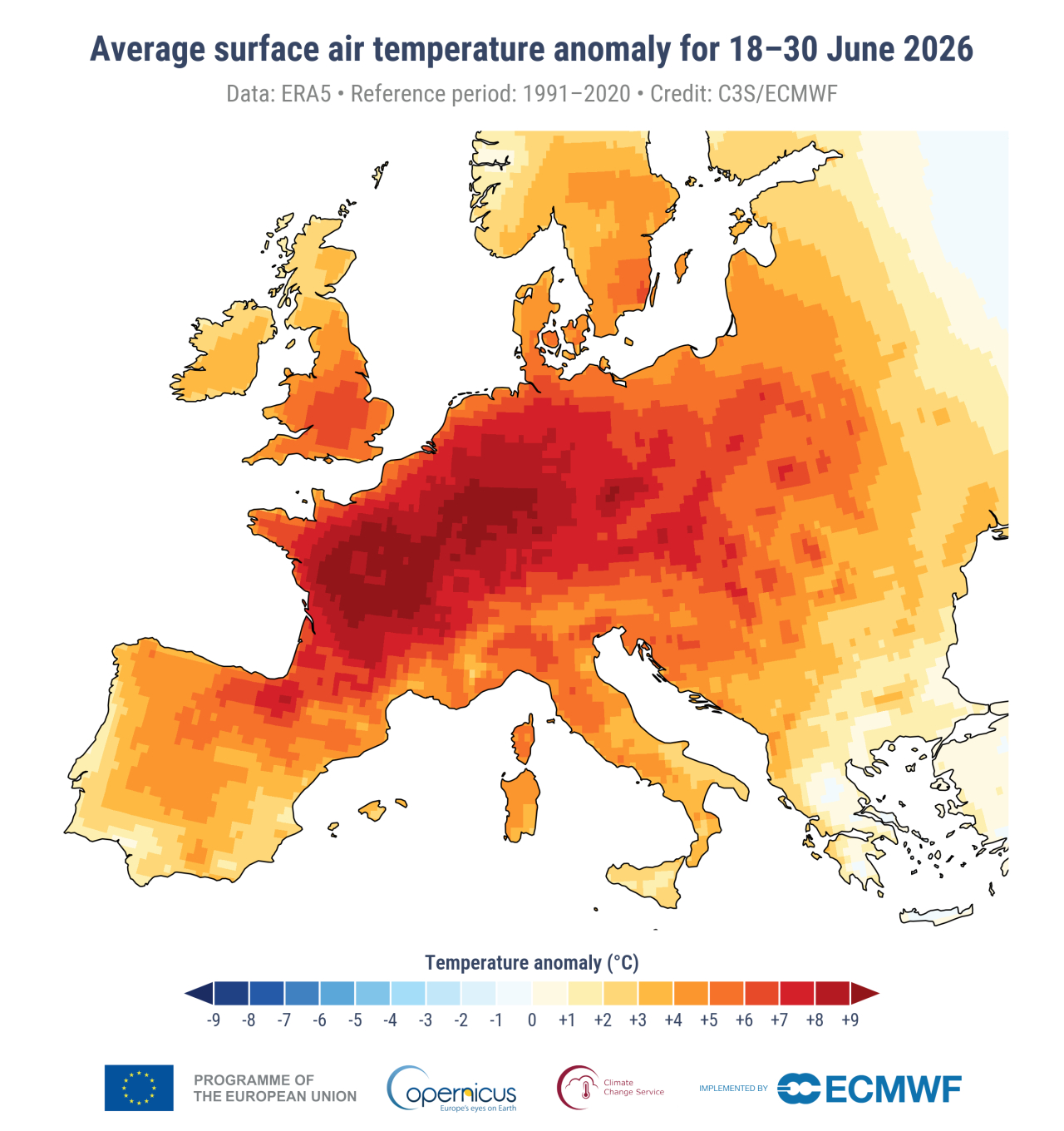
June 2026 was the hottest registered June in western Europe and the second-warmest globally, according to Copernicus Climate Change Service, implemented by the European Centre for Medium-Range Weather Forecasts (ECMWF).
June saw record temperatures, driven by the highest sea surface temperatures (SSTs) so far for the month.
Europe was hit by extreme heat over land and sea, with much of western Europe experiencing a record-breaking heatwave and marine heatwaves across the western Mediterranean and along the Atlantic coasts.
The monthly average SST for the extra-polar ocean was the highest for June
Globally, the monthly average SST for the extra-polar ocean (60°S–60°N) was the highest for June, exceeding the previous record set in June 2024 by just 0.01ºC, partly reflecting the development of strong El Niño conditions in the equatorial Pacific, Copernicus Climate Change Service (C3S) explained.
The heatwave that hit much of Europe during the second half of June came only a few weeks after a particularly intense heatwave in May, with another heatwave emerging in early July.
The June heatwave broke monthly and all-time temperature records across several European countries and contributed to severe health impacts, including heat-related deaths, the update reads.
The succession of heatwaves illustrates the growing challenge posed by increasingly frequent and intense heat extremes across Europe and the globe, C3S said.
Burgess: These records reflect a climate system continuing to accumulate heat
C3S noted that Europe also saw widespread dryness that, together with extreme heat, contributed to wildfire activity, particularly in the Iberian Peninsula and southern France, and heightened drought risk in parts of eastern Europe.
The June heatwave occurred against a backdrop of increasingly dry soils across western and central Europe, further exacerbating drought conditions that had begun to develop during May’s heatwave.
According to Samantha Burgess, Strategic Lead for Climate at ECMWF, June 2026 underscored how profoundly the climate is changing. Western Europe recorded its warmest June on record, and continued record warmth in the global ocean, she added.
“Together, these records reflect a climate system continuing to accumulate heat. The result is increasingly intense heatwaves, a persistently warm ocean, and growing risks for people, ecosystems and infrastructure across Europe and beyond,” Burgess stressed.