Of 7.2 billion people in the world, 2.1 billion live without safe water at home, according to the UN data. Today is World Water Day, and this year’s theme is ‘Leaving no one behind’, in line with the central promise of the 2030 Agenda for Sustainable Development: as sustainable development progresses, everyone must benefit.
In 2015, the global community committed to the UN Sustainable Development Goal 6, which promises that by 2030 everyone will have access to clean water, decent sanitation and good hygiene. In 2019, over 2 billion people in the world live without safe water at home, one in four primary schools have no drinking water service, while more than 700 children under five years of age die every day from diarrhoea linked to unsafe water and poor sanitation.
Water scarcity affects nearly two-thirds of the world’s population – around 4 billion people worldwide experience severe water scarcity during at least one month of the year.
70% of freshwater withdrawals goes for agriculture
Currently, about 70% of the world’s freshwater withdrawals are for agriculture, 16% are for energy and industry and 14% are for domestic purposes. Recent work suggests that unless we change the way we use water, we could face a 40% gap by 2030 between global demand and what can sustainably be supplied, according to a 2013 article on the World Economic Forum’s (WEF) website.
Collaboration between the public and private sectors is crucial to ensuring that economic growth does not threaten equitable access to drinking water, according to the U.S.-based non-profit WaterAid.
In many areas, the amount of groundwater pumped out for irrigation exceeds the amount that is naturally replenished. This can cause wells and pumps to run dry. Global groundwater depletion has increased by 22% in the past decade, largely due to rising demand in India (23%), China (102%) and the U.S. (31%).
Some products have a huge water footprint:
- Your morning cup of coffee contains about 200 ml of actual water, yet the ground coffee takes 132 liters to produce. An alternative might be to have a cup of tea instead, at 34 liters per cup.
- Avocados have an estimated water footprint of 2,000 liters per kilogram.
- Rice accounts for 40% of all global irrigation, and 17% of global groundwater depletion, with an average water footprint of over 2,497 liters of water per kilogram.
- Cotton is a thirsty fabric: if grown and produced in India, for example, it has a water footprint of 10,000 liters per kilogram.
Coal among reasons for water crisis
There are many reasons for the global water crisis, and coal is one of them, writes Greenpeace.
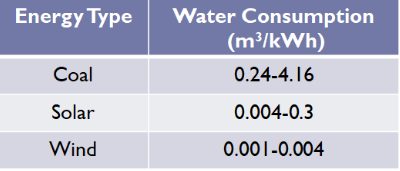
From mining to combustion, coal depletes water resources at nearly every step of the process. For every tonne of coal mined, between 1 and 2.5 cubic meters of groundwater is made unusable. At some sites, wastewater from coal-fired power plants remains poorly treated, pouring a dangerous mix of carcinogens into the environment. Coal power plants consume large amounts of water for cooling. The list of ways coal adds to water depletion goes on.
However, Greenpeace adds, there is a solution at least to the coal conundrum: clean energy sources like solar and wind require very little water, and are increasingly cheaper than coal.
On a global scale, the problem is not whether there is enough water. It is about how water resources are managed and whether they are equitably distributed. There are many alternatives to fossil fuels, but for humans, there is no alternative to water, Greenpeace concludes.