







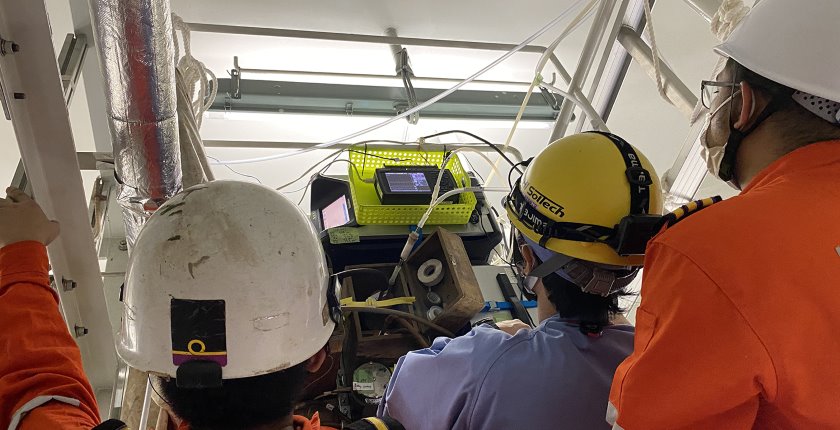
Photo: Mitsubishi Heavy Industries, Ltd.


Mitsubishi Shipbuilding, part of MHI Group, launched a carbon capture project on a cargo ship with its partners with the ambition to develop commercial systems that would slash the sector’s contribution to climate change.
The world’s first marine-based carbon dioxide capture system project was a success, Mitsubishi Shipbuilding said. The trapped greenhouse gas aboard coal carrier Corona Utility is more than 99.9% pure, it revealed.
The crew is operating the demonstration plant. Engineers from the Japanese company began testing it in August. The project for capturing CO2 from the exhaust gas was conducted with transportation company K Line and ship classification society ClassNK and backed by the Maritime Bureau of Japan’s Ministry of Land, Infrastructure, Transport and Tourism.
The ship’s crew was trained to operate the experimental system and the test drive is scheduled to last until the end of March.
Mitsubishi Shipbuilding is part of Mitsubishi Heavy Industries (MHI) Group. The vessel transports coal for Tohoku Electric Power. The data will be used as a benchmark for implementing commercial marine-based CO2 capture systems. The test drive is scheduled to last until the end of March.

The system, intended for onshore plants, was adapted for marine use. Mitsubishi Shipbuilding said it would continue to work on ships and other types of marine equipment to contribute to achieving carbon neutrality on a global scale.
The technology to store CO2 indefinitely and ease climate change is still in its early stages
Captured CO2 can be used in a wide range of applications the production of fertilizer or methanol or dry ice for cooling. The gas is also utilized for enhancing oil recovery by pumping it underground, where it can also be kept permanently, reducing global warming. The technology to store CO2 that way and ease climate change is still in its early stages.
Maritime transport accounts for 3% to 5% of global greenhouse gas emissions and the share could double within a few decades, according to some estimates. But the sector is also a major polluter. Big vessels mostly use heavy fuel oil, also called bunker oil, basically the leftovers from oil refining, which results in extreme air contamination with a range of substances. The sector’s environmental standards are mostly unregulated.




Be the first one to comment on this article.