



The six economies of the Western Balkans need to collectively invest at least USD 37 billion over the next decade to effectively protect people and property from the damaging and escalating impacts of climate change, according to the World Bank Group’s Western Balkans regional Country Climate and Development Report (CCDR).
Investments in climate action in Albania, Bosnia and Herzegovina, Kosovo*, Montenegro, North Macedonia, and Serbia would help avoid loss of human life, property, and productivity, and would help accelerate economic growth, the World Bank said.
The World Bank Group’s Country Climate and Development Reports are new core diagnostic tools that integrate climate change and development considerations. The reports suggest concrete, priority actions to support the low-carbon, resilient transition, the bank said, adding that these documents aim to inform governments, citizens, and the private sector.
The bank notes that floods have directly affected two million people in the region in the past decade, with the impacts set to worsen with more extreme rainfall. Wildfires are a growing threat, with over 1,500 recorded in 2021, a 21% increase over the past decade. Droughts are also negatively affecting agricultural production, the bank said.
Climate change adaptation investments yield significant returns
According to its estimates, climate change adaptation investments, particularly in low- and middle-income economies, yield significant returns, with about USD 4 in benefits for every USD 1 invested.
Xiaoqing Yu, World Bank Country Director for the Western Balkans, said that climate change poses a clear threat to economic development in the region.
“The costs of investing in adaptation are significant. But the good news is that the benefits are even higher. By preparing for climate hazards, we can save lives, safeguard local communities, and stimulate economic growth,” he pointed out.
Western Balkans CCDR outlines three policy categories
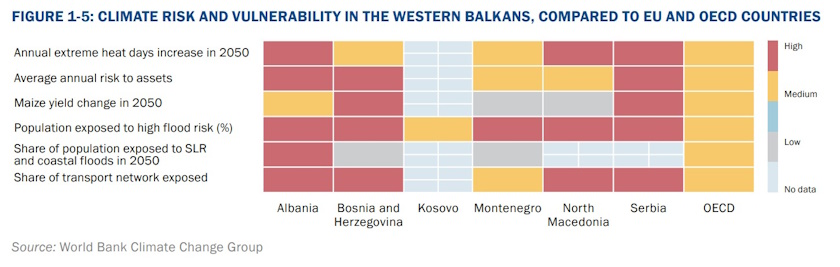
The Western Balkans CCDR outlines several policy recommendations to guide the region’s transition to climate neutrality by 2050. These recommendations are organized into three categories of policies.
The first category, transversal policies, involves integrating adaptation and mitigation efforts across institutions to achieve effective action on climate change. For instance, specialized climate-focused agencies or commissions should be created, and national climate change commitments should serve in an advisory capacity on all climate-related issues.
Cross-border collaboration is needed
The second category, called transboundary policies, is related to cross-border collaboration. It envisages strengthening the regional institutions as key to enabling coordination in areas like early warning systems, shared resource management, or harmonized energy systems.
Finally, the targeted policies category addresses the specific needs of vulnerable communities. Targeted policies include education and training reforms to enhance labor mobility and efforts to adopt climate-smart practices, the bank noted.
The World Bank also said that countries in the Western Balkans need to reduce their greenhouse gas emissions to remain competitive, bolster energy security, and attract international investments. However, reaching climate neutrality by 2050, in line with the European Union’s objectives, would require additional investments of USD 32 billion, it stressed.