


Floating wind farms will become the most cost-effective way to produce renewable energy, according to Mammoet. The Dutch company provides services of transport and installs large sustainable energy structures. Its latest project is Hywind Tampen, the largest floating wind farm in the world.
Norwegian company Equinor builds offshore wind farms, among its other energy projects. It owns Hywind Tampen, a floating wind farm that is under construction. It will provide electricity for oil and gas fields Snorre and Gullfaks in the Norwegian North Sea. It will be the first floating wind power plant to supply offshore platforms with power.
The facility will consist of 11 wind turbines of 8.6 MW each. It is estimated to meet around 35% of the annual electricity demand of five platforms: Snorre A and B and Gullfaks A, B and C, the company said.
How to build a floating giant
Engineers faced several important questions regarding the installation of the largest wind power plant. Because of the depth of the water and the geology of the soil, it was not possible to install conventional, bottom-fixed turbines. Therefore, they are placed on floating concrete structures with a common anchoring system.
Floating wind turbines are anchored to the seabed with ropes and anchors, in the same way that a floating oil rig is moored. In Hywind Tampen, they are on 107-meter spar buoys that lie mainly underwater.
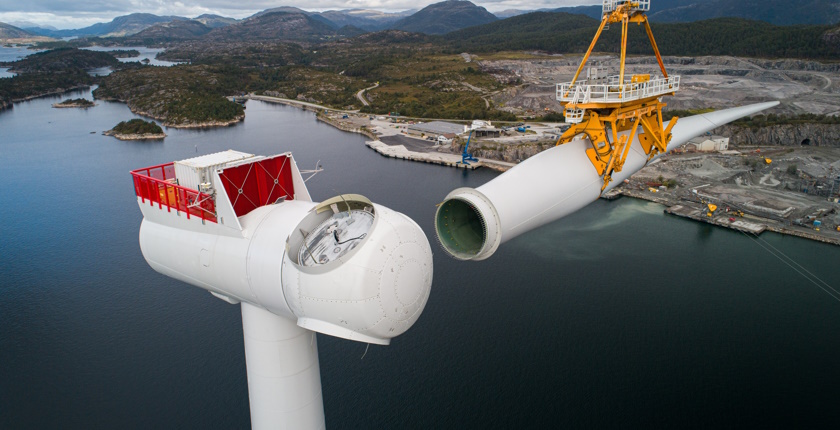
Placing the turbines was also challenging, due to the weight and height of the structures. However, thanks to Mammoet’s experience, everything is going smoothly. Using its cranes, the company managed to assemble a turbine 143 meters from a pier.
Mammoet also worked on the installation of the first floating wind farm, also owned by Equinor. Hywind Scotland was a pilot project with five turbines and a total capacity of 30 MW. It was commissioned in 2017. The facility produces enough energy for 20,000 households in the United Kingdom.
Comments (1)
Crane Services Calgary
Fascinating insight into large-scale renewable innovation. It’s impressive to see how engineering and sustainability come together on such a massive project.