







Photo: Felix Wolf from Pixabay


Almost 90% of citizens in Serbia support the introduction of a deposit return scheme, according to a survey conducted by Every Can Counts. It is also the highest level of support among all 16 countries where the poll was conducted.
The report titled Global Recycling Habits and Attitudes 2025, based on the survey’s results, represents another confirmation that citizens in Serbia support the introduction of a deposit return scheme (DRS). Similar survey results were published in 2021 and 2022.
Despite officially planning it for many years, the authorities in Serbia haven’t rolled out such a deposit mechanism yet. According to one of the latest announcements, from October 2023, the introduction is set for 2027.
The benefits of a deposit system are well known. Romania is among the countries that introduced it relatively recently.
Following its 2020 and 2022 campaigns, Every Can Counts (ECC) commissioned another global research in 2025 into people’s recycling behaviours and attitudes. The study was designed and analysed by Made with Insight.
It covered 16 countries: Belgium, Brazil, the Czech Republic, France, Greece, Hungary, Ireland, Italy, the Netherlands, Poland, Romania, Serbia, Spain, the United Arab Emirates, the United Kingdom and the United States.
Plastic pollution tops global concerns
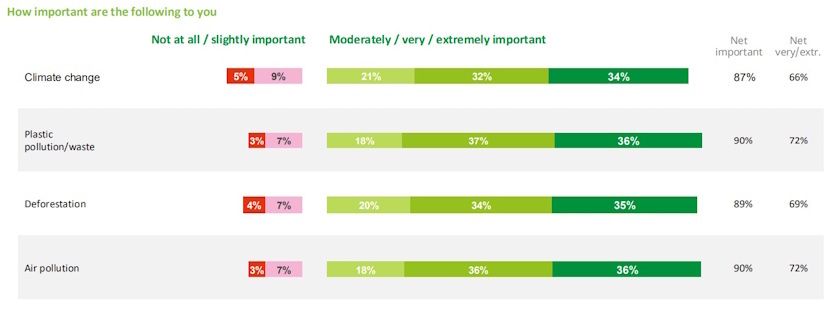
Plastic pollution tops global concerns, matching climate change, deforestation, and air pollution in public priority. Nearly 9 in 10 people worldwide see plastic waste as an important issue and 72% say it is very/extremely important.
The strong consensus highlights growing public demand for action to reduce plastic waste alongside broader climate and environmental goals, according to ECC.
Perceptions of drink cans vary notably by market but remain relatively low across all measures. For recyclability, the highest scores come from the USA (25%), Serbia (24%), and Greece (23%). Sustainability perceptions peak in the UAE (22%) while circularity scores are highest in Greece (23%) and Serbia (22%).
While there is no silver bullet, the strongest motivators for recycling are financial rewards such as deposit refunds (41%) and better convenience (39%), the report reads.
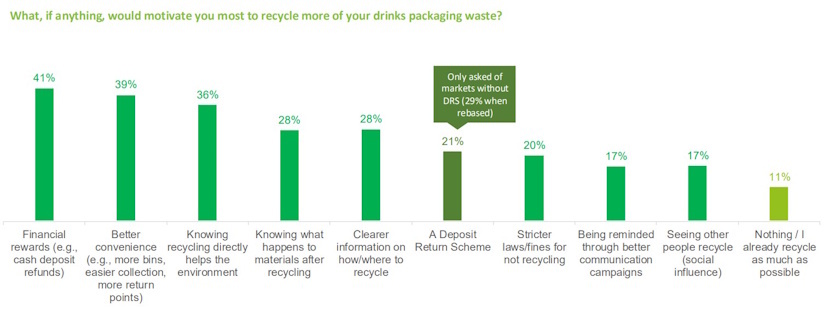
Financial incentives resonate most in Romania (53%), and convenience is the strongest in Greece. Brazil is exceptional for environmental impact (55%), followed by Romania, Serbia and the UAE – all with 46%.
Attitudes towards recycling show two clear patterns, according to the report. First, making recycling more engaging through rewards, games or interactive apps could boost participation, particularly in Brazil (83%), Greece (81%) and Serbia (88%), while interest is lower in markets such as the Netherlands (53%) and Belgium (60%).
Second, there is near universal agreement that manufacturers and brands should be required to use fully recyclable or recycled materials, the report underlines.
DRS is less supported in the USA
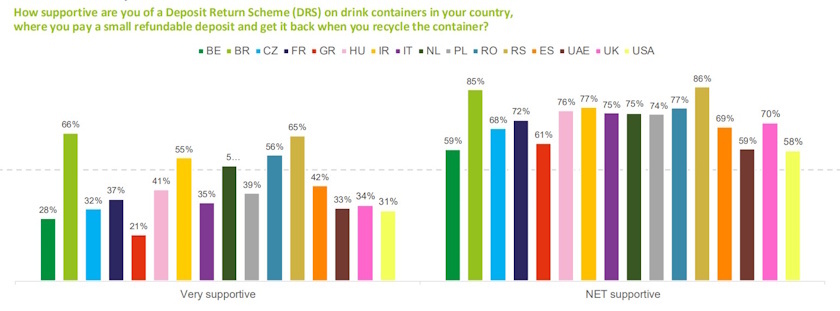
A majority supports DRS in all markets, but the intensity of support varies considerably. Net support ranges from 58% in the USA to 86% in Serbia.
Levels of strong, “very supportive” sentiment show sharper contrasts. Brazil (66%), Serbia (65%), Romania (56%), Ireland (55%) and the Netherlands (51%) stand out as markets with a majority of strong supporters.
At the other end of the spectrum, Greece (21%), Belgium (28%), the USA (31%), the Czech Republic (32%) and the UK (34%) record the lowest intensity.
Convenience and incentives are the top drivers overall while information is generally a weaker motivator, but the mix differs by market, the report reads.
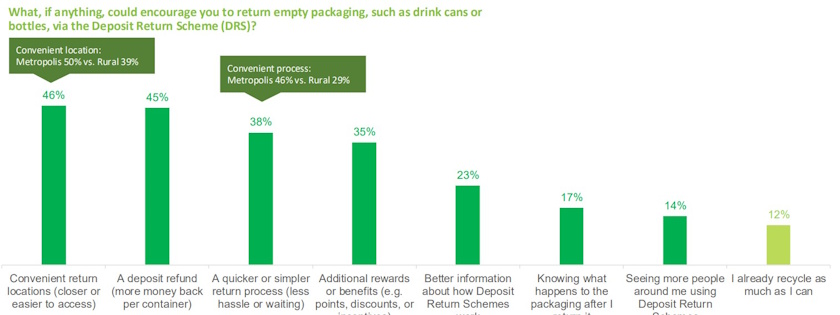
Higher deposit refunds are most influential in the Czech Republic and Spain, while Serbia and Greece balance convenience and refunds more evenly.
When looking only at those who “strongly agree,” support levels show sharper contrasts.
Romania and Serbia stand out with strong calls for all one-way packaging to be included (67%). Brazil scores high across most categories but is weaker on personal responsibility for returning cans.
Hungary, Ireland, Romania and Serbia show high trust that returned containers are recycled, while trust is lower in the Czech Republic, Belgium, France or Greece, ECC concluded.




Be the first one to comment on this article.