

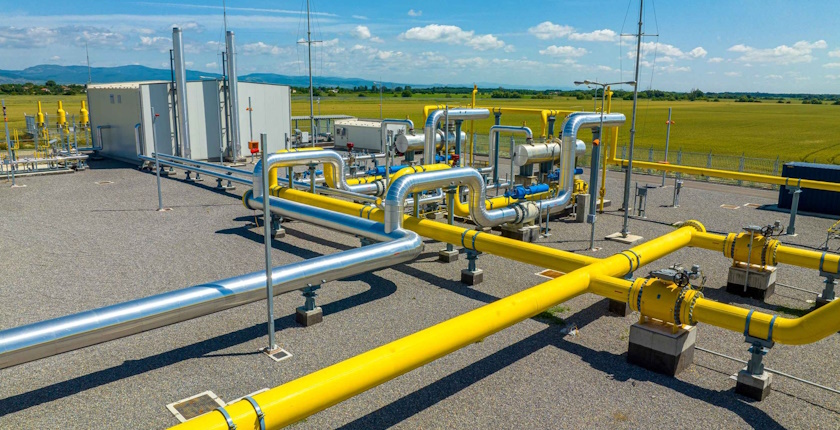
The Interconnector Greece-Bulgaria (IGB) natural gas pipeline is planned to be expanded to five billion cubic meters per year from three billion. The non-binding assessment phase is underway.
ICGB, the operator of the IGB interconnection, targets an expansion in technical annual capacity to five billion cubic meters per year from the current three billion. The company launched the non-binding phase of a process to assess market interest.
The procedure is conducted under Regulation (EU) 2017/459 (NC CAM), the network code on capacity allocation mechanisms for the sector. It marks a key step toward reinforcing long-term energy security in the region, ICGB pointed out.
Interested market participants are invited to submit their non-binding demand indications by September 1. All relevant documents and participation guidelines are available at ICGB’s public consultations page.
The market demand assessment also includes a binding phase, to determine the feasibility of the potential capacity increase. The process is being carried out in close coordination with adjacent gas transmission system operators (TSOs), according to the company.
Expanding IGB’s capacity is a strategic move for the entire region, the heads of ICGB pointed out
Expanding IGB’s capacity is a strategic move for the entire region, said ICGB’s executive officers George Satlas and Teodora Georgieva. “As the first route for diversified natural gas supplies to Bulgaria, IGB plays a critical role in ensuring secure, sustainable energy for Southeast Europe. We remain firmly committed to this process and to delivering enhanced connectivity and resilience across the region with our partners,” they added.
Following the current phase, ICGB and adjacent TSOs need to compile demand assessment reports for each interconnection point. They would form the basis for possible future steps, including project proposals, consultations and regulatory approval, the announcement reads.
Serbia, Hungary, Bosnia and Herzegovina and North Macedonia largely depend on Russian gas, delivered through the TurkStream and Balkan Stream pipeline corridor. IGB and the Serbia-Bulgaria interconnector enable access to Azerbaijani gas and Greece’s liquefied natural gas (LNG) terminals.