



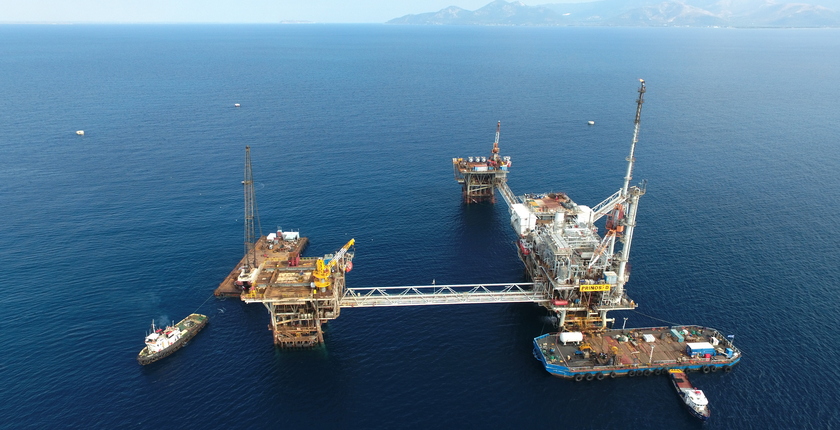
EnEarth, a subsidiary of United Kingdom–based Energean, has received a storage permit for its carbon storage project at a depleted offshore oil field in northern Greece. The project, called Prinos CO2, will permanently store carbon dioxide from remote emitters, supporting Greece’s decarbonization goals, according to a press release from integrated energy services firm Kent, which is performing the front-end engineering design.
The Prinos CO2 carbon storage project is “the first of its kind to obtain an environmental permit and a storage permit in the Mediterranean, and one of the few in Europe,” reads the press release.
The carbon storage permit was issued in late February by the Hellenic Hydrocarbons and Energy Resources Management Company (HEREMA), Greece’s licensing authority for the geological storage of carbon dioxide. The permit is valid for 25 years.
The storage site is a depleted oil field and its underlying saline aquifer, and CO2 will be stored underground at a depth of about three kilometers beneath the seabed, HEREMA said, adding that the maximum permitted injection rate in the first phase of the project is one million tons per year.
Phase 1 envisages 20 years of operation.
In the press release, Kent said that the Prinos project was being designed to receive and process up to 2.8 million tons of liquid CO2 annually, starting in 2029 at the latest.
The Prinos oil field is located in the northern Aegean Sea, between the island of Thasos and the port city of Kavala.
CO2 will be stored three kilometers beneath the seabed
Kent explained that CO2 from emitters would first be shipped to a marine terminal at an onshore plant near Kavala, where it would be temporarily stored before being conditioned, pumped, and transported through a subsea pipeline to a standalone CO2 injection and water production platform within the existing Prinos complex.
Kent will develop the front-end engineering design (FEED) for the CO2 handling and storage facility, which will receive, store, transport, and inject CO2 into the Prinos aquifer. The FEED phase will define the technical scope and execution strategy for the project, ensuring the highest standards of safety, efficiency, and sustainability, the firm said.
Prinos CO2 has been included in the EU’s list of Projects of Common Interest
Prinos CO2 has been included in the European Union’s list of Projects of Common Interest (PCIs).
The project is valued at EUR 1.2 billion, of which EUR 270 million in funding is from the EU’s Connecting Europe Facility and Greece’s Recovery and Resilience Plan 2.0.