






Photo: Manuel de la Fuente from Pixabay


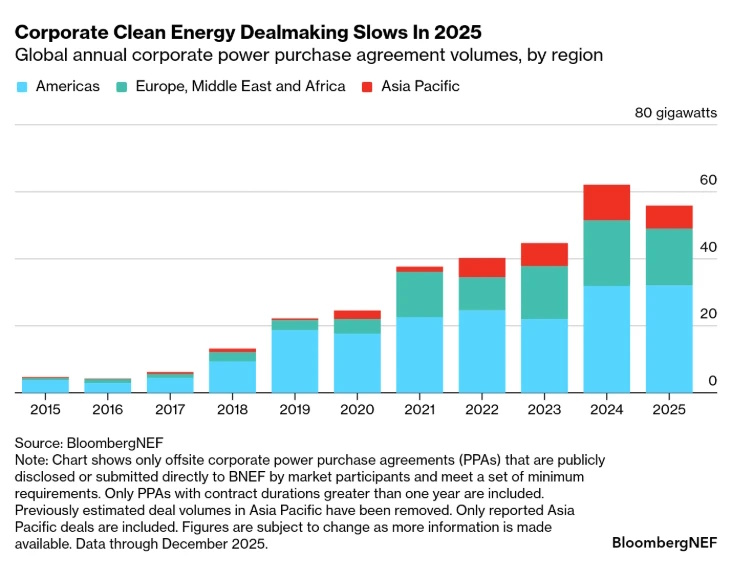
Global clean power purchase agreement volumes decreased in 2025, for the first time since 2016, according to a BloombergNEF report. Meta, Amazon, Google and Microsoft contracted almost half altogether, with firm power deals set to become dominant.
Corporations announced deals for 55.9 GW of clean power in 2025, 10% down from the record set the prior year, BloombergNEF said in its 1H 2026 Corporate Energy Market Outlook.
It explained that the clean power purchase agreements (PPAs) market was predominantly driven by negative power prices and policy risks. The report covers offsite corporate PPAs for wind, solar, hydro, nuclear, and geothermal with a minimal duration of 12 months.
Nayel Brihi, BNEF corporate energy analyst and lead author of the report, said that corporate clean energy buyers are operating at two different speeds. Large tech buyers are venturing into bigger deals and frontier technologies, while smaller companies are grappling with power market realities, he explained.
Brihi: Corporate clean energy buyers are operating at two different speeds.
“Some buyers in newer markets are just familiarizing themselves with the concept of offtake agreements altogether. For the market to return to growth, we will need to see clean, firm power supply options such as co-located solar and storage delivered at scale, and at competitive prices,” Brihi stressed.
The market is increasingly defined by a divergence between hyperscalers and the broader universe of corporate buyers, BNEF underscored.
Tech giants Meta, Amazon, Google and Microsoft signed contracts for 49% of all capacity. Meta and Amazon secured a combined 20.4 GW. Meta’s activity was concentrated in the US, while Amazon was the most active buyer in Europe and Asia Pacific, the report reads.
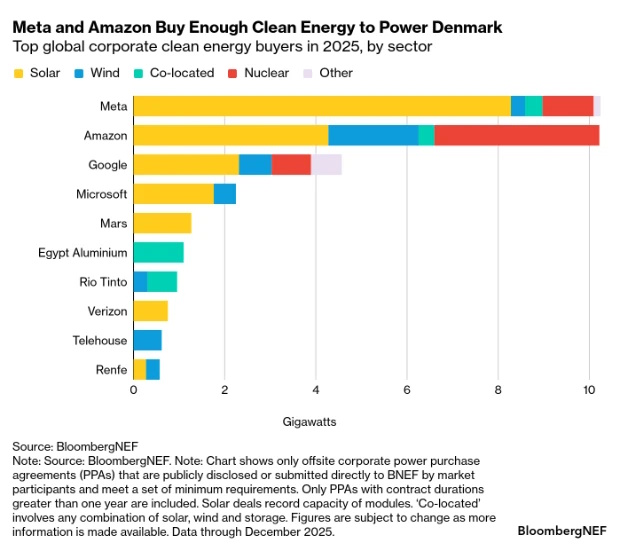
The top seller was Engie, with 3.6 GW, BNEF’s data showed.
Developers offering “clean, firm power” solutions are top global sellers. They include co-located solar and storage, hybrid solar and wind, and nuclear PPAs. These “baseload-like” products accounted for 5.2 GW of activity, according to the report.
BNEF describes firm power deals as the ones for sources capable of securing baseload, but also flexibility.
Two forces are reshaping the market
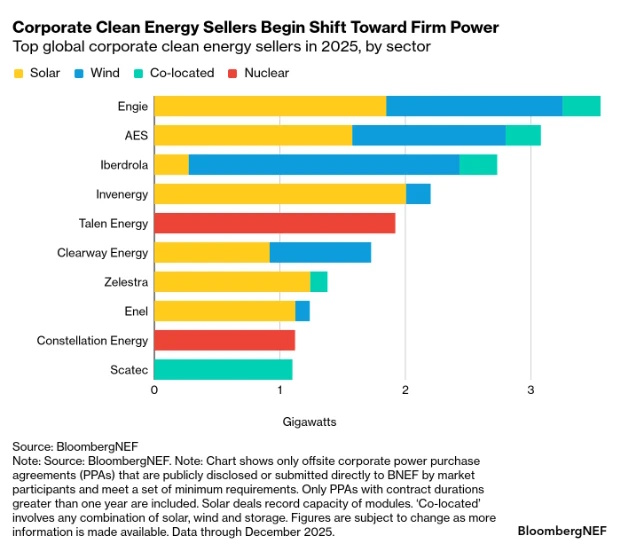
Rapidly increasing hours of negative power prices and regulatory shifts are eroding the value of standalone solar and wind deals, pushing buyers toward hybrid and more sophisticated deals, BNEF stressed.
According to the report, the Greenhouse Gas (GHG) Protocol – the global standard for corporate carbon accounting – is updating its scope 2 emissions standards with proposed amendments potentially requiring hourly tracking and stricter geographical boundaries for indirect electricity, heat, steam and cooling purchases.
Under an hourly tracking regime, 100% renewables claims will become harder to justify for most buyers, BNEF pointed out.
Corporate clean energy buyers are already preparing for this change, with 5.8 GW of co-located and hybrid deals tracked in 2025, it added.


Be the first one to comment on this article.