







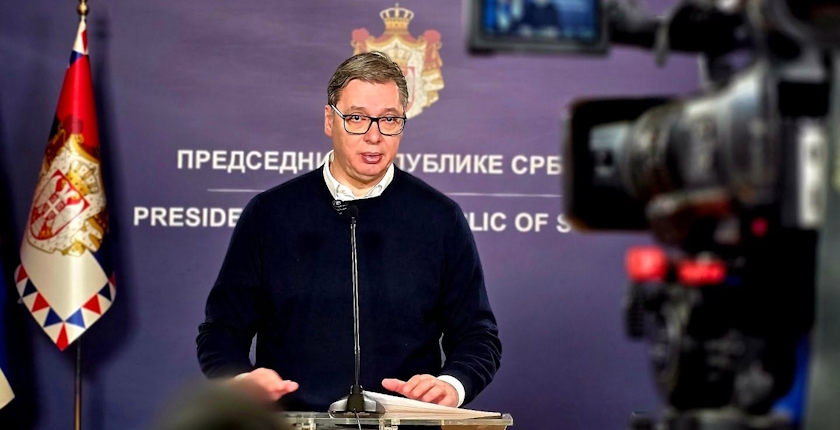
Photo: Aleksandar Vučić / Instagram


The United States and United Kingdom imposed sanctions on Gazprom Neft and other Russian companies as well as on vessels and individuals. Russian state-owned Gazprom’s oil subsidiary holds 50% in Serbian oil refiner and fuel distributor NIS, while the parent company controls another 6.2%. President of Serbia Aleksandar Vučić said the move means Russia must completely exit ownership.
The United States has introduced sanctions against Russian oil extraction companies Gazprom Neft and Surgutneftegas, the Office of Foreign Assets Control (OFAC) said. It is a division of the Department of the Treasury. American entities are now obligated to wind up operations with the two designated firms by February 27.
OFAC said the new measures fulfill the commitment of the Group of Seven (G7) to reduce Russian revenues from energy. The sanctions, imposed because of Russia’s invasion of Ukraine, include an unprecedented number of oil-carrying vessels, many of which are part of the “shadow fleet,” opaque traders of Russian oil, Russia-based oilfield service providers, and Russian energy officials, according to the statement. Simultaneously, the United Kingdom sanctioned Gazprom Neft and Surgutneftegas.
The sanctions package affects Serbia’s flagship oil importer and refiner NIS, which is 50%-controlled by state-owned Gazprom Neft. The Russian firm’s parent company Gazprom, which is not under direct sanctions, holds another 6.2%.
NIS is under secondary sanctions risk
Serbia holds 29.9% of NIS. The company also operates a chain of service stations, including in neighboring Bosnia and Herzegovina, Romania and Bulgaria.
OFAC explained that NIS is under secondary sanctions risk under US executive order 14024 and other legislation. It means it could also be targeted for transactions with Gazprom Neft.
President Vučić claims Russia’s exit from ownership is imminent
Nevertheless, the new sanctions mean that Russia must completely and urgently exit ownership, according to Serbian President Aleksandar Vučić. Immediately after OFAC’s announcement, he said his country’s authorities would discuss the matter with American, Chinese and Russian officials.
US Deputy Secretary of State for Management and Resources Richard Verma and Assistant Secretary of State for European and Eurasian affairs James O’Brien have already arrived in Belgrade. The new sanctions are a comprehensive hit against Russian companies, Vučić pointed out and said he would meet the US delegation tonight and in the morning.
The ownership change must be initiated immediately and approved by OFAC, Serbia’s president said
If Russia sought to sell the shares of Gazprom Neft and Gazprom, it couldn’t sell them to any company, as the buyer would instantaneously come under sanctions, the Serbian head of state stressed. NIS will be able to operate regularly, but the ownership change must be initiated right now and also approved by OFAC, Vučić said.
By February 25, the entire transaction must be closed, not just signed, he underscored. There is a possibility to delay a part of the payment for a certain share by March 12, but only if OFAC approves it, the president asserted.
Vučić said last month that the US would impose sanctions on NIS and block the inflow of oil through the JANAF pipeline. It is Serbia’s only supply source, running from the port of Omišalj in Croatia.
A rumor emerged lately on social networks that Shell would take over NIS.
Similarly, under political pressure and affected by sanctions, Russian privately owned oil refiner and fuel station operator Lukoil is selling its business in Serbia’s neighbor Bulgaria. Hungarian company MOL expressed interest in the purchase, as did, reportedly, Kazakhstan’s state-owned KazMunayGas.



Be the first one to comment on this article.