

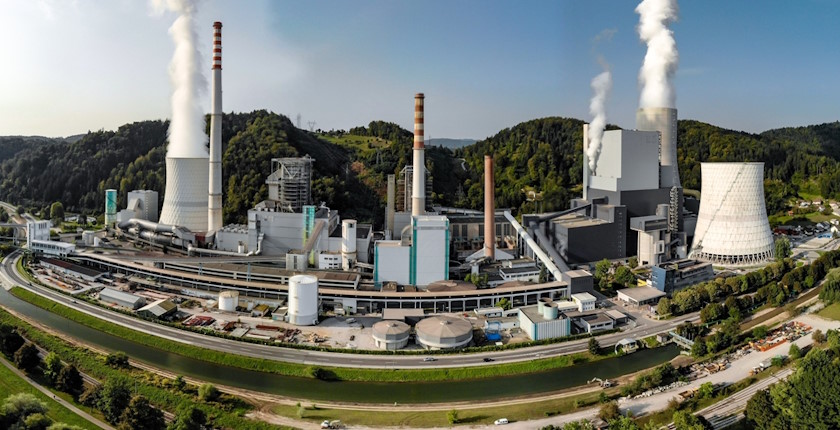
Studies are set to be produced by mid-year as part of preparation for the possibility of separating Slovenia’s only coal power plant Termoelektrarna Šoštanj (TEŠ) and its coal mine Premogovnik Velenje from state-owned Holding Slovenske elektrarne.
Slovenian Sovereign Holding (SSH or SDH) has revealed, among the key projects in its latest annual plan, that it may spin off a “thermal energy company” from HSE, the country’s biggest electricity producer. The subsidiary, also fully controlled by the government, said it would carry out preliminary preparatory activities for the possibility of separating the coal assets, as quoted by Naš čas.
The move is in line with Slovenia’s coal phaseout strategy and in view of the fact that electricity production in coal plant Termoelektrarna Šoštanj would be highly unprofitabile, especially from 2025 onwards, but also given its role in the national electricity system, Holding Slovenske elektrarne pointed out. The macroeconomic, technical, socio-economic and other analyses will include the lignite production segment, it added.
TEŠ is supplied by the Premogovnik Velenje coal mine, also the only one of its kind in Slovenia. The first phase of preparations is scheduled to be completed by mid-year.
Other Balkan states to closely watch coal spinoff process in Slovenia
Other Southeastern European countries with state-owned coal plants and mines, except Romania, still hold them in power utilities together with hydropower facilities and other assets.
In the rest of the region, coal plants and mines are in the same government-controlled power utilities as hydroelectric plants and other facilities
Such obsolete systems are becoming an ever heavier financial burden. Namely, In the European Union, the cost of carbon dioxide emission certificates is almost as high as prices on electricity exchanges. As for the Western Balkans, which aspire to join the 27-member bloc, they are facing the EU’s Carbon Border Adjustment Mechanism (CBAM), essentially a CO2 tax for imports in the EU.
In addition, it is becoming more difficult for companies with portfolios that are problematic on the climate front to obtain sustainable financing. Slovenia’s decisions will be closely watched in the rest of the region.
Slovenia bracing for EUR 2 billion loss from coal assets
The idea is for TEŠ and the coal mine to form a company under direct state ownership. They are expected to generate a combined loss of EUR 2 billion within a decade, according to Necenzurirano.si. The news outlet noted that the spike in electricity prices during the energy crisis brought relief to TEŠ.
The Šoštanj plant lost EUR 280.4 million in 2020 while in the following two years it was around breaking even. But HSE was still struck a heavy blow from expensive power imports, prompting a government bailout worth EUR 492 million in late 2022.
Just before the turn of the year, Holding Slovenske elektrarne said it returned another EUR 100 million or EUR 342 million in total.
The national strategy from two years ago envisages a coal phaseout by 2033. The government will need to provide more detailed plans and legislation to get a green light from the European Commission to keep TEŠ afloat.
The coal plant’s remaining two turbines have a combined capacity of 844 MW. HSE has 2.09 GW in total, of which its 17 hydropower plants account for 888 MW and 27 small hydroelectric units have 24 MW overall. The holding has 142 MW in gas turbines, of which two out of four are in TEŠ, another 11 MW in solar power and 180 MW in its pumped storage hydropower plant Avče.