


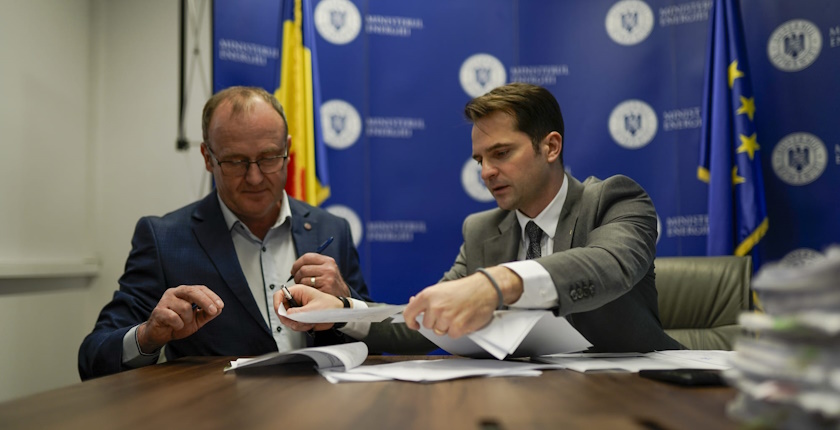
Romanian Minister of Energy Sebastian Burduja signed 113 grant contracts for photovoltaic systems for self-consumption, mostly with local authorities. The package for 41.7 MW in total is worth EUR 63.6 million.
Prosumers and their solar power installations are one of the main pillars of the energy transition in Romania. Among households, small firms and institutions, municipal authorities are emerging as a significant segment. Some are even planning utility-scale photovoltaic plants. Through the European Union’s Modernisation Fund, local authorities have just obtained grants under a program for renewables with energy storage, for self-consumption.
The Ministry of Energy said the package for public entities for PV facilities is worth EUR 63.6 million. Minister of Energy Sebastian Burduja signed 113 funding contracts for an overall 41.7 MW. There are 91 communes, nine towns and six municipalities among the beneficiaries, according to the list
The remaining ones are municipal hospitals in Salonta in Bihor county and in Rădăuți in Suceava, and the Sihăstria monastery in Neamț county.
Burduja: Municipal authorities to lower utility costs with solar power installations
The contracts will help local authorities reduce utility costs and cover energy consumption in schools, kindergartens, health centers and public lighting, Burduja pointed out.
“We are in a politically complicated moment. Romania is in the middle of a scenario that no one imagined, and the danger is clearly seen in the anti-democratic influences from the East, influences that, at least in the energy sector, Romania escaped through investments. This is what I prioritized in my mandate: investments, investments, investments. For me, obtaining EUR 14 billion in grants under funding contracts represents an important step in ensuring Romania’s energy independence and security,” the minister stated.
The money saved will return to the community through new investments, Burduja underscored.
Grant program for PV systems for households cracking from bottlenecks
On the other hand, the country’s program for grants for solar panels, mostly for households, is facing substantial difficulties. The Casa Verde Fotovoltaice scheme, worth billions of euros, grew rapidly.
Now many certified installers can’t handle the load and some have even shut their businesses down. Beneficiaries already paid a relatively small amount to participate, but grant payments are conditioned by deadlines. Furthermore, thousands of new prosumers are waiting for months to get their completed installations online.