

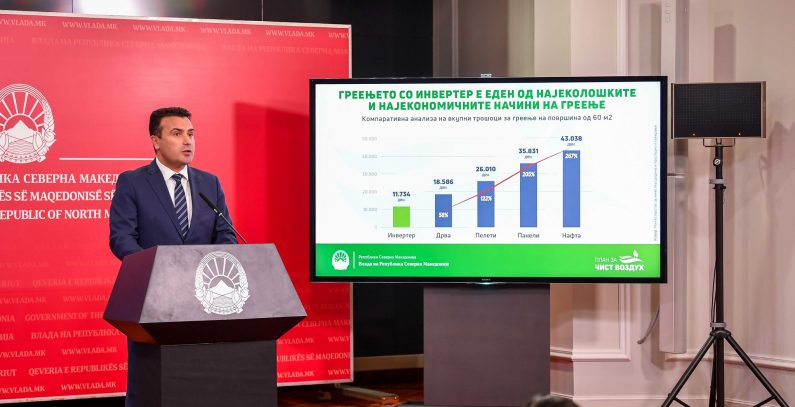
North Macedonia’s state-owned power company Elektrani na Severna Makedonija (ESM) has set aside EUR 10 million in subsidies for the purchase of inverter air conditioners as part of the government’s Clean Air Plan, Prime Minister Zoran Zaev has announced.
ESM has set aside the EUR 10 million for the first program phase, with 10,000 households in the most polluted Macedonian cities – Bitola, Kičevo, Tetovo, and Skopje – to receive EUR 1,000 each to help them buy inverter air conditioners and stop burning fuels with high CO2 and harmful particulate matter (PM) emissions, according to the Government of North Macedonia.

These fuels include wood, coal, and oil, which people burn in inefficient furnaces and stoves, contributing to major pollution levels in winter months.
A study conducted by the Finnish Meteorological Institute (FMI) as part of a twinning project with the Ministry of Environment and Physical Planning has confirmed that 90% of PM emissions in North Macedonia is caused by heating.
Subsidies for the procurement of high-efficiency inverter air conditioners will be handed to 5,200 households in Skopje, Europe’s most polluted city, 2,500 households in Bitola, 1,500 households in Tetovo, and 800 households in Kičevo.
Environmental activists, however, took to Twitter to warn that it would be more appropriate for the Energy Efficiency Fund to finally start functioning than to award subsidies for the procurement of inverter air conditioning, whose use benefits the electricity market.
Се плашам дека за проблемот со #аерозагадување не размислуваме долгорочно. Да, инвертери се подобри од печки на дрва или пелети, ама струјата во мк ќе поскапи за 30%. А, парите за субвенции на инвертерите ги доделува ЕСМ со интерес во пазарот со струја.#Прашањакоимемачат
— Ana Colovic (@AnaColovic_) October 5, 2019
Davor Pehchevski of CEE Bankwatch Network said that a large amount of money will be disbursed in only four cities and end up in the pockets of a few home appliance vendors, without so much as analyzing whether this would be a discriminatory measure or whether it would distort the market.
Стотици милиони денари ќе се поделат само во четири града и ќе завршат во неколку фирми за електрична опрема, без да се оцени дали таа мерка е дискриминаторска или ќе го наруши пазарот.
— Shokunin (@dpehche) October 9, 2019
Skopje has already undertaken a number of measures over air pollution, such as supplying classrooms with air purifiers.
Data concerning mean concentrations of PM10 and PM2.5 for 2018, published earlier by the World Health Organization (WHO), rank Skopje as Europe’s most polluted capital city, with PM2.5 values four times the recommended levels.