


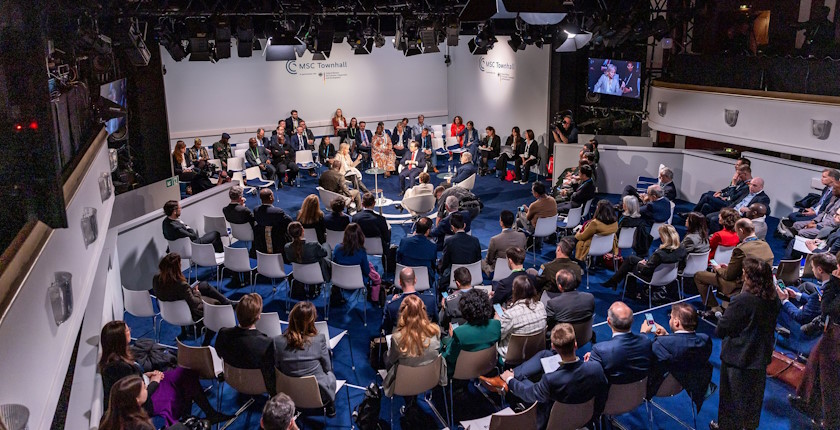
There is no European or national security without energy security, which was one of the factors discussed at the Munich Security Conference. The EU has to comprehensively tackle the challenges from the areas of gas supply and power grid stability to cyberattacks and physical sabotage, Eurelectric warned in a new report. Presenting the conclusions from Europe’s flagship security event, leading global energy expert Gerard Reid pointed out that AI and digital technologies, which are increasingly important for the power system, are evolving so rapidly that Europe is struggling to keep up, at risk of becoming irrelevant.
Faced with the coronavirus pandemic, the war in Ukraine and a full-scale energy crisis in recent years, the European Union showed by adopting an “urgency mentality” that it is “a force that can move mountains,” European Commission President Ursula von der Leyen said at the Munich Security Conference – MSC. In her view, Europe can master the moment, but it “must adopt this urgency mentality more permanently.”
The event was held at a time when the new administration of United States President Donald Trump is shaking up global and bilateral relations including in the energy sector. The Russia-Ukraine war, conflicts in the Middle East, trade wars and climate risks all remain burning issues affecting energy security.
“We have broken one taboo after another and smashed our reliance on Russian gas, making us more resilient – permanently,” Von der Leyen stated.
On the other hand, there is growing concern among buyers of natural gas in the market about dwindling volumes in storage, recently dropping below 50%. Driven by a relatively colder winter, it increases upward pressure on both gas and electricity prices, already extremely high compared to other biggest economies.
Reid: European energy system under cyberattacks every day
The world order is changing, and Europe is at risk of becoming irrelevant, according to one notable participant at the Munich Security Conference – Gerard Reid, a strategy advisor and financier in the energy transition segment. He drew his conclusion from presentations and conversations, the tone, the inability to make decisions and the shifting alliances.
In Reid’s view, technology, and particularly AI, is evolving so rapidly that Europe is struggling to keep up.
“Energy security is national security, and the reality is that every single day, the European energy system receives some form of cyberattack. And it’s not just hackers messing around, there are also physical attacks taking place, particularly in the Baltic Sea where we have seen a series of attacks on pipelines, underwater power cables and telecommunications infrastructure,” he wrote on LinkedIn.
The power system needs to be built to withstand increasing climate risk as well as manmade attacks, global energy expert Gerard Reid underscored
In addition, Reid, who’s a cofounder and partner at Alexa Capital, highlighted the risks associated with widespread blackouts, arguing that the power system needs to be built to withstand increasing climate risk as well as manmade attacks.
“One of the biggest debates in Munich was about energy costs, particularly natural gas prices, which are over three times more expensive in Europe than in the US. There’s also growing concern over whether Europe will have enough gas for next winter, but fears of EU and German government intervention have created the absurd situation where summer gas prices are higher than next winter’s prices! Meanwhile, speculation is swirling that negotiations are taking place to allow Russian gas to flow to Europe via Ukraine again. Officially, EU leaders say this will never happen. But history tells us: never say never!” he stressed.
According to Reid, Europe needs to invest in energy security to ensure 24/7 delivery of low-cost energy.
Eurelectric calls for redefining energy security
Cables in the Baltic repeatedly sabotaged, devastating storms leaving Ireland in the dark, war raging in Ukraine and price shocks caused by Russia’s fuel disruptions: Europe’s energy system is being challenged like never before, said Eurelectric – Union of the Electricity Industry, in a new study. It published the document Redefining Energy Security In the Age of Electricity in cooperation with Compass Lexecon and unveiled it at the Munich Security Conference.
“The recent year has shown us that business-as-usual in Europe is no longer an option. With the threats faced by our sector, security of supply is becoming an urgent priority that policymakers and regulators must acknowledge,” said Eurelectric’s President and E.ON’s Chief Executive Officer Leonhard Birnbaum.
Birnbaum: Security of supply is becoming an urgent priority that policymakers and regulators must acknowledge
The organization pointed to the impacts from disturbances in pipeline gas supply, Russian attacks on the Ukrainian energy infrastructure as well as cyberthreats. It called for developing a new, comprehensive approach to energy security with an increasing role for electrification.
Exogenous factors for a new European energy security strategy include geopolitical developments, resilience and the climate, the study reads.
Among the endogenous risks is the high penetration of variable renewable energy sources, predominantly solar and wind, the authors said. The balancing of supply and demand at all times requires special focus on the deployment of flexibility in the system, as well as the strategic expansion and digitalization of the power grids, they concluded.
EU needs energy security strategy encompassing entire value chain, possibly all energy vectors
The energy crisis showed how the security of supply is tied to affordability and external challenges, such as reliance on critical materials, the growing complexity of the electricity system, vulnerability to cyberattacks, and the impact of geopolitical tensions on costs, the study adds.
“A more integrated approach should streamline, consolidate and ensure consistency across the different planning tools already included in EU and national laws. It should consider the entire value chain and possibly all energy vectors (electricity, gases, heat, transport, etc.) – upstream, downstream, and end-use sectors – to better identify system needs and options for decarbonisation and electrification,” the authors wrote.
A higher degree of digitalization makes the power system more vulnerable to cyberattacks
The study highlights three dimensions. Clean security is clean electricity supply to ensure a decarbonized system and reduce dependency on fossil fuels.
The second one is physical security: the ability of the electricity system to guarantee electricity supply to consumers with a clearly established level of performance. Economical security is the affordability of electricity supply available to consumers to protect against demand destruction.
As for digitalization – information and communication technologies (ICT) in general – it plays a crucial role in improving real-time coordination, the document adds. As the power system grows more complex, the importance of digital solutions grows exponentially, the authors said.
They stressed that digitalization brings new challenges, underscoring that electricity stands as one of society’s most critical sectors. The higher degree of power system digitalization may make it more vulnerable to cyberattacks, which doubled between 2020 and 2022 in the energy sector, the study reads.