


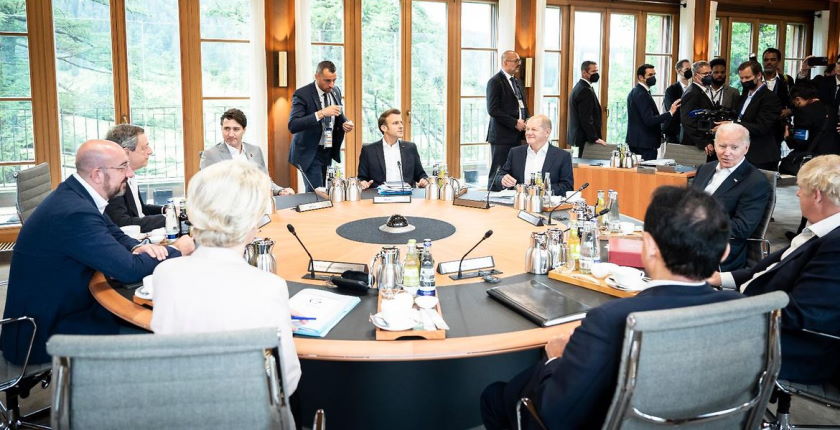
The Group of Seven formally kept its climate pledges, but urged for an increase in energy production to secure supply and overcome the energy crisis. The leaders backed the deployment of gas, particularly LNG, and nuclear power. The G7 committed to eliminating fossil fuel subsidies. Still, its member countries lately allocated huge sums to limit consumers’ energy bills.
After their summit in Germany, the leaders of the world’s biggest economies excluding China and India focused their joint statement mostly on measures to isolate Russia because of its attack on Ukraine and to reduce the dependence on Russian fossil fuels. The G7 pointed to the fallout from the energy crisis and highlighted the importance of the security of supply.
The G7 adopted a stance similar to the EU, which has endorsed gas and nuclear energy as transitional technologies
Mirroring the shift in climate policy of its members, particularly in the European Union, the group urged for the acceleration of decarbonization efforts while at the same time promoting fossil gas and nuclear energy. The G7 said the global economy should be based on low-carbon and renewable energy sources. It promised to make the power sector “fully or predominantly decarbonized” by 2035.
Formally, the communiqué prioritizes sticking with the goal from the Paris Agreement and other treaties to limit global warming to 1.5 degrees Celsius. Achieving net zero emissions from international aviation and shipping by 2050 and cutting global anthropogenic methane emissions by at least 30% by 2030 are among the targets.
Paradox in new version of energy transition
Coal remained the biggest adversary. The G7 said it would accelerate the phaseout of domestic unabated coal power generation. Unabated means without measures to prevent emissions and control pollution. However, the most influential intergovernmental forum has a different stance toward some technologies that were being marginalized to a certain extent until the energy crisis erupted.
Investment in LNG is necessary in response to the current crisis, according to the G7
“We commit to end new direct public support for the international unabated fossil fuel energy sector by the end of 2022, except in limited circumstances clearly defined by each country consistent with a 1.5°C warming limit and the goals of the Paris Agreement. In this context and with a view to accelerating the phaseout of our dependency on Russian energy, we stress the important role increased deliveries of LNG can play, and acknowledge that investment in this sector is necessary in response to the current crisis. In these exceptional circumstances, publicly supported investment in the gas sector can be appropriate as a temporary response, subject to clearly defined national circumstances, and if implemented in a manner consistent with our climate objectives and without creating lock-in effects, for example by ensuring that projects are integrated into national strategies for the development of low-carbon and renewable hydrogen,” the statement reads.
Similarly to what happened in the European Union, the G7 now wants faster deployment of renewables, but with exceptions for gas, particularly liquefied natural gas (LNG), and for nuclear power. Such a paradox makes energy and climate policies unclear and raises the question of priorities and the availability of funds for all the initiatives at the same time.
Role of gas, nuclear power in hydrogen production
Promoting so-called low-carbon hydrogen and sources opens the way for the use of more gas, ideally including carbon capture and storage equipment, and nuclear power.
The G7 reaffirmed its “commitment to the elimination of inefficient fossil fuel subsidies by 2025.” Actually, its members churned out billions of dollars since the start of the energy crisis to shield households and the overall economy from rising bills.
The leaders of the most industrialized nations failed to lay out a mechanism for phasing out fossil fuel subsidies
The measures range from subsidizing fuel prices directly at the pump to incentives for coal plants. Indirect subsidies include cutting fuel taxes and limiting electricity and heating bills for consumers. There was also no mention of a mechanism for phasing them out by 2025.
Ahead of key negotiations about the reform of its Emissions Trading System or ETS, EU institutions have watered down the initial proposals, which is set to bring relief to users of fossil fuels in the industry.
The G7 also encouraged an increase in energy production to curb market prices and praised the Organization of the Petroleum Exporting Countries (OPEC) for lifting output.
As for nuclear energy, the leaders have put an emphasis on the deployment of advanced technologies including small modular reactors, SMRs.