


The European Commission scheduled for March 25 the declaration of the first batch of strategic projects under the European Union’s Critical Raw Materials Act. Rio Tinto has submitted its controversial Jadar project, for a lithium mine and processing plant in Serbia.
In addition, the administration in Brussels said it would extend the Carbon Border Adjustment Mechanism to certain downstream steel and aluminum products, also within the package of measures to decarbonize and safeguard metals production.
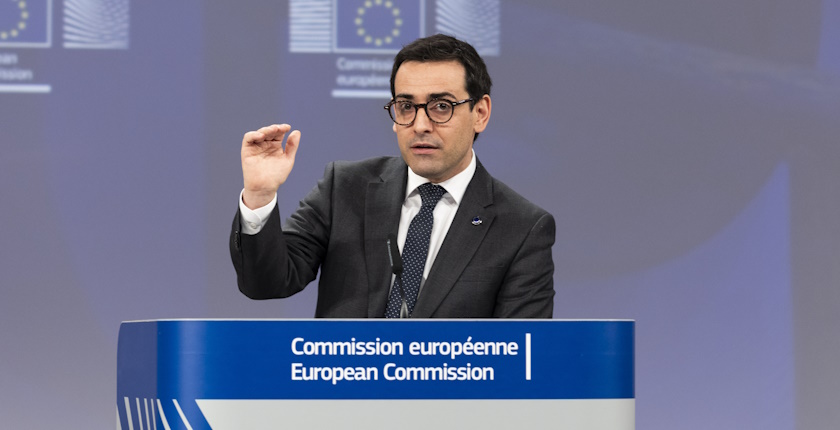
Presenting the new Action Plan on Steel and Metals, the European Commission’s Executive Vice President Stéphane Séjourné, in charge of prosperity and industrial strategy, vowed to secure the supply of essential raw materials. He revealed that on March 25 he would identify the first group of strategic projects facilitated through the Critical Raw Materials Act (CRMA).
The legislation was much criticized before it was adopted a year ago. One of the candidates is Rio Tinto’s disputed Jadar project in Serbia. The mining giant is planning underground exploitation of lithium and the construction of a processing facility. The area, near the city of Loznica in the country’s west, is populated and dependent on agriculture.
The CRMA legislation enables strategic partnerships centered on projects for raw materials in third countries, such as Serbia
The controversy over the investment has prompted some of the most massive and widespread protests, held in several waves since 2021. Balkan Green Energy News has a chronological overview of the key events in the development of the Jadar project since 2001, when Rio Tinto arrived in Serbia.
Serbia and the EU signed a memorandum of understanding in Belgrade last year for a strategic partnership in sustainable raw materials, battery value chains and electric vehicles.
Séjourné announced that he would present “dozens of critical raw materials projects.” However, he highlighted only aluminum, copper, nickel and “many steel alloying elements,” without mentioning lithium. The administration in Brussels said it would streamline permitting and simplify access to public funding for strategic projects for raw materials, at home and in third countries.
EU to help metal exports competitiveness
The European Union outlined the measures in the face of tariffs imposed by the United States and much higher energy prices than across the Atlantic and in China. The changes would include incentives for decarbonization and quotas for domestic green steel in public procurement and for recycling.
One of the main tools is the Carbon Border Adjustment System or CBAM, which is undergoing a review. The EU has increased its ambition for reform, according to Séjourné.
The steel and metals industry in the EU is facing a serious crisis and trade tensions have not helped matters, Séjourné acknowledged
“By the end of the year, we will be presenting measures to reinforce CBAM’s action. These will operate in three directions: exports, anti-circumvention measures, and the extension of the products concerned. Our producers cannot be the most virtuous and the most penalized on the international market. Finally, we’ll also be looking at modifying the rules of origin to prevent foreign steel from undergoing a simple minor transformation in Europe, and then being sold as a European product,” the top industrial policy official stated.
The European Commission stressed that it would table the first legislative proposal amending CBAM by the end of the year to extend its scope to certain steel and aluminum-intensive downstream products.
Incentives to use nuclear power in hydrogen production
The steel and metals industry in the EU is facing a serious crisis, between an explosion in electricity prices and global overcapacity, Séjourné acknowledged, adding that “trade tensions have not helped matters.” The action plan involves spurring massive investments in hydrogen.
Support is underway for low-carbon hydrogen, “particularly in conjunction with nuclear power,” the European Commission’s vice president said. The EU has until now refrained from subsidizing nuclear energy projects. However, it is preparing a package for the development of the technology for small modular reactors (SMRs) and scientific research.
Electrolyzers powered by nuclear plants produce so-called pink hydrogen. Another low-carbon version is blue hydrogen, made directly from methane – fossil gas, but with the carbon dioxide emissions captured and (permanently) stored. Green hydrogen is the one from water electrolyzed using renewable electricity.