


The Salonit Anhovo cement maker won the European Bank for Reconstruction and Development (EBRD) bronze Sustainable Energy Award for the progress it achieved in using non-hazardous solid recovered waste in its energy mix. Another reason for the award to the Slovenian company is the fact that it lowered its pollution to levels that the cement industry is expected to achieve in 2030.
Salonit Anhovo is presently at levels expected for the industry in 2025 in terms of specific heat consumption and in 2030 in terms of clinker ratio in cement and specific CO2 emissions, the EBRD said in a statement.
The Slovenian company has introduced a new system allowing it to increase levels of alternative fuel substitution from the current 60 per cent to more than 75 per cent which means CO2 emissions lower by more than 10,000 tons per year. The plant will achieve a carbon emission intensity substantially below the relevant EU benchmark, the EBRD said.
The investment was financed with a EUR 15 million EBRD loan in December 2016.
The operating costs of the plant will also be lowered because of the altered fuel composition is to reach a 75 percent share of non-hazardous solid recovered waste.
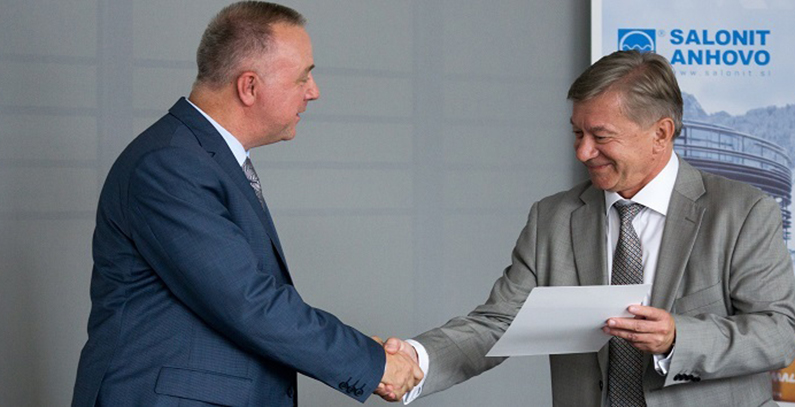
The prize was presented by EBRD Director, Environment and Sustainability Department Dariusz Prasek at a ceremony in Ljubljana attended by Slovenian Minister of the Economy Zdravko Počivalšek and EBRD Ljubljana office chief Jolanta Gabriel.
Prasek told the ceremony that Salonit Anhovo’s use of alternative fuel is an excellent example of how an innovative, tailor-made solution can benefit both finances and the environment.
Minister Počivalšek recalled that cement production requires high levels of energy consumption, adding that the company’s solution brings important business and environmental improvements.
Salonit Anhovo Chairman of the Board Julijan Fortunat said the innovative solution was made by the company development team based on 30 years of experience using waste as fuel.
The EBRD presents Sustainability Awards in three categories – Sustainable Energy Award, Climate Change Adaptation Award and Environmental and Social Innovation Award.
Cement production accounts for about five percent of CO2 emissions globally and about 40 percent of that is the result of burning fuel to produce heat for the production process.
Under the Kyoto protocol the European Union is committed to reduce greenhouse gas emissions which includes those from the cement industry but the levels of pollutants from that industry is regulated individually by the member states which set the limits of pollutants in emissions from cement plants.