





Photo: Balkan Green Energy News


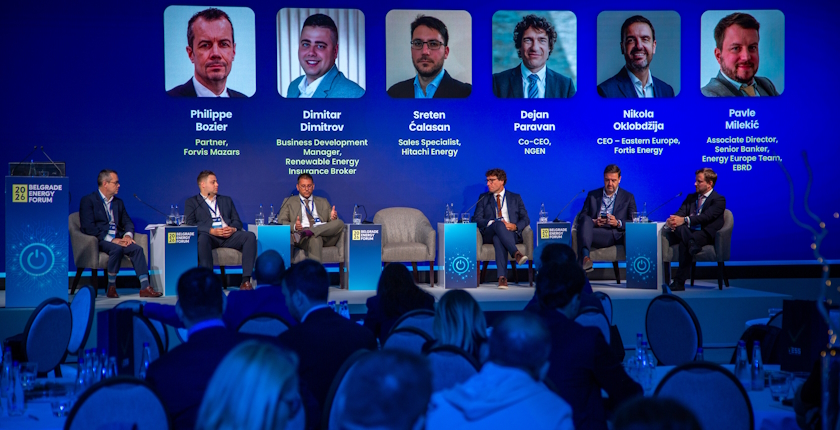
Battery storage is becoming conventional and a critical element of the electricity system, according to a panel held at Belgrade Energy Forum – BEF 2026. From the viewpoint of financing, investment and technology sectors alike, countries in Southeastern Europe must show clarity and enable operators to participate in multiple markets. They range from arbitrage to low-voltage grid services or even black start capabilities. The speakers highlighted the importance for system stability and renewables uptake, alongside investment feasibility and the selection of optimal equipment.
Within a single decade, battery energy storage systems – BESS leapt from obscurity and a niche position to a necessity for the energy transition. At Belgrade Energy Forum 2026, a panel titled From Intermittency to Reliability: BESS Integration in SEE recalled the sharp drop in prices of the technology in parallel to its improvement. The participants agreed that greater availability in the region implies a more detailed business case – required for financing and investment – meaning that legislation and regulation need to align with the needs of the electricity system and lay out the path ahead.
Therefore, they concluded, operators of battery storage in Southeastern Europe, including co-located facilities, would need to simultaneously work in energy arbitrage and several types of ancillary grid services.
Generating electricity is increasingly less valuable than storing it
The panel focused on what makes a battery endeavor achievable and financeable in the region, hurdles between a project and the necessary funds, and what can be done to speed things up. In the speakers’ view, transparency regarding the available revenue streams provides the parameters for choosing the equipment. As the market is growing, more factors are coming into the equation for credit packages and insurance, all the way down to servicing and maintenance. But especially the frequency and depth of the charging and discharging cycle.
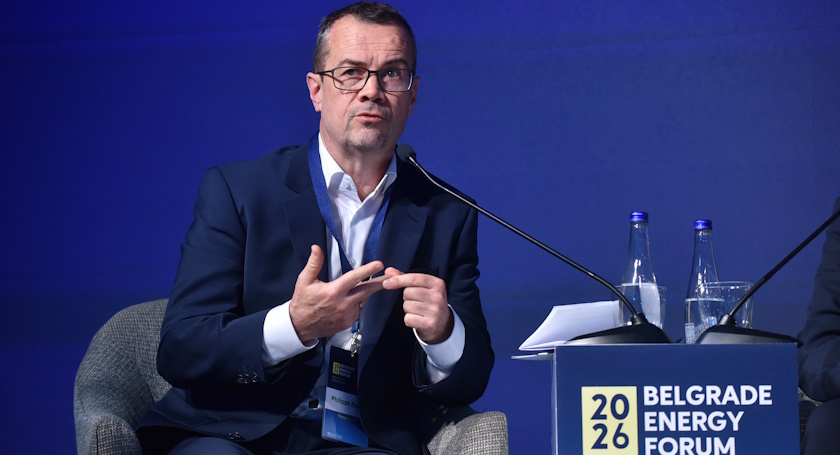
Partner at Forvis Mazars Philippe Bozier, the moderator, observed that generating electricity is increasingly less valuable than storing it. A developer currently can’t even present a project for financing if its name doesn’t include BESS, he stressed. “Everybody admits that batteries are becoming a critical element of any energy system,” Bozier asserted.
BEF 2026 was the fourth annual edition of the conference, organized by Balkan Green Energy News in Serbia’s capital city.
BESS is tool for smoothing out volatility
NGEN Group’s Co-Chief Executive Officer Dejan Paravan said there are two approaches to BESS.
“Someone with money sees a good investment, to bring some return from the volatility of the markets. The other way is that you are faced with increasing market volatility and you want to invest in the battery actually because it helps to manage the volatility of your portfolio,” he explained. For the second approach, the company counts not only on utility-scale battery systems, but also the ones for customers in the commercial and industrial (C&I) sphere that want to manage their energy costs.
Paravan noted that high penetration of renewables is fueling volatility, evident in the shape of day-ahead power prices, and affecting the ancillary services market, as the needs of transmission system operators (TSOs) are increasing. The third point where BESS helps are the congestion issues at places where the grids, including on the low-voltage level, were built decades ago and can’t adequately handle distributed sources.
NGEN Group developed its own technology for battery optimization, market access and algorithmic trading. “It’s many, many, many decisions per day. So this can be done only in an automated, very structured way. It is the only way that you can switch between different markets, different revenue streams… Everybody knows that to monetize a battery, you need multiple revenue streams,” Paravan underscored.
The company is in a huge scaling phase, investing throughout Europe, he added.
Revenue stack in Serbia yet to be outlined
In Serbia, all that operators of co-located BESS can do is peak shaving, and to charge when prices are low, for discharging later, said Nikola Oklobdžija, Fortis Energy’s CEO for Eastern Europe. Other revenue streams aren’t defined yet. The biggest question for investors is whether arbitrage would be introduced – charging from the grid, for discharging back to the grid, he pointed out.
Fortis Energy expects its Noćaj project to come online in the first quarter of 2028, Oklobdžija said. He expressed hope that the authorities would operationalize the grid arbitrage and ancillary service markets by then.
Early investors in Serbia have sized their planned batteries at the minimum level that the law defined for avoiding grid connection delays
When Serbia introduced an energy storage requirement as a way for wind power and photovoltaic projects to avoid delaying the connection to the grid, most developers applied just for the minimum defined by law, Oklobdžija asserted. It is a 20% equivalent in operating power terms, times two hours, which is 0.2 MW and 0.4 MWh, respectively, per 1 MW of the renewable electricity plant’s intended capacity.
“This conservative approach is a direct consequence of the regulatory vacuum: in the absence of defined auxiliary service markets or grid arbitrage revenues, developers have had little financial incentive to invest in larger storage capacity. A fully developed revenue stack would have prompted substantially different sizing decisions. Banks and lenders assess BESS projects in part based on average daily cycling rates – a metric that directly reflects revenue-generating potential. Without diversified income streams, that case is inherently weaker,” Oklobdžija separately told Balkan Green Energy News.
Fortis Energy has applied for a grid connection study in Serbia a couple of months ago for a standalone battery system, he said.
High regulatory risk amid variety of BESS revenue stack options, timeline unknowns
In some ways, BESS is now conventional, as any bank can finance a project that has a tolling agreement in place, said Pavle Milekić from the European Bank for Reconstruction and Development (EBRD). “If we look at hybrid co-located PV and BESS, that’s now becoming almost mandatory. That’s something that we’d be happy to finance. It’s what we want to see on a solar plant,” he explained.
The lender is willing to look at all available revenue streams, but it’s very much tied to the actual country specifics, he underscored and said there is no such thing as a standard BESS financial product.
“We don’t finance BESS. We finance BESS cash flows and need to understand how can you monetize it so that we can then shape the debt and structure the debt around it. You’re playing on multiple markets. It could be the day-ahead market arbitrage or intraday arbitrage, but then you have the ancillary services, black start capability… All of this is regulatory risk,” Milekić added. He is an associate director and senior banker at the EBRD’s Energy Europe team.
The markets that an asset could participate in are ultimately a reflection of the underlying physical infrastructure in the country, Milekić added.
“What provides balancing? Is it hydro? Is it pumped storage? A large percentage of renewables? All of those things are going to be affecting the pricing in those markets,” he said.
All ancillary services in Croatia will open up, but when
EBRD’s first equity investment in BESS is a project in Šibenik, Croatia. It is for 60 MW and 120 MWh, and NGEN is responsible for the technology.
Eventually, all the ancillary services markets will open up in the country, but no one knows when, Milekić stressed. “This is the first project in Croatia. No one else has a grid connection. It will be the first one online and it’s going to be the most profitable. But are the ancillary services markets going to open up in six months, two years, six years? No one can underwrite that risk,” he said.
Milekić: Those batteries are going to be needed everywhere in our region
It is one of the reasons that the EBRD opted for equity investment, according to Milekić.
“The direction of travel is clear. All these markets are decarbonizing. You have more intermittent renewable energy joining the system. You have much more volatility of power. Those batteries are going to be needed everywhere in our region,” he stated, referring to the Western Balkans and Croatia.
REIB’s Dimitrov: Obtain insurance on time to avoid redoing the entire design
Business Development Manager in Renewable Energy Insurance Broker (REIB) Dimitar Dimitrov said fire safety and business interruption risk are currently the key considerations for insurers. “Also, cybersecurity has become a hot topic in the past six months. We see a lot of tension build up regarding cyberattacks. We see a lot of things happening behind the scenes, that are usually not reported in the news,” he revealed.
The right time to address the insurance considerations is during the project layout design phase, before equipment selection and financing discussions begin, Dimitrov stressed. Insurance companies have requirements based on the distance between BESS containers. As a result, the developer may be forced to redesign the entire project to avoid higher insurance costs and potentially more expensive financing, he warned.
Tension has been building up regarding cyberattacks
Certification of the equipment is crucial, too, in light of emerging industry standards. “We’ve observed a large-scale fire test performed as part of the UL 9540A testing process. In the controlled scenario, a battery container was intentionally driven into thermal runaway, while adjacent containers were positioned just 20 to 50 centimetres away. Temperatures inside the affected container exceeded 200 degrees Celsius, yet the neighbouring containers remained at approximately 15 to 20 degrees,” Dimitrov said. Even after seven hours, the fire did not spread beyond the original container,” he added.
Together with two insurers, Renewable Energy Insurance Broker has developed a BESS product with formulas for three ways of operating a battery: profit sharing, tolling and a mix of the two. REIB has insured 10 GWh in BESS projects, over 7 GW of photovoltaics and more than 3 GW of wind. It has its own assets as well.

Adding BESS to photovoltaics is necessary for stability required for financing
Hitachi Energy’s Sales Specialist Sreten Ćalasan concurred that BESS is mandatory for large-scale solar. He argued that banks are looking for stability and long-term resilience.
Targeted incentives and a well-designed market structure can be a game changer, in his view. Ćalasan highlighted the role of performance and degradation, operating lifetime and guarantees for bankability and return on investment. Cycle degradation is complex an the main thing is to know the plan for using it, he noted.
“Charge-discharge patterns, number of cycles, operation temperatures, everything is affecting the batteries. But typically from manufacturers of batteries, you have guarantees that are defined. For example, one cycle per day, and they can guarantee the performance for 10, 15, 20 years… You cannot go in deep charge and discharge all the time,” Ćalasan asserted.
Hitachi Energy doesn’t make batteries, but power conversion systems (PCS), he explained. It cooperates with all leading battery manufacturers and has more than 10 GW in projects around the world, Ćalasan said.
Case of squeezing battery systems from financing viewpoint
Also touching upon the degradation topic, EBRD’s Pavle Milekić mentioned a point of misalignment of interest between project sponsors and lenders. Namely, a sponsor might be incentivized to maximize the number of cycles in the first few years. It degrades the asset faster, leaving the bank with tail risk.
“There are ways to work around that. The classic one is simply to give a cap and say: you as a sponsor cannot cycle this battery more than x times per day. It’s good, but you’re harming the upside or limiting it, right? Or you can also, as a lender, insist on some sort of cash sweep mechanism, and say: look, if you are earning excess returns by squeezing that asset more than we anticipated, then part of that should go towards repaying the tail risk of the debt,” Milekić said.
Oklobdžija from Fortis Energy weighed in, too, acknowledging there would be opportunities to use the batteries more aggressively to catch more revenue. “But I think this is more of an extreme situation, maybe an hour, a couple of hours or a couple of days,” he estimated.
For most investors and operators, the long-term tradeoff between accelerated degradation and short-term revenue gains will not justify departing from a conservative cycling strategy, Oklobdžija wrote in a note.



Be the first one to comment on this article.