


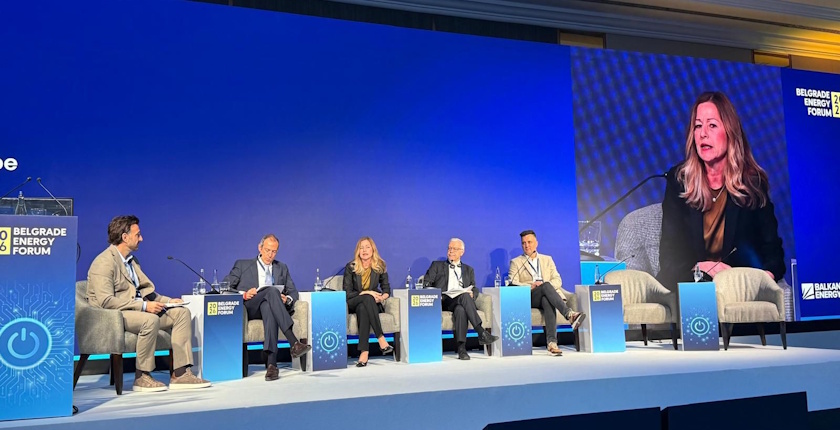
The introduction of the EU’s carbon border tax, uncertainties surrounding market coupling, and negative prices have brought about instability, which, amplified by ongoing wars, has fundamentally changed the environment for financing renewable energy projects, according to participants at Belgrade Energy Forum 2026 (BEF 2026). Still, representatives of international financial institutions, commercial banks, and investment funds advised conference participants to adapt to this volatility and prepare for a new phase in project financing.
All participants in the renewable energy market are facing a major shift in terms of financing, according to the moderator of a panel on financing, Marijan Rančić, Director of Business Development at New Energy Solutions.
“We started ten years ago with feed-in tariffs that ensured stable revenues and long-term offtake arrangements. Then we moved to auctions and merchant exposure risk. Now we are facing even greater challenges, such as negative prices, the impact of CBAM (the European Union’s Carbon Border Adjustment Mechanism – CBAM), and market coupling,” said Rančić at the opening of the panel, titled Emerging finance structures for the energy transition in Southeast Europe.
Panelists:
- Francesco Corbo, Regional Head of Energy for Western Balkans 6 and Croatia, EBRD
- Svetlana Cerović, Head of Financing, UniCredit Bank Serbia
- Reinhold Strauss, Board Member of the Green for Growth Fund (GGF)
- Vladimir Bogosavljević, Head of Business Development, MARSH
A new phase in the development of financing for green energy projects

Marijan Rančić, Francesco Corbo, and Svetlana Cerović (photo: Balkan Green Energy News)
The European Bank for Reconstruction and Development (EBRD) has been involved in all stages of the development of financial models in Serbia and the Western Balkans.
“The EBRD is here to de-risk investments and help create a market environment that is attractive to commercial banks and private investors. Our role is not primarily about volumes; our real measure of success is reaching the point where our support is no longer needed in the market,” said Francesco Corbo, Regional Head of Energy for the Western Balkans and Croatia at the EBRD.
“Back in 2017, the EBRD financed the first two renewable energy projects under Serbia’s feed-in tariff scheme. One of them was the Čibuk 1 wind farm, which remains the largest wind energy facility in Serbia. The project was financed together with UniCredit, Intesa, other private banks, and GGF,” he added.
It is encouraging that the Čibuk 2 wind project was fully financed by commercial banks
After that, there were several years without major investment in the energy sector, followed by COVID and the energy crisis. “As part of the liquidity loan provided to [Serbia’s state power utility] Elektroprivreda Srbije, we secured a commitment to organize three consecutive rounds of renewable energy auctions. The CfD scheme was launched in 2023, with projects awarded in 2024,” said Corbo.
“For us, one of the most encouraging developments in 2024 was that the Čibuk 2 wind project was financed entirely by commercial banks, without EBRD support. However, market conditions change quickly, and the role of the EBRD remains central in supporting investments in the energy sector,” according to him.
UniCredit is one of the commercial banks that has been supporting renewable energy from the very beginning.

Svetlana Cerović (photo: Balkan Green Energy News)
Svetlana Cerović, Head of Financing at UniCredit Bank Serbia, stressed that the bank’s portfolio consists of over 500 MW of projects. These include utility-scale projects as well as smaller-scale projects, often financed through the ESCO model, contributing to industry decarbonization, she said.
The bank is participating in the financing of the two largest wind parks, one in the operational phase and the other in the trial phase.
Cerović noted there are delays and bottlenecks in project execution and in bringing new megawatts to the grid. The causes are various, including decision-making related to the optimal equipment, whether it should be Chinese or European. Some are struggling to secure necessary equity, and permitting is also an issue, according to her.
The risk-optimization role of international financial institutions is crucial
“Since the beginning of this year, we have faced huge volatility. In discussions with our management, we often hear that volatility is the new normal, while our role is to adapt and be part of the solution, and to proactively support industry and clients to bring the projects to execution,” she pointed out.
UniCredit’s current pipeline is larger than its existing portfolio. The bank, according to her, is working together with different financing institutions, both commercial banks and international financial institutions (IFIs), to bring them closer to finalization.
“In times of uncertainty, the risk-optimization role of IFIs is crucial. We increasingly see these institutions acting as equity investors and deploying structured risk-sharing instruments. This is particularly important as markets face severe liquidity constraints and growing exposure to merchant risk,” Cerović explained.
One of the financiers very active in the Western Balkans is the Green for Growth Fund (GGF).
GGF supported the Bogoslovec wind farm project in North Macedonia
The fund, according to GGF Board Member Reinhold Strauss, is dedicated to supporting investments that reduce CO2 emissions and enhance resource efficiency, with a particular focus on energy efficiency. Its portfolio manager is Finance in Motion.
The private share in refinancing is growing. By now, GGF has reached roughly 35% refinancing from private sources, but it aspires to have about 50%, according to Strauss.
GGF offers the full range – from loans to equity financing. “As a public-private vehicle, it also looks for additionality. For instance, it supported wind farm Bogoslovec in North Macedonia a couple of years ago, where the fund added EUR 3,5 million of equity for a EUR 61 million project,” Strauss recalled.
CBAM and market coupling have created significant market distortions

Reinhold Strauss and Vladimir Bogosavljević (photo: Balkan Green Energy News)
Svetlana Cerović noted that CBAM is impacting the bankability of renewable energy projects by creating market liquidity constraints and reducing the supply of financial power purchase agreements (PPAs) to secure financing. Developers without long-term contracts for difference (CfDs) are also considering corporate PPAs and the integration of battery energy storage systems (BESS) to optimize revenue in an evolving market, she added.
She is confident that in the future there will be more large industrial companies that produce electricity. This model involves an ESCO company developing, building, and operating a power plant for a fee, with the industrial firm consuming the electricity from the plant installed on a roof or in the surrounding space, she explained.
“This is an alternative to long-term corporate PPAs, a way of hedging electricity price in the long term and at the same time contributing to energy saving and reducing the carbon footprint,” said Cerović.
EBRD recommends focusing on the longer-term perspective
It is currently difficult to secure corporate PPAs and strong off-takers. The introduction of CBAM and the planned market coupling, which, in the best-case scenario, could happen in Serbia in the first quarter of 2028, has unfortunately created significant market distortions, according to Francesco Corbo.
The EBRD’s recommendation is to focus on the longer-term perspective. Over the next few years, the market will adapt and mature, he said. “We expect to see more corporate PPAs, stronger off-takers, and a more developed energy market overall.”
“We have already gone through one major transition, moving away from feed-in tariffs, which was itself a dramatic shift. Today, we are operating under the CfD scheme. The next step will be preparing the market for a new phase that will enable the successful financing and closing of future renewable energy projects,” Corbo stressed.
EBRD will finance a battery project in Croatia
The EBRD invested in a large standalone BESS project in Šibenik, Croatia. However, according to Francesco Corbo, it is still somewhat premature to finance standalone battery energy storage systems in Serbia, as the country does not yet have a sufficiently developed regulatory framework for such projects.
The bank is currently supporting the Serbian authorities in developing the necessary regulatory and market framework. Corbo believes that within the next one-and-a-half to two years, Serbia should be ready for the EBRD to engage in BESS projects as well.
Svetlana Cerović noted that two or three years ago, when the first BESS systems were integrated in Western European projects, everyone thought it was optional, but now it is the new normal.
“Not only because of the flexibility of the grid, but also if you are thinking about your return on investment. You don’t want to jeopardize your position and returns when there are negative prices, but also low prices,” she added.

Photo: Balkan Green Energy News
Vladimir Bogosavljević, Head of Business Development at Marsh, revealed that some of the revenue protection products available in Western European countries could also be implemented in this region, while certain solutions are more or less illegal.
When it comes to BESS, he believes that parametric insurance is an entirely different approach compared to traditional indemnity insurance and can provide adequate coverage.
In parametric insurance, the trigger is predefined, along with the corresponding payout mechanism. So, for a wind farm, the triggers may be a lack of wind or excess wind, while for solar projects, triggers may be radiation levels or high temperatures, he explained.
These parameters are monitored 24/7. The moment the insurer is aware of the loss, there is a payout, without lengthy loss adjustment procedures, according to Bogosavljević.
“All insurance markets rely on ERA5 as a data source for weather-related parameters. Even when certain solutions are not yet available in Serbia, Marsh, as the world’s leading insurance broker, can access international market capacity and adapt those solutions to local needs,” he stressed.
The insurance of green energy projects is not taken seriously enough

Francesco Corbo, Svetlana Cerović, Reinhold Strauss, and Vladimir Bogosavljević (photo: Balkan Green Energy News)
It has been more than 15 years since the first wind farm was built in Serbia. During that time, according to Vladimir Bogosavljević, insurers and the insurance market have gained significant experience and understanding of renewable energy projects, both in Serbia and in the region. Unfortunately, he added, the same cannot always be said for lenders and investors.
The usual request from the investor or lender is for insurance to be quick and cheap, and this approach obviously is not a good one, according to him. Another usual case is the use of copy-paste insurance requirements taken from some real estate project, despite the fact that renewable energy projects involve a completely different risk profile, he added.
As risk advisors and insurance brokers, Marsh deals with risks and claims daily. The process starts with a detailed insurance gap analysis – identifying which risks can be insured, which are considered part of the business risk, and which exposures are simply uninsurable.
Renewable energy projects face various risks
These projects face various risks. For example, what happens if a pole of a wind farm collapses during construction? Who bears the loss of profit if the project is delayed one to three years? What happens if some crucial piece of equipment is traveling two to three months across the world and is damaged in a maritime incident?
“So obviously, there are many risks that these projects face, many of which remain insufficiently covered in Serbia and the wider region. Our role is to help all interested parties better understand these exposures and secure more adequate insurance protection,” Bogosavljević explained.
Svetlana Cerović underscored that in the early stages, the critical importance of insurance was sometimes underestimated. Today, project risk insurance and insurance due diligence are vital components of risk analysis.
The bank insists on optimal coverage, including both equipment repair and business interruption, according to her.
This level of insurance, she said, is essential during both construction and operational phases and requires careful management, particularly as climate change introduces new risks that demand close examination.
Strauss: GGF can offer longer repayment terms
“What GGF can offer is usually longer tenors, and we try to act with a clear additionality. Usually, we try to be together with the first movers and help them to enter the market via financial institutions or to provide a small equity portion to help the equity group to get started with the project, like in North Macedonia,” Strauss explained.
GGF is open for supporting BESS projects. It is also interested in financing companies seeking to prepare for market entry in Europe, improve their CO2 balance, and become resource-efficient.