







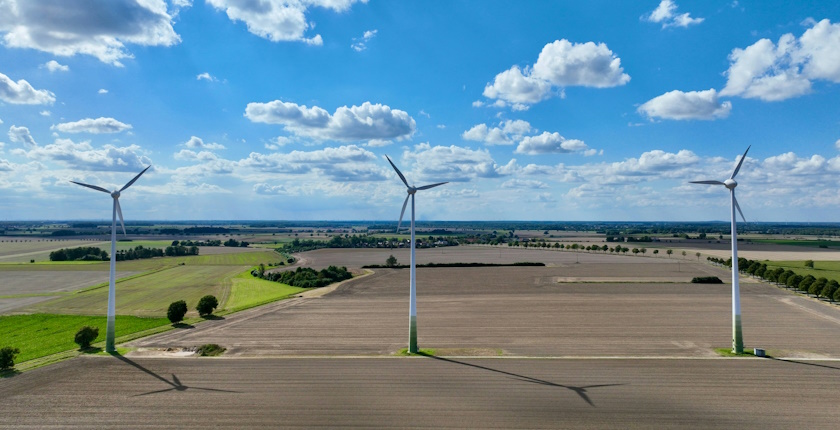
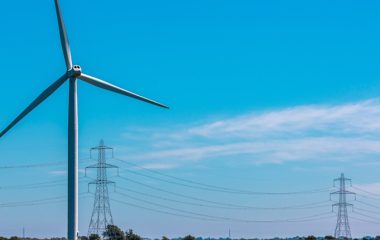
Photo: Andreas Felske on Unsplash


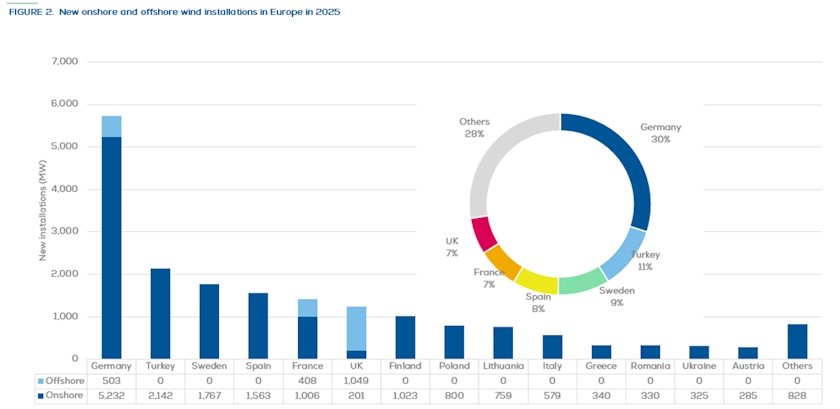
Germany had a 30% share in Europe’s capacity growth of 19.1 GW last year, according to WindEurope. Turkey remains the strongest in Southeastern Europe, with 2.1 GW in new wind power installations in 2025 – reaching 15.9 GW – and 10.9 GW in the pipeline for the period through 2030.
Europe installed 19.1 GW of new wind power capacity in 2025, and the European Union accounted for 15.1 GW, WindEurope said in its annual report. Onshore capacity had a 90% share. Total wind reached 304 GW, of which 87% is onshore.
In the EU, the capacity advanced to 246 GW, and 91% is on land. Notably, Europe decommissioned 0.9 GW of wind facilities in 2025, while commissioning 2 GW of repowered capacity. Therefore, net capacity additions actually amounted to 18.2 GW.
Germany had a 30% share of total installations in European terms, or 5.7 GW. It includes 503 MW of offshore wind.
Wind energy met 19% of electricity demand across the EU, unchanged from 2024. The demand was on par with 2024, remaining just under 2.5 PWh. Total wind generation was 465 TWh. It dipped some 10 TWh year over year, amid unusually unfavorable conditions in the first quarter.
Despite strong growth in capacity, wind power output in the EU came in slightly lower than in 2024
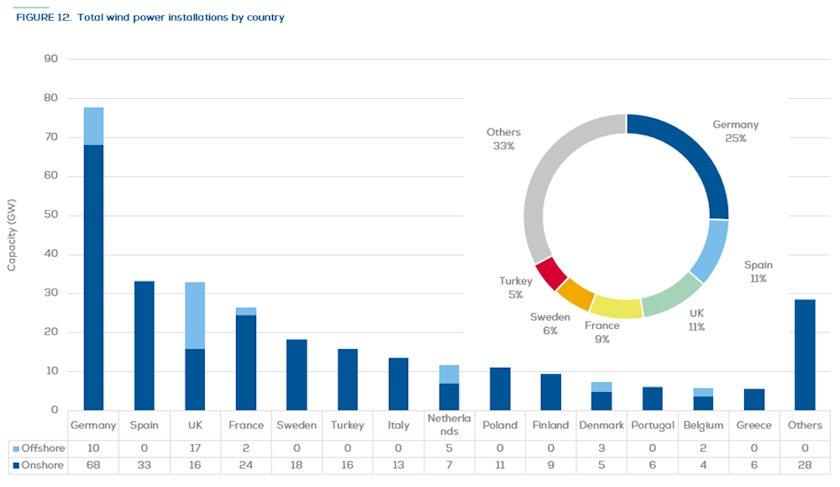
Germany has the largest wind power fleet in Europe – 77.7 GW at the end of 2025. Spain is second, with 33.2 GW, closely followed by the United Kingdom, 32.9 GW. All of the Spanish fleet is onshore, whereas 50% of the British fleet is offshore. Together with France (26.4 GW), Sweden (18.5 GW) and Turkey, (15.9 GW), they account for 67% of total installed wind capacity in Europe.
Europe connected 1.96 GW of offshore wind capacity to the grid, the least since 2016. “This is in part due to delays in construction. We expect a catch-up effect in 2026,” the announcement reads.
Only three countries expanded their offshore fleets: the UK (1.05 GW), Germany (503 MW) and France (408 MW).
Turkey brought 2.1 GW online, coming in as the second-largest country in new onshore capacity. WindEurope expects it to build 10.9 GW of onshore wind capacity by 2030, bringing the total to a whopping 26.3 GW. The figure is apparently without the megawatts that would be decommissioned in the meantime, and there are also no offshore wind parks.
Hosting 15.9 GW at the end of December, Turkey is sixth in Europe overall. Conversely, the country’s Ministry of Energy and Natural Resources just said that wind power capacity was 14.9 GW at the end of January.
Lithuania stood out as well, increasing its total capacity by 43% to 2.54 GW.
Van der Straeten: Hands off market design, EU ETS
Europe’s wind industry is stepping up to the task, said WindEurope’s new Chief Executive Officer Tinne Van der Straeten.
“In 2025 the industry invested EUR 45 billion to make Europe more competitive and secure. But politicians considering to tamper with the EU electricity market design and the architecture of the EU ETS directly undermine these investments. Changing the rules of the game now would be waving goodbye to competitiveness and energy security”, she pointed out.
Wind parks covered 21% of electricity consumption in Greece
The highest daily output in all countries that the report covers, 2.8 TWh, occurred on January 6. It was equivalent to 119 GW or 51% of the installed fleet operating at full capacity for an entire day.
Denmark remained the champion in the share of wind power in consumption by far, at 50%. It compares to 56% from the previous annual update. Lithuania and Ireland are next, both with 33%.
As for the region that Balkan Green Energy News follows, Greece tops the chart – 21%, trailed by Croatia, at 17%. Turkey and Romania cover 11% of their demand from wind. Cyprus and Bulgaria are at 3% each.
All Europe expected to reach 439 GW
The report’s authors projected installations in Europe through 2030 at 151 GW, of which 77% would be onshore, versus 83% in the EU. It means the total in Europe would hit 439 GW. As for the EU, 112 GW of new buildout is seen before the end of the decade. It implies 343 GW altogether, but the 27-member trade bloc’s target is 425 GW.
The European Union is seen with 343 GW of wind power capacity at the end of the decade, falling much behind its 425 GW goal
According to the estimate, the EU will add 19 GW this year and the entire region expands by 25 GW.
Interestingly, tiny Liechtenstein is expected to add its first wind turbines this year, 500 MW, and no more before the end of the decade.
WindEurope expects 16 GW to be decommissioned through 2030. Half of the wind parks concerned would be repowered, replaced by 17 GW. The remaining 8 GW is to be permanently removed. On average, repowering triples electricity output while reducing the number of turbines by around one third, the authors explained.
Greece, Romania to add most wind power after Turkey
Greece increased its capacity by 340 MW last year, to 5.7 GW. In the projection, it climbs to 7.7 GW by 2030. Its target is 8.9 GW.
Romania climbed 330 MW to 3.5 GW. It is the last on the list of the 18 European countries hosting more than 3 GW. Before the end of the decade, Romania reaches 6.1 GW or 1.5 GW less than its objective.
Serbia added the Kostolac wind power plant in 2025, alongside most of the Čibuk 2 facility, so it climbed by 199 MW to 807 MW. The country is expected to grow another 1.3 GW this decade.
Slovenia, which has just a couple of separate wind turbines, is seen starting a buildout in 2028, to reach 110 MW in 2030.
WindEurope estimated that Albania would connect its first 70 MW to the grid this year and advance to 410 MW at the end of the period.
The trajectory shows Bosnia and Herzegovina lifting its capacity by 270 MW to 580 MW. Kosovo* increases by 220 MW to 360 MW.
The forecast for Montenegro is another 200 MW, but just this year and next, for 310 MW in total at the end of the decade. North Macedonia advances by 420 MW to 520 MW.
After failing to add a single turbine for more than a decade, Bulgaria starts growing again in 2027. The capacity increases by 540 MW by 2030, to 1.22 GW and another 10 MW offshore.
Croatia is expected to finish the decade with 1.64 GW of (just onshore) wind, versus 1.26 GW the end of last year, in which it bumped the capacity up by 27 MW. Cyprus would remain at the current 177 MW.
Be the first one to comment on this article.