






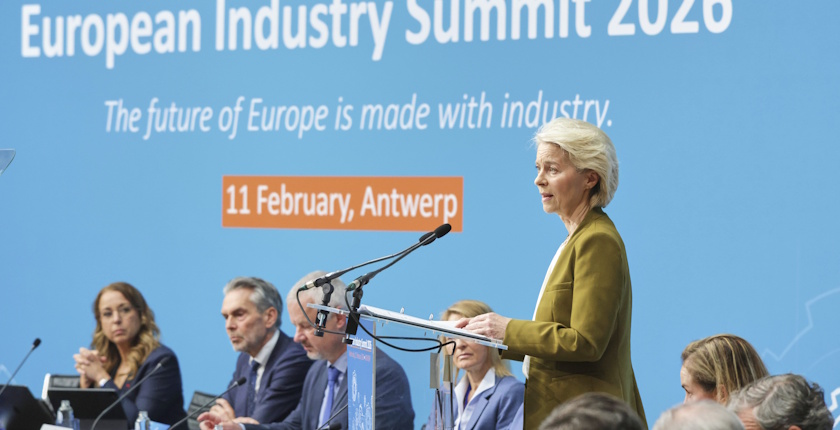
Photo: © European Union, 2026/Dati Bendo


The European Commission has joined forces with member states to lower taxes and make energy more affordable, according to its President Ursula von der Leyen.
Energy prices are still too high and too volatile, Ursula von der Leyen admitted at the Antwerp European Industry Summit. For her, the explanation is clear: gas prices drive energy prices up, while renewables and nuclear drive prices down. She backed this with figures.
Last year, the average price of electricity produced from natural gas in Europe was EUR 100 per MWh. The average price for renewables was EUR 34 per MWh, and the price for nuclear power was between EUR 50 and EUR 60 per MWh.
The next few years are crucial because, according to the International Energy Agency, gas prices are expected to remain low for the next three to four years.
The good news is that the EU is well-positioned to lower costs
“We should use this time to invest in a low-carbon energy system that will protect us when fossil fuel prices go up again,” she stressed, according to the European Commission.
In her view, the good news is that the EU is well-positioned to lower costs. One of the reasons is that in 2025, for the first time ever, the EU produced more electricity from solar and wind than from all fossil fuels combined.
Von der Leyen named three activities and instruments to lower energy prices: infrastructure for a true Energy Union, the modernization of taxation, and power purchase agreements and contracts for difference.
Regarding infrastructure, she said that price spikes in one country could often be avoided if cheaper energy could flow across borders.
“And we have a blueprint to address this, the European Grids Package. It is on the table, proposed by the Commission. As part of it, we are fast-tracking the construction of Energy Highways all across Europe,” the President underlined.
The taxes that industry pays on electricity are 15 times higher than taxes on gas
Clean energy must flow freely all across our Union so that cheap energy can flow where it is needed, when it is needed, she added.
In addition, the EU, in her words, must drastically modernize energy taxation. While energy costs are going down, national taxes on energy are going up, she underscored. Furthermore, the taxes that industry pays on electricity are 15 times higher than taxes on gas, according to von der Leyen.
“This is just wrong. So we are working with national governments to reduce the tax burden and bring prices down,” von der Leyen stressed.
Finally, she called for a greater use of power purchase agreements (PPAs) and contracts for difference (CfDs).
“We need them in all member states, and not only for large companies. Because locking in energy prices protects you from volatility and lets you plan for the long-term,” she concluded.
Be the first one to comment on this article.