






Photo: iStock


The European Union added 27.1 GWh of battery capacity last year, marking a 12th consecutive record, driven by utility-scale storage. Bulgaria achieved the third-largest expansion and the highest annual surge.
The battery storage growth rate in the EU rebounded strongly in 2025 after a slowdown. The overall fleet, 77.3 GWh, is ten times larger than at the end of 2021, SolarPower Europe said in its EU Battery Storage Market Review 2025.
Another tenfold increase by 2030 is necessary to meet flexibility needs, estimated at 750 GWh, the authors pointed out. The year-on-year growth in new installations was 45% or 27.1 GWh. It follows a revised 23% in 2024.
Residential batteries had a 56% share of the total at the end of 2025
On the other hand, annual solar capacity additions declined for the first time in a decade. With grid expansion lagging behind renewables, flexibility has emerged as the key enabler of further progress, the association said. Batteries are now stepping in to deliver flexibility rapidly and at scale, stabilizing grids, reducing curtailments, supporting security of supply and lowering system costs, the report reads.
Utility-scale systems accounted for 55% of added capacity, capturing more than half for the first time. The organization attributed it to an improvement in market conditions and policy frameworks.
Expansion of rooftop solar slows, pushing residential battery growth below 10 GWh
Residential battery growth decreased for the second consecutive time. The additions came in 6% weaker, at 9.8 GWh, largely due to lower electricity prices and reduced support schemes, taking steam out of the rooftop solar market. Commercial and industrial (C&I) batteries grew modestly but remained far below their potential, the document adds.
On the other hand, residential battery capacity represented 56% of the total at the end of 2025. The utility-scale segment amounted to a third.
Notably, the methodology has home batteries at up to 20 kWh, and the commercial and industrial item between 20 kWh and 1 MWh. All larger systems are in the utility-scale section.
“The decline in distributed batteries reminds us that we still need clearer policy support to unlock more investments for businesses and households. EU battery manufacturing has made significant progress over the past years, but uncertainty remains,” lead author and market analyst at SolarPower Europe Antonio Arruebo said.
EU lacks anode, cathode manufacturing capacity
The report highlights a solid midstream industrial base, with 252 GWh of nominal battery cell production capacity, but there are significant structural gaps. The electrolyte and separator manufacturing capabilities are strong, at an equivalent of 345 GWh and 220 GWh per year, respectively.
Conversely, production of active materials remains very limited. Cathodes account for 52 GWh and anodes at 3 GWh, also calculated as an equivalent.
Nearly the entire battery cell output is for electric vehicles
A whopping 92% of the battery cell manufacturing capacity is geared toward serving the electric vehicle market, rather than stationary storage, and 70% consists of nickel-based batteries. Demand for stationary storage is expected to continue its rise as lithium-iron-phosphate (LFP) become dominant. SolarPower Europe said.
Project postponements and relatively high production costs continue to challenge competitiveness, underscoring the need for a more resilient and fully integrated European battery value chain, the organization warned.
Bulgarian annual installations come in nearly 13 times stronger than in 2024
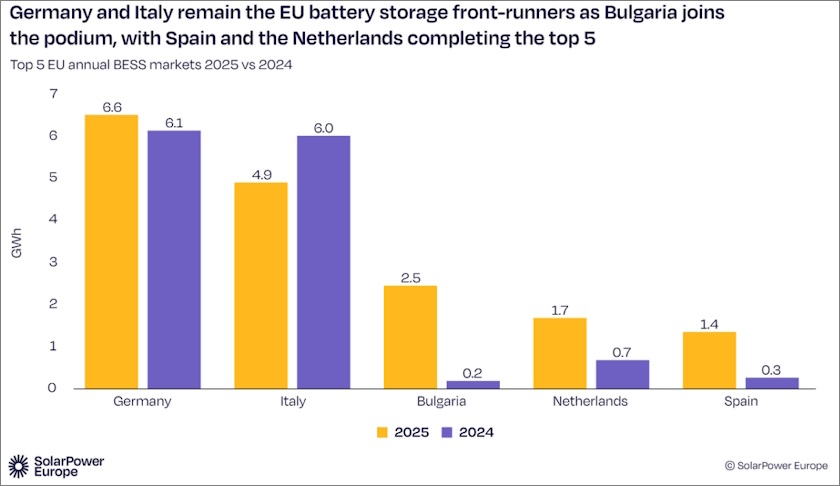
In 2025, Germany (6.6 GWh) and Italy (4.9 GWh) again led the market expansion in absolute terms. Bulgaria’s growth was the fastest. Deployment was almost 13 times higher than in the previous year, hitting 2.5 GWh and advancing the country to third place. The Netherlands and Spain completed the top 5 ranking.
Looking at the entire operational capacity, Germany hosts 33%, followed by Italy, 24%, while Bulgaria, the Netherlands and Spain share the third place at roughly 4% each.
If the size of Bulgaria’s economy and the number of inhabitants are taken into account, it is by far the strongest in the top tier.
Altogether, 63% of all added capacity is in the first five countries in the chart, versus nearly 80% in 2024.
As for the rest of the region that Balkan Green Energy News is focusing on, several battery energy storage systems (BESS) were built in Greece in 2025, but they are awaiting grid connection permits.
Poland tops the lithium ion battery cell manufacturing map, with 86 GWh per year. Next is Hungary, at 78 GWh, followed by France (42 GWh) and Germany (40 GWh). Romania squeezed itself into the top 5, with 2.3 GWh per annum. The chart includes Norway, Switzerland and the United Kingdom.
Solar, wind beat fossil fuels for first time
The battery market is tightly connected with solar power, which grew by 65.1 GW in the European Union last year. It was 0.7% less than in 2024, when a 2.8% annual growth rate was measured, Ember said. The decline in 2025 was marginal, but it could be signifying a turning point.
On the flipside, solar and wind together supplied more power than all fossil fuels in the EU, 30.1% against 29%, according to the think tank. For the first time, large-scale solar power facilities accounted for more than half of all new PV capacity.
In other news, Wood Mackenzie said the global battery capability jumped 106 GW last year, or 46% more than in 2024, reaching 270 GW, and 630 GWh in storage capacity. The research and consultancy firm estimates that operating power would climb to 1.55 TW by 2034.


Be the first one to comment on this article.