





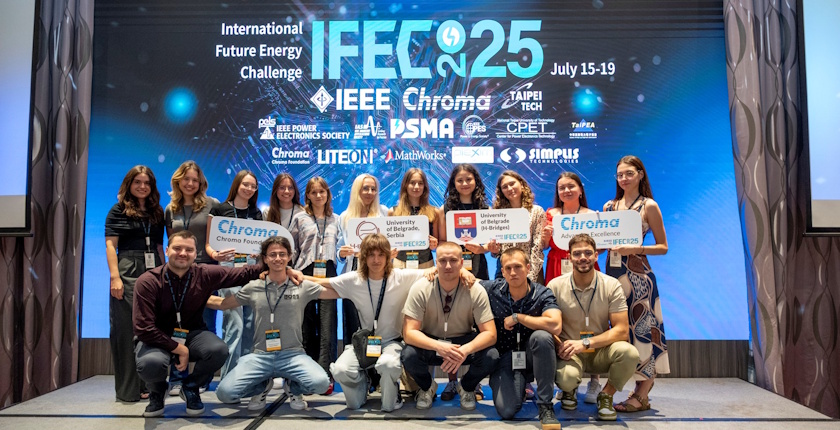
Foto: H-Bridges


The H-Bridges student team from the School of Electrical Engineering (ETF) of the University of Belgrade, Serbia, is once again taking part in one of the world’s most prestigious university competitions in energy innovation – the International Future Energy Challenge (IFEC). This year’s challenge focuses on the design of a bidirectional onboard charger for electric vehicles, a solution that enables not only battery charging but also energy feedback to the power grid.
The IFEC competition is organized under the patronage of the Institute of Electrical and Electronics Engineers (IEEE). Each year, the organizers define a new task aligned with the latest technological trends, allowing participating students to work on state-of-the-art solutions in electrical engineering and computer science.
The competition is held in three phases. In the first stage, teams submit conceptual design proposals to the organizers and judges. Up to 20 teams from around the world are then invited to present preliminary experimental results at the IEEE Applied Power Electronics Conference (APEC) in the United States, one of the largest global conferences in applied electrical engineering.
In July, the top ten teams advance to the final round, where their solutions are tested in laboratory and real-world conditions. The final venue changes each year depending on the competition theme and the host university.
At the beginning of each season, new students join the H-Bridges team
At the beginning of each season, new students join the H-Bridges team, motivated to go beyond traditional education and gain hands-on experience. Team members independently handle all aspects of the project, from conceptual design to prototype development and testing, as well as securing the necessary components and funding for participation in the semifinal and final stages of the competition.
The H-Bridges team is supported by the University of Belgrade’s School of Electrical Engineering (ETF). In addition, numerous companies in Belgrade and abroad recognize the value of the competition and the team’s projects, providing sponsorships and donations in the form of materials, equipment, and financial support. This assistance enables the team to attend the semifinal and final rounds of IFEC and contributes to its continued success.
Those interested in supporting the H-Bridges team can find additional information on the team’s official website. Support from partners and donors plays an important role in the team’s ongoing activities.
The team also regularly participates in other international and national competitions.
H-Bridges preparing for IFEC 2026
The H-Bridges team is led by Aleksandar Milić from the Department of Power Converters and Drives at the School of Electrical Engineering. The team is organized into several subteams focusing on hardware and PCB design, software and control, and public relations and corporate cooperation. Members come from all study programs at the School of Electrical Engineering, as well as from other faculties.
H-Bridges has achieved notable results at IFEC over the years. In 2019, the team won first place with an electric bicycle drive system and an accompanying Android application for cyclist-vehicle communication. The team also secured second place in the 2020, 2022, and 2023 editions of the competition.
This year’s IFEC task focuses on the design of a bidirectional onboard charger for electric vehicles
This year’s IFEC task focuses on the design of a bidirectional onboard charger for electric vehicles. The project addresses the growing need for innovative solutions in renewable energy integration, electric mobility and energy storage systems.
Bidirectional chargers allow vehicles not only to draw energy from the grid but also to feed it back, offering potential benefits for vehicle efficiency and grid stability without the need for additional charging infrastructure. The system is designed to feature a compact form factor, reliable control, and high power quality at the point of connection.
The team is currently working on the conceptual design of the charger and plans to present its first results at the IEEE APEC conference in March 2026 in the United States. The final stage of the competition will take place in Belgium at KU Leuven, where student-developed chargers from around the world will be tested under both laboratory and real-world conditions.


Be the first one to comment on this article.