







Photo: Pixabay


Norway claims to be one of the climate leaders and it was among the first countries to ratify the Paris Agreement. However, according to Oil Change International (OCI), the Scandinavian country is pursuing an “aggressive policy of expanding its oil and gas industries” and has awarded about 700 exploration permits in the past ten years alone. Also, according to the Daily Mail, Britain announced it would start exploitation on six more oil and gas fields in the North Sea this year.
Norway has become the most agile or, as they say in the Oil Change organization, the most aggressive oil and gas explorer in Europe. Over the last ten years, the Norwegian government has granted the same number of exploration licenses as in the period 1965-2012, as noted in the OCI briefing.
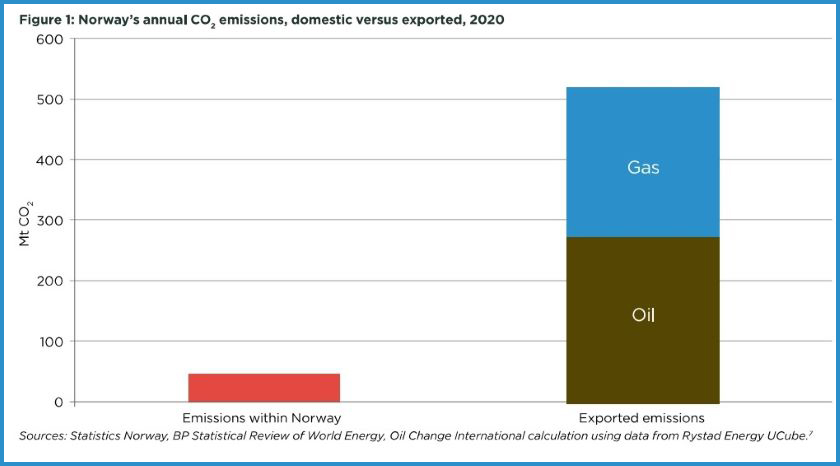
OCI claims that oil and gas in Norway’s exploitation fields, which are already licensed but not yet in operation, could increase emissions by an additional three billion tons of CO2, which is 60 times the annual domestic emissions of Norway.
Wisting – the largest field in Norway, but with a huge climate impact
Equinor plans to seek approval to develop the Wisting oil field in the Barents Sea in 2022, according to the OCI. By the size of the oil reserves, Wisting could become the largest field in Norway, but with a huge climate impact, the report adds.
If Norway approves exploration and development of the Wisting oil field, it would be the northernmost exploitation field in the world, located in an Arctic area with a vulnerable ecosystem, said OCI, an organization focused on exposing the true costs of fossil fuels.
Over 500 million barrels from the Wisting oil field is equivalent to the annual emissions of about 50 coal-fired power plants
Over 500 million barrels of the Wisting oil field could release more than 200 million tonnes of CO2 during combustion, equivalent to the annual emissions of about 50 coal-fired power plants, OCI said.
OCI is urging Norway to comply with climate goals
“If the current Norwegian government wants to be taken seriously on climate issues, it must review the country’s oil and gas policies and align them with the goals of the Paris Agreement and with the principles of global equity,” the OCI said.
Since 2012, new permits issued by Norway have opened up the possibility of potential extraction of 2.8 billion barrels of oil and gas, which is almost 3.5 times more than the second-largest European producer, the United Kingdom.
Oil Change International recommends that the Norwegian government stop the Awards in Predefined Areas (APA) licensing system and reject Equinor’s bid to develop the Wisting oil field.
The UK is continuing its exploration
Six oil and gas fields in the North Sea are expected to be given the go-ahead, despite the promise of the Prime Minister of the United Kingdom Boris Johnson on net zero emissions, reports the Daily Mail.
The Oil and Gas Authority is ready to approve drilling in six areas. Exploitation could begin in the Rosebank field, west of Shetland, and at Jackdaw, Marigold, Brodick, Catcher, and Tolmount East in the North Sea, according to the article.
It is estimated that the reserves of all fields together are around 62 million tons of oil equivalent, which is enough to cover the consumption in the United Kingdom for six months.
Prime Minister Johnson has clearly stated his intention for Britain to reduce net zero emissions by 2050 at the latest. However, according to the media outlet, the Treasury reportedly fears economic impacts from switching too quickly to green energy sources.




Be the first one to comment on this article.