






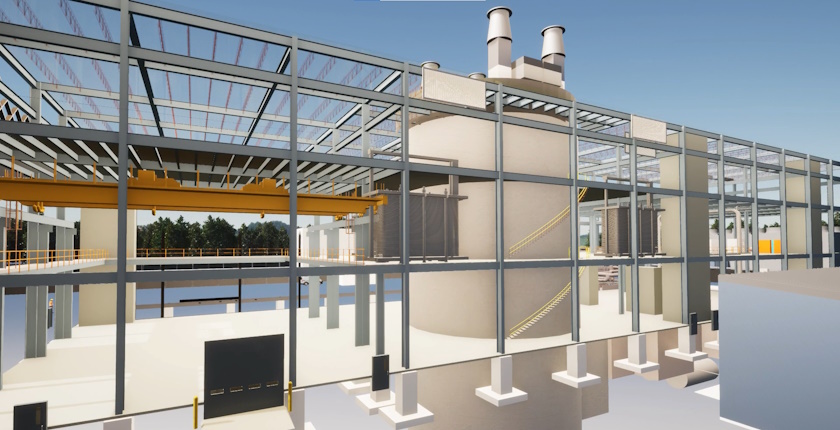
Photo: ARC Clean Technology


YEO Technology’s strategic investment in ARC Clean Technology, which develops advanced small modular reactors, brings potential cooperation opportunities for the deployment of the technology in Turkey. The startup with headquarters in Canada and the United States has closed a series B financing round, with a focus on its advanced sodium-cooled fast reactor of 100 MW.
Amid its push into other sectors and markets, Istanbul-based YEO Technology (YEO Teknoloji Enerji ve Endüstri) aspires to be an early mover in advanced small modular reactor (aSMR) technologies, counting on Turkey’s upcoming investments in nuclear power. The company revealed that it invested in ARC Clean Technology, valuing the startup at USD 60.4 million.
Advanced small modular reactors are expected to become a complementary solution for baseload power demand, the update adds. YEO said it expects the transaction to open the way for cooperation with the startup, which has headquarters both in Canada and the United States, in the deployment of the technology in Turkey and the surrounding region.
The investment is strategic, in line with the company’s goals of early positioning in future energy technologies, access to carbon-free and sustainable energy solutions, and long-term value creation, according to the announcement. YEO didn’t reveal other details.
ARC counts on rising demand for AI computing
ARC Clean Technology is developing the ARC-100, a generation 4 sodium-cooled fast reactor. It originates from the Experimental Breeder Reactor-II (EBR-II), which worked for 30 years at Idaho National Laboratory.
Using metallic uranium-zirconium fuel, ARC-100 provides 100 MW of electricity capacity, from 286 MW of heat. It is also intended for supplying steam for industrial processes as well as powering electrolyzers in hydrogen production and data and artificial intelligence (AI) centers.
The ARC-100 would only need to be refueled after 20 years
The startup is targeting a 20-year refueling cycle and a design life of 60 years.
Just last week, ARC Clean Technology said it closed its series B financing round. It involved new and existing investors from the energy, infrastructure and technology sectors. The proceeds are for advancing commercialization programs for the ARC-100.
Additionally, the funding will support work with the US Department of Energy, the collaboration agreement with Korea Hydro and Nuclear Power (KHNP) for global aSMR fleet deployment, and continuation of a Canadian project supported by strategic partner Hatch.
Global search for partners for nuclear reactors in Turkey
Turkey expects to put the first reactor at the Akkuyu nuclear power plant into operation in 2026. While developing the legal framework for small modular reactors (SMRs), the government is also considering a partnership with South Korea and the US for the second conventional nuclear plant, in Sinop.
Discussions about small reactors and a large nuclear power plant in Eastern Thrace are also underway with China and Russia. Turkish officials earlier mentioned contacts with Canada, France and the United Kingdom as well. The country aims to reach 7.2 GW in nuclear power capacity by 2035 and 20 GW by 2050.
The capacity of Reap Battery’s new LFP battery production facility is 5 GWh per year
Of note, YEO’s subsidiary Reap Battery launched production in mid-December of lithium-iron-phosphate (LFP) battery energy storage systems (BESS) in Tuzla, Istanbul.
In addition to the domestic market, the facility with an annual capacity of 5 GWh is targeting the US, Europe, the Middle East, Central Asia and Africa. It manufactures systems for renewable energy projects, the power grid, mobility, commercial and industrial applications, and residential energy storage.
Notably, Warsaw-based Synthos Green Energy and Bulgarian firm Blue Bird Energy have just signed a letter of intent to partner on the deployment of small modular reactors in Bulgaria.




Be the first one to comment on this article.