


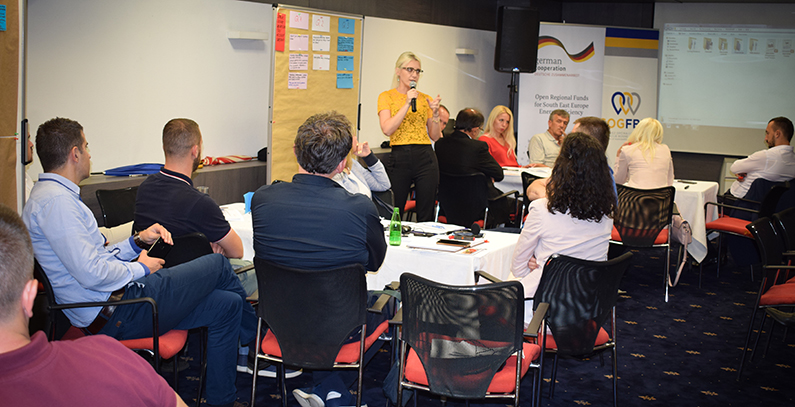
The Association of Municipalities and Cities of the Federation of Bosnia and Herzegovina (FBiH) and the Association of Local Authorities of Republika Srpska, in cooperation with the European Secretariat of European Mobility Week and the financial support of the GIZ Open Regional Fund for South-East Europe – Energy Efficiency (ORF-EE), organized a workshop on the European Mobility Week, on July 10, in Sarajevo.
This was the first dedicated workshop organized for representatives of Bosnia and Herzegovina’s municipalities and cities since European Mobility Week was launched in 2002.
Sean Carroll of the European Secretariat of European Mobility Week presented campaign experiences in EU member states and the concept for 2019.
The event is marked in more than 2,000 cities and over 50 countries around the world from September 16 and 22. Cities and municipalities can apply to participate online, selecting activities they wish to organize as part of European Mobility Week, such as activities within the week or one or more permanent measures.
This year focus is on safe walking and cycling and the possible health, environmental, and cost benefits of these forms of mobility. Active transportation does not generate harmful gas emissions while being beneficial for the cardiovascular system and general well-being.
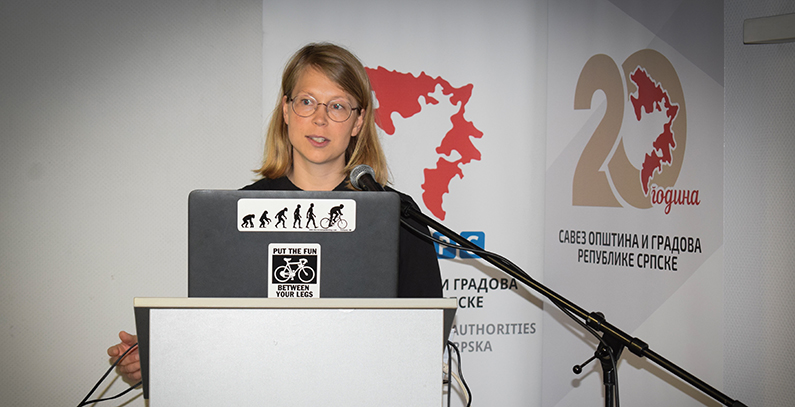
On behalf of the GIZ ORF-EE, the gathering was addressed by Julia Nagel, Project Manager of the ORF-EE’s Sustainable Urban Mobility in South-East European Countries II project (SUMSEEC II). Nagel presented the SUMSEEC II project and its focus areas, as well as European Mobility Week as an event that can drive change in municipalities, both for employees and residents, with the aim of implementing the new model of sustainable and comprehensive urban planning.
Tihomir Dakić of the Center for Environment, who is the European Mobility Week national coordinator for BiH, presented criteria for this year’s applications and moderated the workshop, with representatives of municipalities and cities taking an active part in the discussion on the current situation concerning urban mobility in local communities, the obstacles and how to overcome them, and potential measures that should be applied and realized during this event.
The workshop also featured a presentation of the website concerning European Mobility Week in BiH languages, created to facilitate access to information for the public and representatives of municipalities and cities.
Conclusion and recommendations
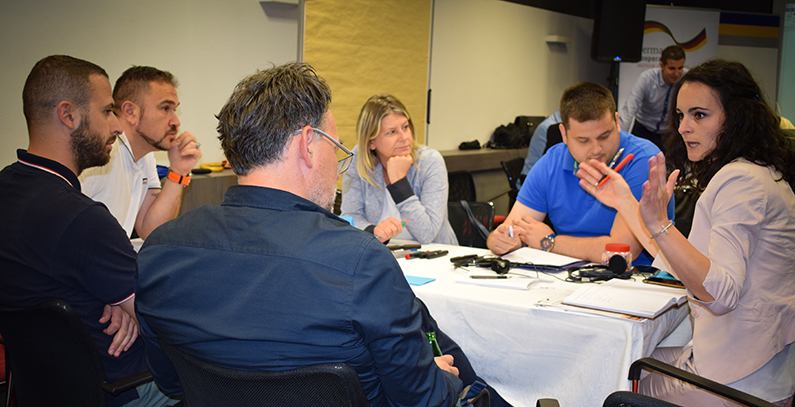
The main workshop conclusion is that the discussion in mixed groups was exceptionally important, having fostered an exchange of information and different views on how to resolve mostly common problems. The workshop gathered representatives of 14 municipalities and cities: Sarajevo, Zvornik, Banja Luka, Doboj, Laktaši, Mrkonjić Grad, Trnovo, Lukavac, East Sarajevo, Pale, Travnik, Teslić, Bijeljina, and the Canton of Sarajevo.
Some of the key findings and recommendations stemming from the discussion:
- Work jointly to change the population’s behavior concerning urban mobility;
- Investment in the pedestrian and cycling infrastructure should be a priority to enable behavior change;
- Introduce parking fare and increase prices;
- Invest in public transportation systems;
- As part of work on spatial planning documentation, traffic planning needs to be given special attention;
- Improve the safety of non-motorized traffic;
- Network cities and municipalities in BiH at an international level, through various networks and initiatives to exchange information and examples of good practice, as well as to form potential joint project proposals;
- Form non-motorized transportation zones in city and municipal cores;
- Networking on urban mobility is needed on the local level with representatives of associations, educational institutions, the private sector…;
- Introduce the park and ride system in major cities in BiH;
- Educate the youngest participants in traffic and foster smart mobility habits;
- Promote European Mobility Week in BiH cities and municipalities.
The GIZ ORF-EE project through both associations of cities and municipalities in BiH will support at least 4 municipal pilot projects dealing with urban mobility, to be selected, as well as measures to be taken as part of the European Mobility Week.