

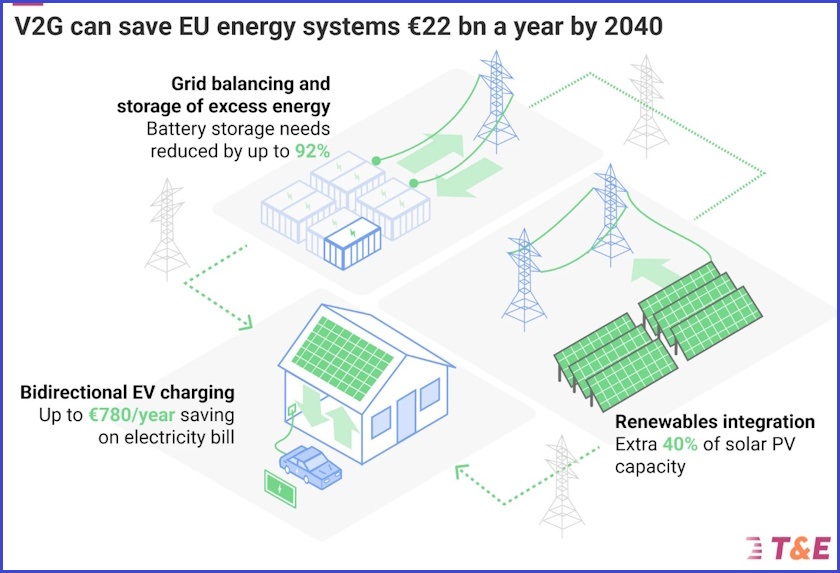
By leveraging the full potential of electric vehicles as “batteries on wheels” in the period through 2040, Europe can reduce energy system costs by EUR 22 billion per year and cut the need for stationary battery storage by up to 92%, according to a report by research institutes Fraunhofer ISI and ISE for Transport & Environment (T&E).
However, while the benefits are huge, the potential is not yet fully captured, Transport & Environment (T&E) said.
There are important interoperability challenges as the current focus on either AC or DC – alternative or direct current – bidirectional charging by different manufacturers poses a significant barrier to widespread adoption.
According to T&E, ensuring interoperability between all EVs and chargers – by mandating bidirectional capability as a standard at the European Union level – is crucial for materializing the full potential of the technology.
Savings stem from a reduction of generation capacity, curtailment, fuel consumption
Vehicles Policy Manager at T&E Fabian Sperka said V2G can only take off if it is ensured that all EVs can work with all chargers.
“Lawmakers can unlock the potential of this technology by deciding the EU standards for bidirectional charging. That will be a win for consumers, the environment and progress towards the EU’s climate and energy goals,” he noted.
Using electric vehicles to store energy and feed back into the grid could soon save Europe’s energy companies and motorists billions of euros a year. EVs equipped with bidirectional charging can act as “batteries on wheels” that draw down electricity at times of oversupply and give back when demand is higher.
By 2040, widespread adoption of bidirectional charging could reduce annual energy system costs across the EU by 8.6%, amounting to EUR 22.2 billion in savings per year, the study underlines.
Even by 2030, potential savings of 5.5% or EUR 9.7 billion annually were calculated. Total savings between 2030 and 2040 could amount to EUR 175.45 billion, T&E said.
They stem from a reduction of generation capacity and curtailments as well as lower fuel consumption.
According to the researchers, EVs could become a major power resource by 2040. They could contribute to Europe’s annual power supply with as much as 9%, becoming the fourth-largest supplier.
During peak demand periods, EVs could supply 15% to 20% of instantaneous electricity demand, acting as a massive, distributed virtual power plant, the study reads.
Need for stationary battery storage could be cut by up to 92%
“Batteries on wheels” could also boost renewable energy integration by enabling an additional 430 GW of solar PV capacity by 2040, nearly doubling the current EU capacity.
The impact on energy storage and savings for drivers is significant, too, according to the study.
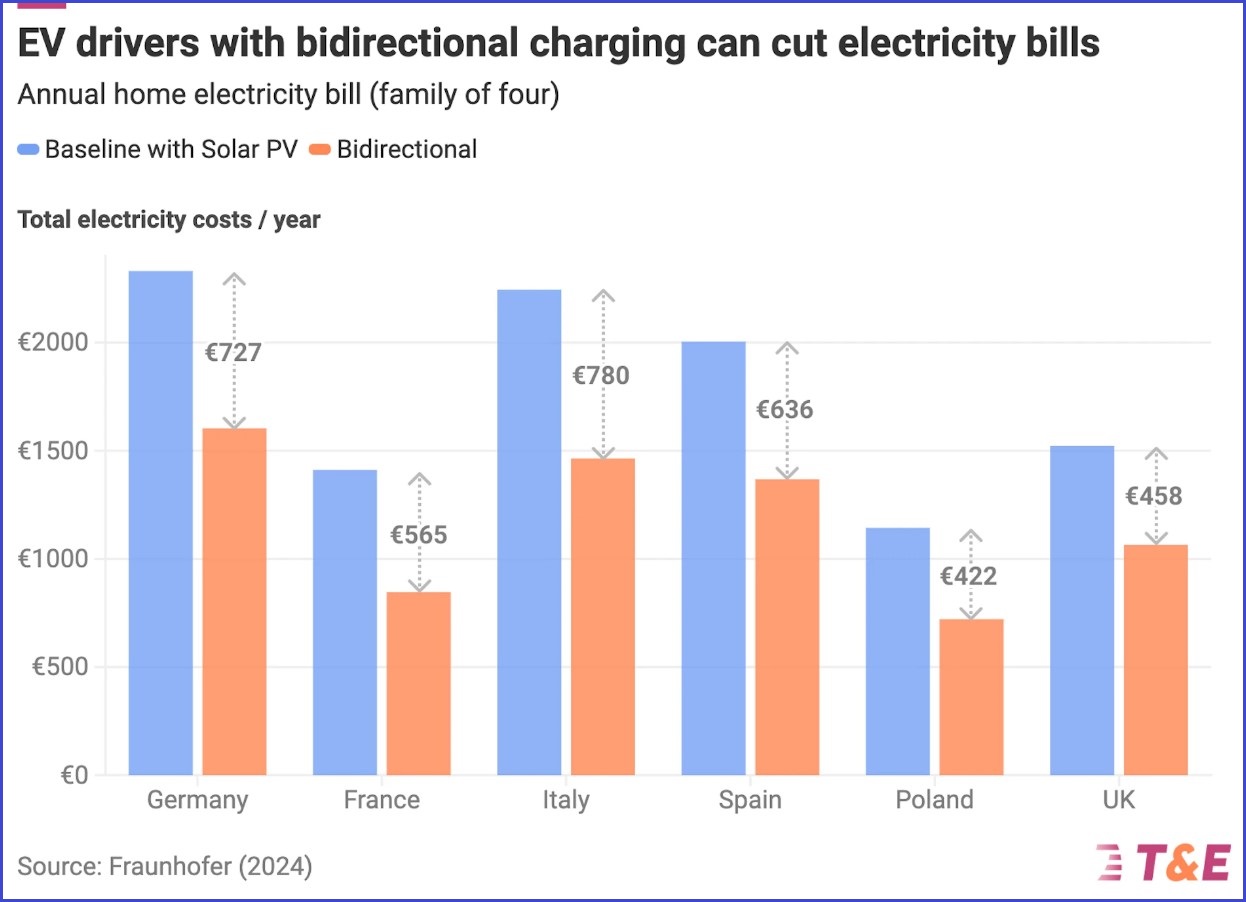
The need for stationary battery storage could be cut by up to 92% by 2040, while backup power plant requirements could be reduced by 126 GW. EV drivers could save between 4% and 52% on annual electricity bills or EUR 31 to EUR 780, depending on factors such as location, photovoltaic capacity ownership, and vehicle battery size – even without V2G services.
The study finds that contrary to common concerns, bidirectional charging can extend EV battery lifetime by up to 9% compared to standard charging practices. According to the researchers, V2G technology shouldn’t be seen as a substitute for necessary grid reinforcement and expansion.