






Photo: iStock


Technological progress is expanding where geothermal electricity can be produced – making it an increasingly cost-competitive, secure alternative to fossil fuels, including for the power-hungry data centers. Given the new methods, it can already replace 42% of output from coal and gas plants in the EU, Ember found. Enhanced geothermal systems even have the ability to indirectly store surplus solar and wind power.
Advances in drilling and reservoir engineering are unlocking geothermal electricity across much wider parts of Europe. Once limited to a few favourable locations, the technology is positioned to scale from a niche “volcanic” resource to mainstream, Ember said in its study Hot Stuff: Geothermal Energy in Europe.
It could replace 42% of the European Union’s coal and gas-fired generation for less than EUR 100 per MWh, the think tank’s new numbers showed.
“Once restricted to a few geological hotspots like Iceland or Tuscany, modern geothermal is now cost-competitive with gas across much of the continent. As Europe seeks to slash emissions while meeting the energy demands of heavy industry and AI data centers, this untapped resource offers a clean, firm power supply that remains insulated from the price volatility of imported fossil fuels,” said Ember’s Policy Advisor Tatiana Mindekova, the author of the report.
Conventional geothermal relied on underground rock formations that were both hot and naturally permeable, allowing water already present at depth to circulate and transport heat. With 99 TWh in 2024, the share in global power output was below 0.5%.
Deeper, hotter, drier
During the last decade, progress in geothermal technologies – often referred to as next generation geothermal – has removed the need for naturally occurring permeability, meaning the presence of open pores in rock that allow fluids to flow. New approaches can now create or enhance these flow pathways artificially.
Plants rarely operated deeper than three kilometers. But enhanced geothermal systems or EGS are now unlocking heat from much deeper, hotter rock layers, with little or no natural water or permeability.
The techniques were adapted from the oil and gas sector, to allow a working fluid, usually water, to circulate and extract heat.
Well costs plunged 40% in the past decade
Advances in power conversion systems enable electricity generation at lower temperatures. Additionally, well costs plunged 40% in one decade.
Geothermal reservoirs can be operated flexibly to absorb surplus wind or solar electricity indirectly, primarily through increased pumping and injection, and later the release of stored thermal and pressure energy to generate additional power.
There is additional value in the recovery of valuable minerals, like lithium, by direct extraction from underground brines. Up to 95% can be picked, compared with roughly 60% from hard-rock mining, the study reads. On top of that, far less water is necessary.
Geothermal electricity already cost-competitive with fossil fuels in Europe
By 2030, nearly 1.5 GW of new capacity is expected to come online each year globally, three times more than in 2024. Geothermal could meet up to 15% of the growth in electricity demand by 2050, the think tank stressed.
Geothermal electricity is already cost-competitive with fossil fuels in Europe. The levelised cost of electricity (LCOE) of geothermal power – is at around USD 60 per MWh. The estimate for most fossil fuel generation is USD 100 per MWh. LCOE is calculated using the construction and operating costs of a power plant over its lifetime.
Europe had 147 geothermal power plants in operation in 2024. They generated some 20 TWh of electricity from little over 3.5 GW, which was a fifth of global capacity. Turkey, Italy and Iceland together accounted for nearly the entire output.
Hungary hosts over half of EU’s potential with LCOE under EUR 100 per MWh
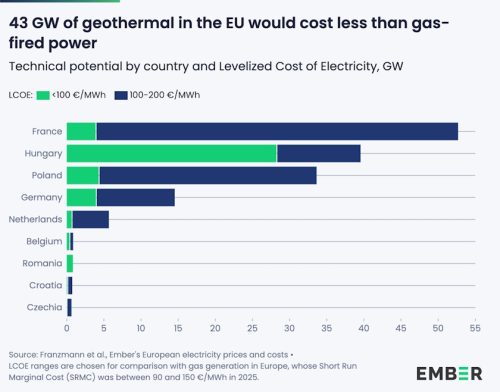
Ember identified 43 GW of enhanced geothermal capacity in the EU that could be developed at costs currently below EUR 100 per MWh. It translates to 301 TWh of electricity per year, equal to 42% of all production in 2025.
Turkey is in the top tier with 18.6 GW of overall potential
The largest potential in the EU is in Hungary, 28.3 GW. Together with LCOE between EUR 100 per MWh and EUR 200 per MWh, the level is at a whopping 39.6 GW. Only France is stronger, with 52.7 GW overall. Notably, Iceland went through the roof with 191.9 GW of potential at up to EUR 100 per MWh.
Looking at the rest of the region that Balkan Green Energy News follows, Turkey is in the top league as well. It has 5.7 GW of potential at up to EUR 100 per MWh, and another 12.9 GW above the provisional threshold.
The study reveals there is 838 MW in Romania for less than EUR 100 per MWh, compared to 631 MW in Serbia and 148 MW in Croatia, which also hosts 607 MW in the higher cost segment. Slovenia is at 168 MW, all in the more expensive range.
Could meet up to 64% of increase in data center electricity demand
Recent trends in the United States suggest that geothermal could cost-effectively meet up to 64% of the anticipated increase in data center electricity demand by the early 2030s.
The analysis includes a warning that despite being a pioneer in the early testing of these methods, Europe is at risk of being left behind. Deployment remains hampered by lengthy permitting processes and the absence of a unified EU-level strategy. At the same time, the US and Canada are aggressively scaling up projects with targeted policy incentives, the study reads.
A recent Stanford University study showed that EGS can complement and significantly reduce the amount of wind, solar, and battery infrastructure needed for a clean, renewable energy transition.
The US Department of Energy expects costs to drop significantly by 2035. The first major EGS project in the US, a 2 GW facility in Utah, was approved only in October 2024.
Be the first one to comment on this article.