


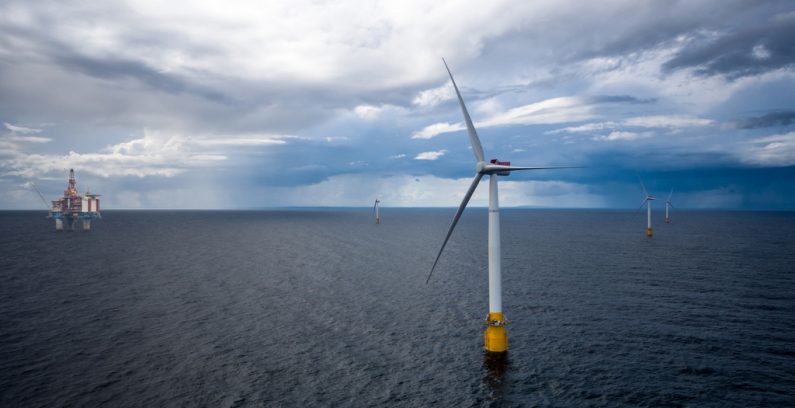
Romania’s acting economy and energy minister Virgil Popescu has said the country’s state-owned hydropower producer Hidroelectrica should consider tapping the Black Sea offshore wind potential, local media have reported.
No studies of he Black Sea offshore wind potential have been done so far, and the idea has not been publicly debated, although there is potential, according to Popescu, who was speaking at an energy conference.
“I have seen what exists in the North Sea and I do not see why the potential of the Black Sea wind could not be used also for the production of electricity in Romania,” said Popescu, according to reports.
Hidroelectrica could join forces with companies from other countries.
Hidroelectrica, as a green energy company, could attract co-financing and join forces with other companies from other countries to work on such a project, according to him. He said that there is “European money” that can be used for this purpose.
According to local media, the high cost of developing offshore wind projects in Romania has so far kept investors at bay. Germany’s Siemens attempted to launch a project in 2010, but it dropped the plans after the Romanian government scrapped renewable energy incentives, the media recalled.
Popescu says EBRD is eyeing 5% stake in Hidroelectrica ahead of IPO.
According to Popescu, the European Bank for Reconstruction and Development (EBRD) is interested in acquiring a 5% stake in Hidroelectrica, which is preparing for an initial public offering (IPO) on the Bucharest Stock Exchange later this year, according to reports.
The Romanian state owns about 80% of Hidroelectrica’s shares, while the rest is in the hands of US investment fund Fondul Proprietatea.
Hidroelectrica is the largest Romanian power producer, with an average annual electricity output of 17 TWh, generated by 228 hydropower plants (HPPs), with a total installed capacity of 3,444 MW, according to earlier reports.
Comments (1)
Dochia
OK, Hidroelectrica should look into Black Sea, and let Jiu River flow free!
https://www.youtube.com/watch?v=pci1Nx9Swl4
(you can choose subtitle in English)