

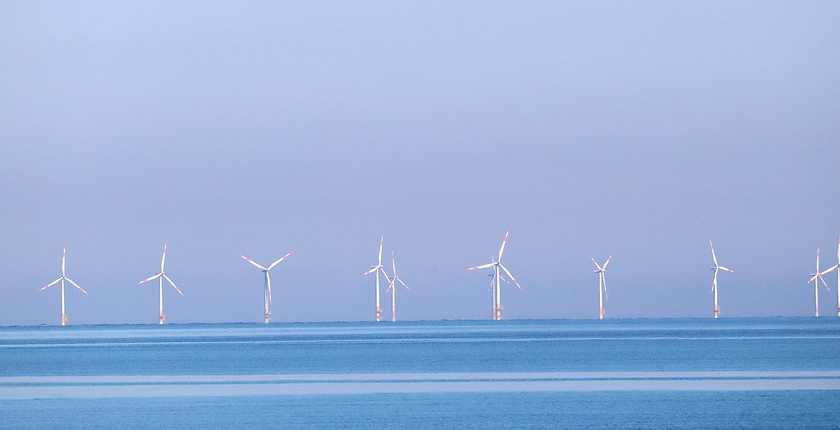
The Greek Parliament passed a law on the development of offshore wind energy and further simplification of renewable energy licensing, including new environmental measures.
The goal is to install at least 2 GW in offshore wind farms by 2030, as part of the National Energy and Climate Plan (NECP).
According to the law, proposed by the Ministry of Environment and Energy, state-owned company Hellenic Hydrocarbon Resources Management (HHRM) will take over the process of developing offshore wind in the country. It will be renamed Hellenic Hydrocarbon Resources and Energy Resources Management to better reflect its new profile.
HHRM will be responsible for offshore concessions and technical studies to specify the most promising marine zones for offshore projects. The goal is to have auctions where interested investors will compete to lease such a zone and build their offshore wind farm.
When it comes to linking offshore wind farms to the transmission grid, the Independent Power Transmission Operator (IPTO) is exclusively responsible for carrying out the study, installation and operation of interconnections, while offshore wind developers will install their own cables to connect projects to IPTO’s nodes.
The timeline for offshore auctions
Initially, relevant ministries will issue a decree approving the national offshore program, which will specify possible zones for offshore projects. Afterwards, a presidential decree will determine one or more of the zones for development.
After two months, HHRM will start the licensing process for studies inside the zones by interested parties who will then be able to begin work.
After a period of 2.5 years, a ministerial degree will set individual areas inside these zones, as well as maximum capacity for offshore projects within them.
Next, the Regulatory Authority for Energy will begin an auction where every investor will submit offers for each area they have been licensed for. The criteria will be based on the lowest offer, while successful investors will have exclusivity inside each area.
It should be noted that the area offshore Alexandroupolis has been designated as a pilot zone for offshore wind, so the first projects are expected there.
Reactions from environmental groups and offshore companies
The adoption of the law has been met with varying responses on behalf of the market and environmental groups.
Eleven environmental groups said last week the law would damage Natura 2000 areas and that the consultation process was too short and inadequate.
Some market players expressed concern that the process specified by the ministry would take up to nine years until the first projects are operational.
It should be noted that Greece has a troubled past when it comes to both onshore wind energy and offshore hydrocarbon development. In the first category, investing time was until recently over 10 years in some cases and the ministry issued repeated decrees to simplify the process. In the case of hydrocarbons, Greece has made many efforts in the last 15 years to develop the sector, however not a single drop of oil or gas has been produced so far apart from the existing Prinos installation in Kavala, which started in the 1970s.
On the other hand, Greece is counting on its extensive naval experience to support the offshore wind sector through knowhow and personnel.