





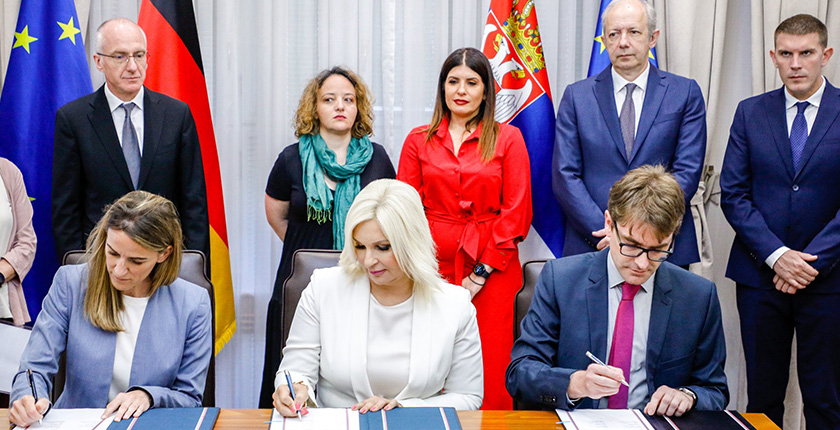
Photo: Ministry of Mining and Energy


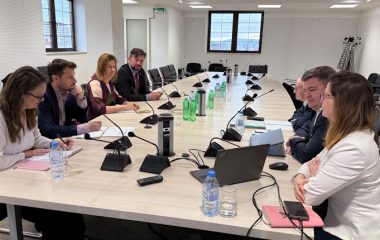
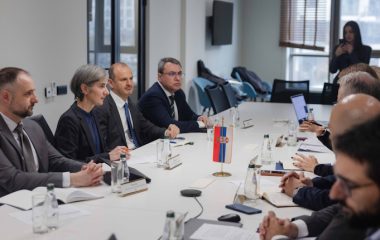
Deputy Prime Minister Zorana Mihajlović signed an agreement with GIZ on the implementation of the project for the Promotion of Renewable Energy and Energy Efficiency in Serbia. The joint effort is intended to enable citizens to participate in the energy transition.
Deputy Prime Minister and Minister of Mining and Energy Zorana Mihajlović said the new project with Germany’s agency for international cooperation GIZ – Deutsche Gesellschaft für Internationale Zusammenarbeit – is the continuation of joint efforts in the creation of a green economy, increasing the use of renewables and the improvement of energy efficiency.
The main thing is to involve citizens in the overall push toward a green transition, Serbia’s top official stressed. “With investments, strategic partnerships, but also with the participation of citizens in the process of energy transition, Serbia can be a country that is not only safer in energy terms, but also with a far healthier environment,” Mihajlović said.
Barmeier: Together we aim to increase the number of prosumers and give citizens the means to produce their own clean electricity
The project is called Promotion of Renewable Energy and Energy Efficiency in Serbia. “Together we aim to increase the number of prosumers in Serbia and to give citizens the means to produce their own clean electricity,” Project Director of GIZ Till Barmeier said.
It is in the interest of the country, its economy and citizens to deploy renewables and increase energy efficiency and the government will continue to implement projects in cooperation with all international partners, according to Mihajlović. Germany is the most important one both in trade and bilateral relations, in her words.
German-Serbian energy projects are worth over EUR 1.5 billion
“When it comes to cooperation in the field of energy, the projects we have worked on together and are still working on are worth more than EUR 1.5 billion,” Mihajlović said.
Ambassador of Germany Thomas Schieb pointed out at the signing ceremony that the deal i another chapter of cooperation with the Ministry of Mining and Energy, in addition to the one that exists with Germany’s KfW Development Bank in the field of improving energy efficiency.

This is a landmark event! It overcomes the distance between legislative possibilities and their implementation. Between the official’s office and the received kilowatts of solar energy.