


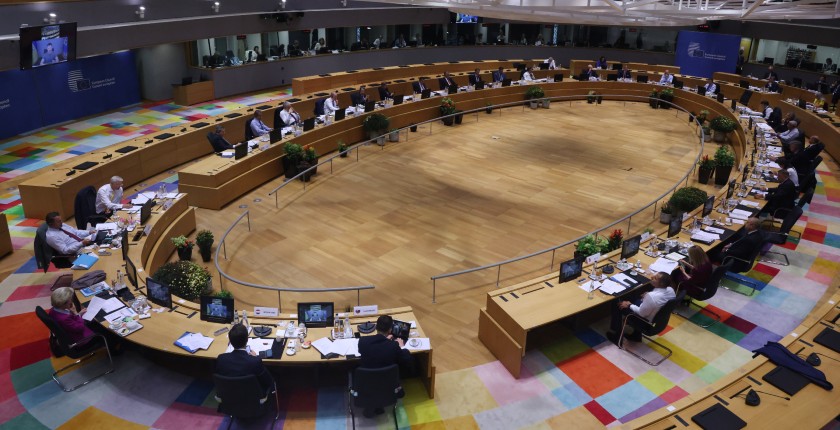
The European Council agreed in principle on a set of measures to ease the energy crisis, but leaving a lot of work to responsible ministries and the European Commission. The most important initiative is to “limit episodes of excessive gas prices,” while the effect of a cap on gas used in electricity production must be analyzed.
Heads of state or government of European Union member countries made modest progress at their meeting in Brussels in the efforts to adopt a joint approach to tackling the energy crisis and reform the energy market. President of the European Council Charles Michel acknowledged it is “an extremely serious, difficult, complex topic” and that it needs “to mature” to get “a very strong framework.”
After months of negotiations, a cap on wholesale gas prices has been taken off the table, perhaps due to the fact that they dropped by almost two thirds since late August, from historic highs. The proposed alternative is “a temporary dynamic price corridor on natural gas transactions.”
German Chancellor Olaf Scholz called the conclusions “a good signal of solidarity.”
Market correction mechanism to mitigate sharp price increases
The matter is now back in the hands of energy ministers, who are meeting already on October 25, and the European Commission. The European Council said it expects urgent “concrete decisions” from them on the so-called dynamic price corridor and “a temporary EU framework to cap the price of gas in electricity generation, including a cost and benefit analysis.”
French President Emmanuel Macron pointed out that if the ministers can’t reach an agreement, the issue must again be discussed by country leaders.
European Council President Ursula von der Leyen explained the new “market correction mechanism” would “limit episodes of excessive gas prices.” In her view, the conclusions offer “a very good and solid roadmap to keep on working” as “strategic guidance” for a proposal.
EU member states have different electricity mixes, so the effect of a price cap on gas for electricity generation needs to be studied
“We will analyze the financial impact for those countries with a lot of gas in their electricity production, what does it mean if we cap the gas to reduce the influence of gas on the electricity price,” Von der Leyen told the press. She also said companies would be able to build consortia for joint gas purchases to “increase common market power.”
EU leaders agreed to introduce a binding target for the platform equivalent to 15% of storage filling needs. Other initiatives were adopted with little detail.
A new benchmark for gas prices should be introduced to complement the one from the Dutch TTF hub, as it reflects mainly pipeline gas and the share of liquefied natural gas (LNG) imports is rising, Von der Leyen added.
Prime Minister of Slovenia Robert Golob said before the meeting that the European Council has to come up with “a very clear and decisive message” on measures necessary for the upcoming winter and the next two winters. “We need to distinguish these two measures and actions, otherwise we will not be ready to support our industry and our households,” he underscored.
Statement by ?? PM Robert Golob ahead of the European Council meeting: We are living in unprecedented times when it comes to energy. I think it is high time that today we as a council come up with a very clear and decisive message and say that we know what we need to undertake. pic.twitter.com/B57iVhDNL2
— Slovenian Government (@govSlovenia) October 20, 2022
Concerns about exporting subsidized electricity
The EU also needs “a well-balanced and common approach” that would be determined after an analysis of the effect of electricity flows to the bloc’s neighboring countries, according to Von der Leyen. For instance, the United Kingdom doesn’t have such a gas price cap for power plants, which comes with subsidies.
France, Spain and Portugal decided to work on a project for a gas and hydrogen pipeline under the sea between Barcelona and Marseille
EU leaders called for energy solidarity measures in case of gas supply disruptions at national, regional or EU level, in the absence of bilateral solidarity agreements.
In addition, France, Spain and Portugal said they agreed to lay a pipeline under the sea from Barcelona to Marseille that would carry fossil gas and hydrogen. With the project, they replaced the proposal for the MidCat pipeline that was supposed to run across the Pyrenees, as France was against it.