







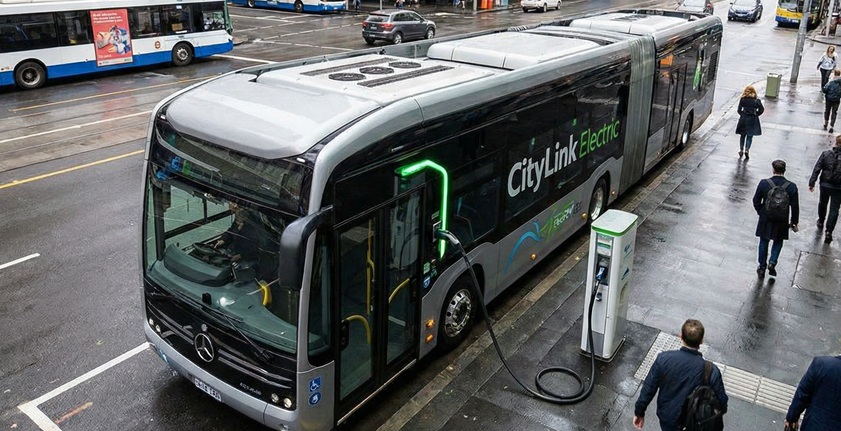
Photo created with AI tool Nano Banana


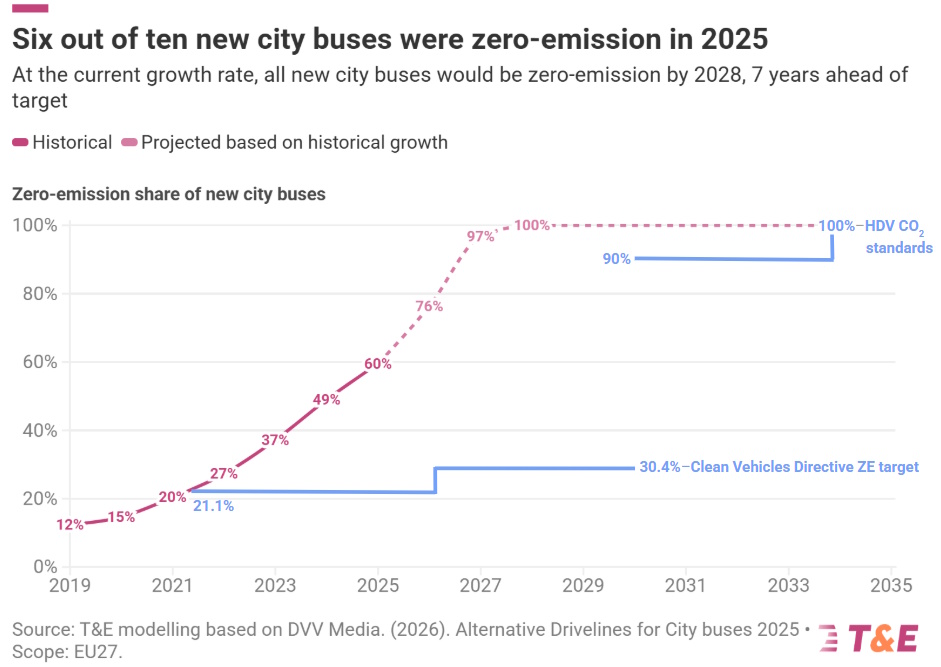
Last year 60% of new city buses in the European Union were powered by electricity and hydrogen. According to Transport & Environment, the 100% share could be reached by 2028, much before the European Commission’s target date.
Six out of ten new city buses in the EU in 2025 were zero emission (ZE), as battery electric and fuel cell powertrains made up 56% and 4% of new sales, respectively, T&E said.
This was unimaginable back in 2019, when the Clean Vehicles Directive was first adopted, the NGO added.
In 2019, electric buses stood at 12% of the market. In 2023, they overtook diesel as the main type for the first time.
Last year, among EU member states, Bulgaria, Denmark, Estonia, Latvia, and Slovenia purchased only ZE city buses. The Netherlands, Luxembourg, Finland, Belgium, Lithuania, and Romania reached 90% ZE shares.
The NGO recalled that the first phase of the Clean Vehicles Directive (CVD) set ZE bus procurement targets by member states for the period from August 2, 2021, to December 31, 2025. Targets range from at least 13.5% in Croatia to 22.5% in most member states.
T&E said five countries may have missed their directive’s target: Czechia, Hungary, Estonia, Slovakia, and Croatia. However, according to the data, Czechia (26% in 2025), and Estonia (84% in 2024 and 100% in 2025) are catching up.
Almost two thirds of all hydrogen-powered buses were sold in Germany
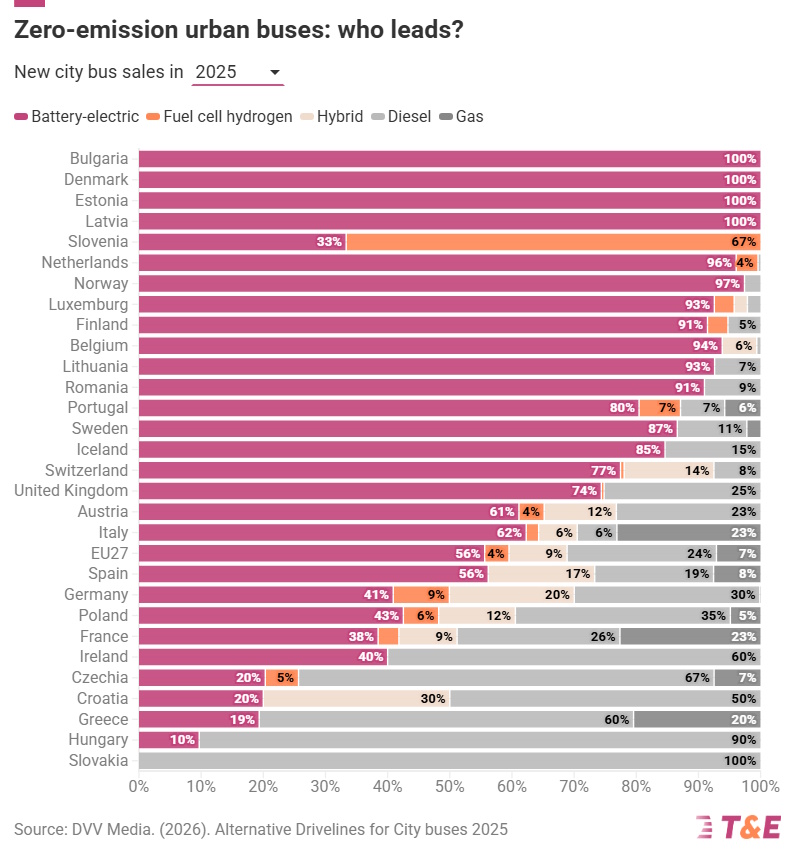
Looking at types of powertrains, battery electric buses have gained more market share in percentage points each year since 2020 than in the previous year.
Fuel cell powertrains have been more timid, going from 3% in 2024 to 4% in 2025. Almost two thirds (62%) of hydrogen-powered buses were bought by German entities.
Only 9% of new city buses were hybrid, down from 16% in 2024 and 22% in 2023, while the EU share of gas buses was halved to 7% in 2025, T&E calculated.
Among major European markets (with over 1,000 new city bus sales annually), the United Kingdom is back at the top of the league, with electric powertrains accounting for three out of four new city buses, according to T&E.
Italy ranked second, while Spain was in third place.



Be the first one to comment on this article.