


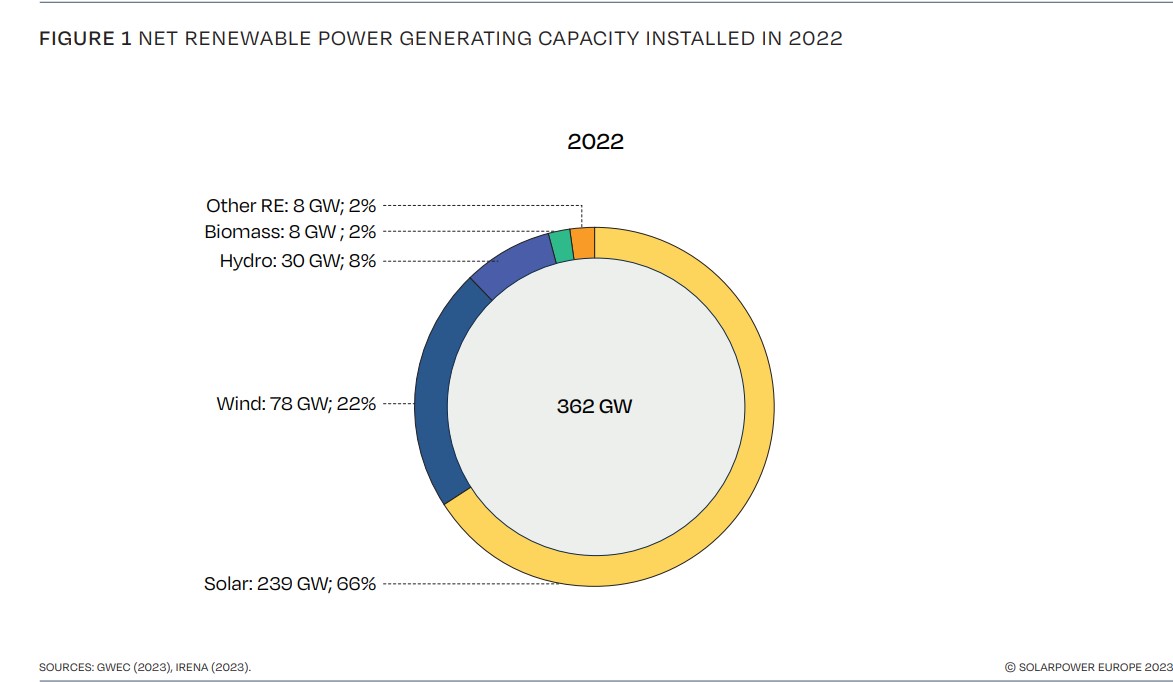
In 2022 the world installed 239 GW of new solar, finally crossing the 1 TW threshold, with rooftop solar contributing with almost 40 GW, according to the Global Market Outlook for solar power 2023-2027.
SolarPower Europe, which produced the report, said this was due to the unmatched versatility of solar – powering individual energy self-sufficiency and comparatively quick-deploying utility-scale projects at competitive low cost.
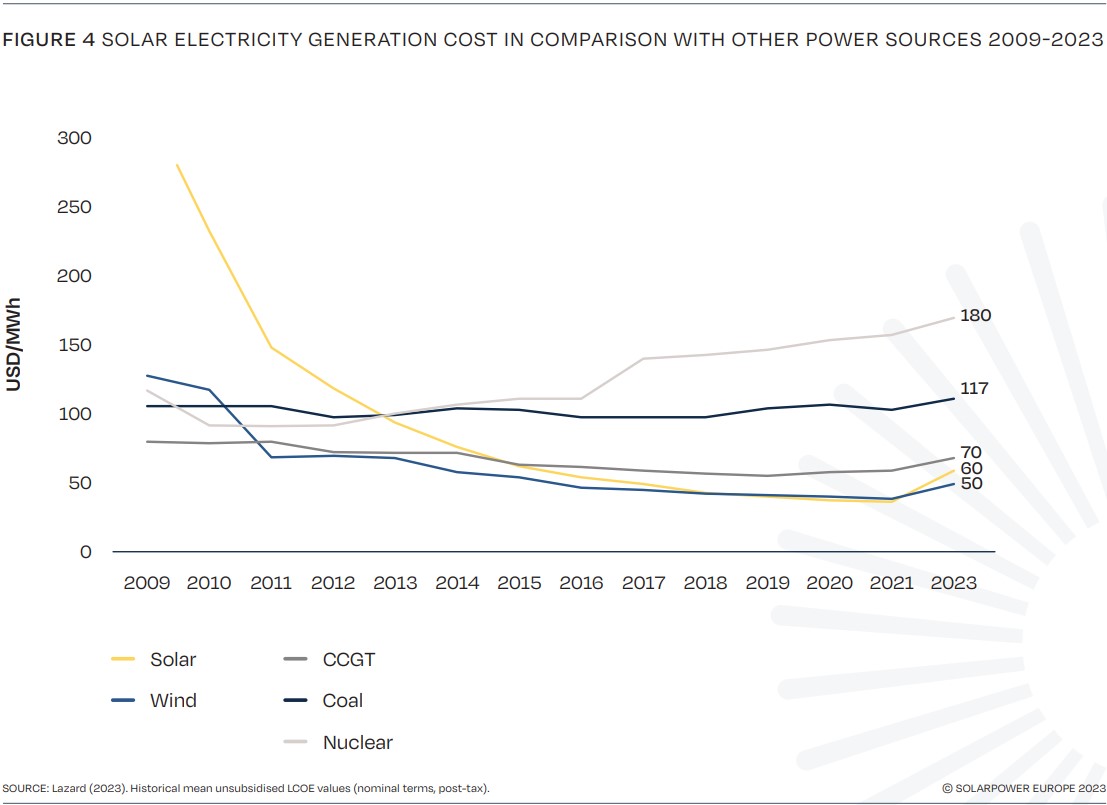
In 2022, significant supply chain disturbances, lingering COVID-19 effects, and inflationary pressure, sparked by the war in Ukraine, caused the first increase in solar’s levelized cost of electricity (LCOE) in over a decade, the report reads.
It has increased from 36 USD/MWh in 2021 to 60 USD/MWh in 2023, the sharpest increase among all power technologies.
“That, however, does not pose a challenge to cost competitiveness, because solar PV remains significantly cheaper than new fossil fuels and nuclear, and product prices already began to decline in recent months and are largely expected to return to pre-crisis levels soon,” according to the report.
The world installed 45% more solar power capacity than in 2021
In 2022, the world installed 239 GW of new solar capacity, or 45% more than the year before.
With over 1.2 TW now installed worldwide, solar will generate 1,612 TWh of electricity globally over the course of 2023 – equivalent to 57% of the European Union’s total electricity demand, the report reads.
In 2022 the world’s rooftop solar capacity shot up by 49%, from 79 GW in 2021 to 118 GW. That means the equivalent of 36 million more homes were powered by solar by the end of 2022.
SolarPower Europe anticipates 2023 to be yet another solar boom year. It expects between 341 GW and 402 GW to be installed worldwide in 2023. The rooftop solar boom will also continue in 2023, with another 159 GW set to be installed.
The world could be installing 1 TW of solar annually by the end of the decade – hitting up to 800 GW per year already in 2027, the organization said.
Its president Aristotelis Chantavas stressed that the world has realized that fossil fuel crises are the crises that never really go away. “More than ever before, people in every part of the world are turning to solar. In a year defined by energy and climate crisis, solar hope continues to shine through,” he added.
26 countries installed more than 1 GW
In 2022, the number of solar countries installing at least 1 GW annually increased from 17 to 26. By 2025, the Global Market Outlook for Solar Power predicts that more than 50 countries will install more than 1 GW of solar per year.
These are the first ten: China, USA, India, Brazil, Spain, Germany, Japan, Poland, The Netherlands, and Australia. Among the countries tracked by the Balkan Green Energy News, Turkey ranked 17th, followed by Greece.
Despite the positive outlook, challenges remain, the report reads.
The sleeping giant of the energy transition is waking up
These challenges are limited grid capacity and a lack of flexibility or storage in national electricity systems. They are, according to the report, posing a critical risk to the global solar transition, because out of the 26 significant solar countries, 20 report grid bottlenecks as a critical barrier to solar development.
Michael Schmela, Director of Market Intelligence at SolarPower Europe said that grids and flexibility are the sleeping giant of the energy transition – and the giant is waking up.
“We’re installing huge amounts of solar, and we need to be able to use it, when we need it. Governments around the world must make upgrading their electricity and storage infrastructure a political priority.”