

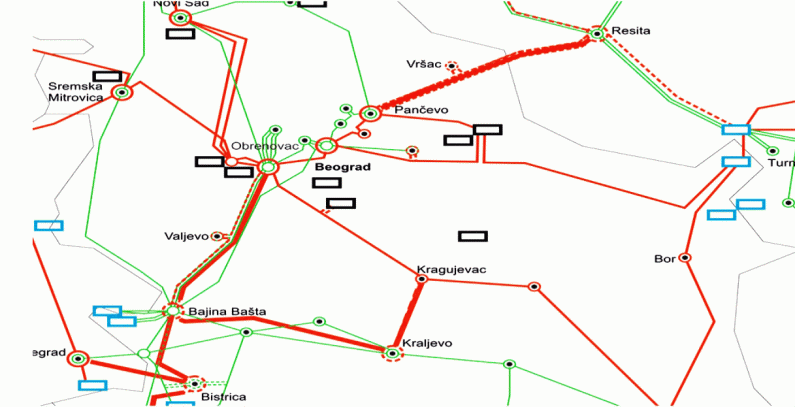
Serbia has been given a grant of EUR 6.6 million by the German development bank KfW to build a section of the Trans-Balkan Electricity Corridor, Serbian Minister of Mining and Energy Aleksandar Antić said. The Minister said that the construction of the section of the power corridor between the towns of Kraljevo and Kragujevac would begin in 2018, adding that the plan is to complete construction in the year 2020.
“The securing of the funds needed to build this section means that the conditions have been met to start work on the section from the town of Obrenovac to Bajina bašta and on from that town to Plevlja in Montenegro and Višegrad in Bosnia-Herzegovina,” the Tanjug agency was told by Serbian Minister of Mining and Energy Aleksandar Antić at the opening of the section of the power corridor linking Pančevo with Romania.
That section from Pančevo in Serbia’s Vojvodina province to the Romanian town of Resita is 68 kilometers long and is managed by the public utility Elektromreža Srbije (EMS), Serbia’s transmission system operator (TSO), which invested EUR 27 million of its own funds in the section. The EMS contracted Serbian companies to build the section of the power corridor from the Pančevo 2 substation to the Romanian border.
Antić said the construction of all the sections of the power corridor through Serbia would cost some EUR 160 million.
Once completed, the electric power corridor will link Romania, Serbia, Bosnia and Herzegovina, and Montenegro with a 400 kV landline and will link those countries to Italy through an underwater power line. That 400 kV power line under the Adriatic Sea will be 455 kilometers long and will run from Lastva in Montenegro to Villanova in Italy.
The section whose opening the Minister attended is the first completed section of the Trans-Balkan Corridor.
Antić said the capital project would bring long-term benefits to Serbia, increasing its supply security, cutting down of power losses and helping develop the country’s energy system.
“This Pan-European electric power corridor will pass through Serbia bringing electricity from east to west. The investment will have a capital effect on our overall transmission and lower power losses of the grid which are the lowest in Europe,” the minister said.