






Photo: Balkan Green Energy News


The European Union’s Carbon Border Adjustment Mechanism (CBAM) has caused serious disruptions to electricity markets in the Western Balkans, called into question their integration with the EU market, and increased uncertainty for renewable energy investments. If this uncertainty is not resolved relatively quickly, CBAM will produce effects contrary to its intended aim of accelerating decarbonization and investment in renewable energy, according to representatives of regulators, power exchanges, traders, and investors who spoke at Belgrade Energy Forum 2026 (BEF 2026).
As of January 1 this year, EU importers of aluminum, cement, electricity, iron, steel, hydrogen, and fertilizers from non-EU countries are required to pay a CO2 tax under the Carbon Border Adjustment Mechanism (CBAM), increasing the price of these goods in the EU market. The Western Balkan countries are among those covered by CBAM.
This year’s Belgrade Energy Forum (BEF 2026), which brought together around 500 participants, provided an excellent opportunity to share initial experiences with the EU’s carbon border tax.
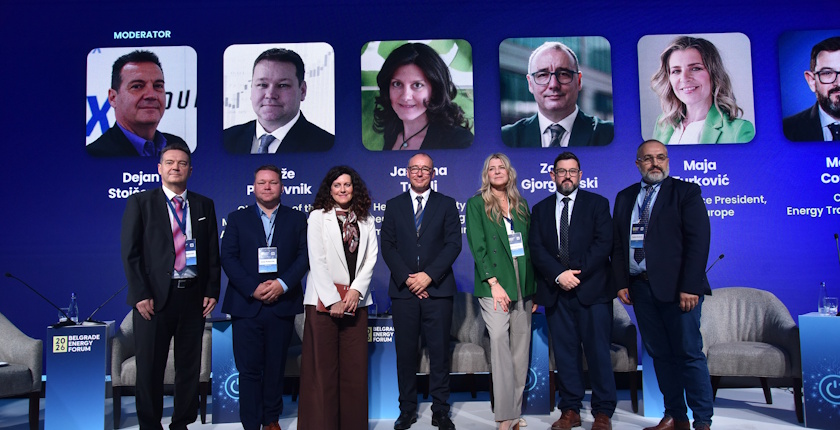
The topic was discussed at a panel titled Impact of the Introduction of CBAM on the Regional Electricity Market, moderated by Dejan Stojčevski, Chief Technology Officer of Serbia’s SEEPEX power exchange.
In Serbia, Stojčevski said, CBAM has caused a decline in liquidity, an increase in the price difference between Serbia’s and Hungary’s power exchanges, a reduction in cross-border electricity trade toward the EU, and a decrease in the value of cross-border transmission capacities.
Speakers at the panel:
- Anže Predovnik, Chairman of the Management Board of ADEX Group and CEO of BSP Energy Exchange
- Jasmina Trhulj, Head of Electricity Department, Energy Community Secretariat
- Zoran Gjorgjievski, CEO, MEMO
- Maja Turković, Executive Vice President, CWP Europe
- Mark Copley, CEO, Energy Traders Europe
- Vladimir Đorđević, Senior Originator, Axpo Group
CBAM has introduced instability into the electricity market
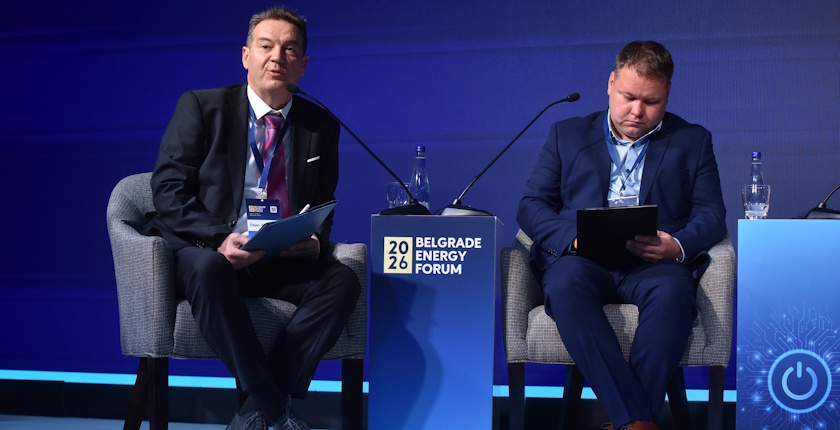
Dejan Stojčevski and Anže Predovnik (photo: Balkan Green Energy News)
All panelists agreed that CBAM has only created problems for the Western Balkans.
Anže Predovnik, a representative of an EU member state, recalled that CBAM was introduced to put all producers of certain goods on an equal footing. In the EU, thermal power plants are required to buy CO2 emission allowances, making their electricity more expensive than that of competitors who are not subject to the same regulation, he recalled.
On the other hand, he added, countries in the region had an obligation to introduce carbon pricing, but they failed to do so, and are now paying the levy under CBAM.
CBAM will remain in place until solutions similar to the EU Emissions Trading System (EU ETS) are introduced at the local level, according to Predovnik.
Gjorgjievski: CBAM creates a paradox
One of the first analyses of the impact of CBAM was produced by the Energy Community Secretariat. Jasmina Trhulj says the levy has led to market instability.
However, she hopes that proposed amendments to the CBAM Regulation will resolve many of the uncertainties and that a much clearer framework will be in place from next year, allowing the market to regain stability.
Trhulj warned that if the uncertainty were to persist over a longer period, CBAM would not fulfil its intended purpose of accelerating decarbonization and the integration of renewable energy.
CBAM, according to Zoran Gjorgjievski, creates a paradox by keeping renewable electricity within the borders of Western Balkan countries. “We believe that in the long run it will harm free trade and all exchanges in the region,” Gjorgjievski warned.
Turković: The risk for investors is now much higher
Investors expect that the amendments to the CBAM regulation will exempt imports of renewable energy from the Western Balkans into the EU. However, Maja Turković noted that there are still no operational procedures in place for CBAM implementation. She added that this represents a regulatory risk, adding that overall, the risk for investors is now much higher.
Even before CBAM, it was difficult to conclude a power purchase agreement (PPA), and now it will become even more so, she said, noting that without PPAs, there can be no investment in renewables.
Vladimir Đorđević agreed that CBAM has made it harder for market participants to conclude PPAs, which are supposed to support the development of new projects.
“CBAM is here to stay. It is now up to us to adapt and do business in the new circumstances,” he said.
Energy Traders Europe is an association that brings together 183 companies trading in natural gas, electricity, and carbon. Its CEO, Mark Copley, described the current situation with CBAM in five words starting with the letter P.
Copley: There is too much blame on the other side
The first is the Policy. The EU has a competitiveness problem, and it makes sense to try and price carbon effectively. You can’t challenge the basis for CBAM, he said. You can challenge the Process. There has been insufficient coordination between the European Commission’s directorates for energy, climate, and taxation, and the result has been mixed messages and uncertainty for everyone, according to him.
That has translated into a level of Progress which has not been positive, according to Copley. “We’ve seen more volatility. We’ve seen spreads widen on borders. We’ve seen customer value being lost,” he said. The fourth P is Politics. “I still feel there is too much blame on the other side and not enough attempts to try and move forward.”
The fifth word is Positivity. The EU and the Western Balkans need the benefits that market integration can give. And so the challenge is to unlock that and move it forward, not to look at who did what badly in the past. The short-term effect is lots of instability, which could be turned into a positive long-term effect, according to Copley.
Trhulj: CBAM was not meant to apply to the Energy Community contracting parties
The introduction of CBAM was not a surprise, Jasmina Trhulj recalled, noting that it was never intended to apply to the Western Balkans. Rather, the Energy Community contracting parties were supposed to adopt the EU’s Electricity Integration Package by 31 December 2023.
After that, they would have had at least 18 months to integrate their markets with the EU, and CBAM would not have applied to them, she explained.
However, the process was moving very slowly on the contracting parties’ side, according to her. “It had been known for years that this was coming,” Trhulj emphasized.
CBAM has dealt a strong blow to market coupling, but there is still room for a solution
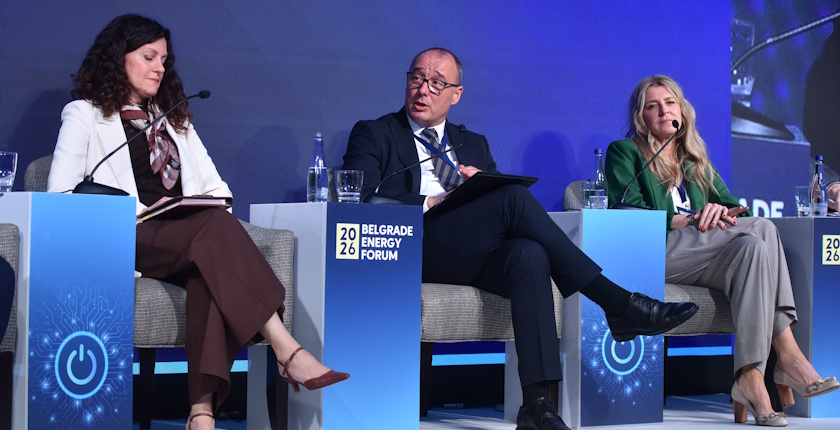
Jasmina Trhulj, Zoran Gjorgjievski, and Maja Turković (photo: Balkan Green Energy News)
Trhulj recalled that Serbia has made the most progress in market coupling and is now awaiting the European Commission’s verification of the transposition of the Electricity Integration Package, while verification by the Energy Community Secretariat is underway for Montenegro and Moldova.
This is an entirely new situation in the Energy Community compared to the previous two decades, when uniform rules were applied only among the contracting parties, she noted.
“Now, as we integrate into the EU, it is crucial to verify that the rules are fully identical on both sides of the border, and that’s what the Secretariat and the European Commission are currently doing for the three mentioned countries,” she said.
Asked when the first market coupling could be expected, she said that Serbia could achieve it by the first quarter of 2028, provided that it received a positive opinion from the European Commission by May 16 and that the existing draft of the market coupling operator integration plan (MCO IP) was adopted.
This group of countries could soon be joined by North Macedonia. Zoran Gjorgjievski revealed that the national regulator had adopted the missing part of the regulatory framework, which should be followed by the verification process.
“This means that MEMO can formally establish a local implementation project (LIP), following the approval of the MCO IP,” he announced.
The scope and timeline for the introduction of an ETS should be defined through the amendments to the CBAM regulation
Trhulj reiterated that market coupling cannot take place alongside the application of CBAM. The Secretariat expects that the ongoing amendments to the CBAM regulation will define the scope and timeline for the gradual introduction of an emissions trading system or reaching a CO2 price equivalent to the price under the EU ETS, according to her. This is a condition for exempting a contracting party from CBAM.
The amendments include a memorandum of understanding, and the Secretariat expects it to provide some flexibility in defining the scope and timeline for each contracting party to align with the EU ETS, she explained.
For his part, Mark Copley described the situation with the amendments to the CBAM regulation as “crazy.” He explained that the amendments going through a legislative process in Brussels are expected to be approved in mid-2027, and then apply from 2028, as well as retrospectively from January 1, 2026.
According to Anže Predovnik, market coupling would increase liquidity, sending a clear signal to investors. However, in addition to coupling, there are also other factors that can improve the market, he noted.
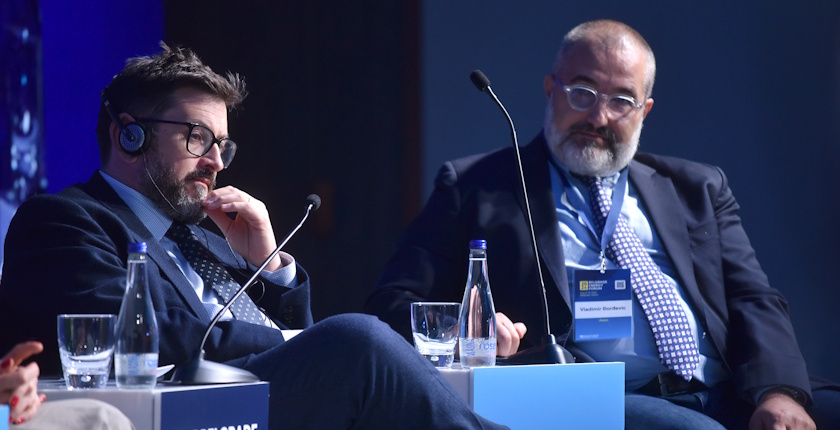
Mark Copley and Vladimir Đorđević (photo: Balkan Green Energy News)
He pointed out that the Slovenian exchange BSP, following market coupling with all neighbors, took further steps. One of the most important of these was the establishment of ADEX Group, which links the Slovenian, Hungarian, and Serbian exchanges through a so-called “one-stop shop” – uniform rules for all participants across the three exchanges.
This concept has led to a 25% increase in trading volumes over the past two years and raised the number of participants to more than one hundred, he said, adding that expansion into Croatia is now underway.
Having also partnered with Montenegro and North Macedonia, ADEX now covers much of the region using the same technological solutions.
Ensuring liquidity without market coupling is, according to Vladimir Đorđević, an impossible task.
Renewable energy and its long-term hedging require a liquid market. “Without that hedging, there are no bankable contracts, and without them, there are no projects,” he stressed.
Turković: Market coupling is key for investors to reduce risk
Speaking about the benefits of market coupling, Mark Copley recalled that his country, the United Kingdom, faces the costs of exiting the EU’s internal market every single day.
Market integration unlocks benefits for security, for the cost of decarbonization, and for competitiveness. That is why integration should be a policy priority for Europe and for the Western Balkans, according to him.
Maja Turković revealed that there have been extensive discussions with the European Commission and that an exemption from CBAM for renewable energy is expected, but not for financial PPAs. “What concerns Brussels is the tracking of the nature of the energy,” she added.
“Stability and regulatory predictability are the most important factors for investment in renewable energy. Market coupling is important because it brings market stability. For us, and for our financial models, market coupling is the key,” said Maja Turković.
She agreed with Stojčevski that market coupling is crucial for investors to reduce their risk.
Are we closer to integration or to creating a border between the EU and the Western Balkans?
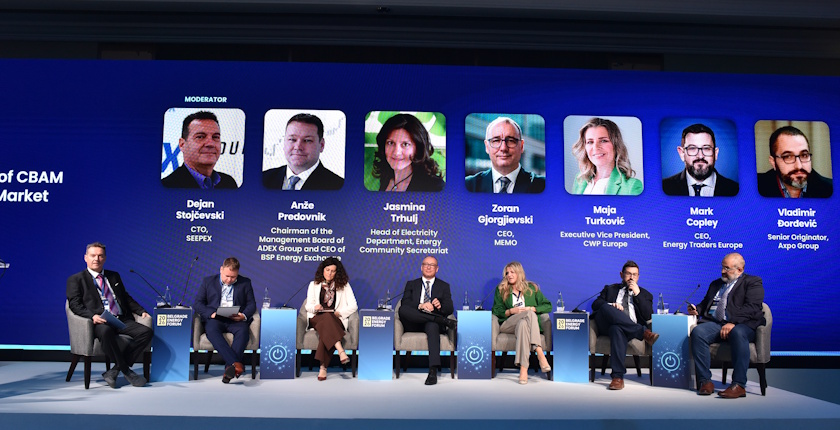
Photo: Balkan Green Energy News
Anže Predovnik
The EU was created to remove borders, not to build them. I think the region must speed up the process of transposing legislation, and the EU must keep integration high on its agenda. In that way, we can arrive at a solution.
Jasmina Trhulj
The very fact that the process is so strict and complex suggests that we are firmly on the path to integration. The Secretariat has been working around the clock in recent months to complete the verification, but at this point, the process is in the hands of our countries.
Zoran Gjorgjievski
Things have been set in motion. What we don’t need are borders and barriers to trade. We need free trade and integration.
Maja Turković
I am moderately optimistic. Otherwise, I would have closed the business. For us, market coupling is key – whether it will create, or whether its absence will create, a new energy border or not.
Mark Copley
We’ve already created a border. Let’s be honest about that. That’s what CBAM is doing. The question is whether we can remove it. But I don’t know how optimistic I am. The politicians who spoke on the first panel need a bit of a reality check because they are going to need to show some leadership in this region if this is going to move forward.
Vladimir Đorđević
We hope for integration because integration leads to longer-term hedging, bankable contracts, and a more prosperous future for all of us.
Flexibility is becoming as important as energy generation, if not more important
Vladimir Đorđević believes that negative prices will send a signal that flexibility has become as important as energy generation, if not more important.
“We expect it to encourage investors to upgrade their power plants with batteries, and solve problems both for themselves and for the market – by reducing the number of hours when these plants are curtailed and lowering volatility, while increasing the flexibility of the system,” he said.
Maja Turković added that “flexibility is a new currency in the electricity market.”



Be the first one to comment on this article.